



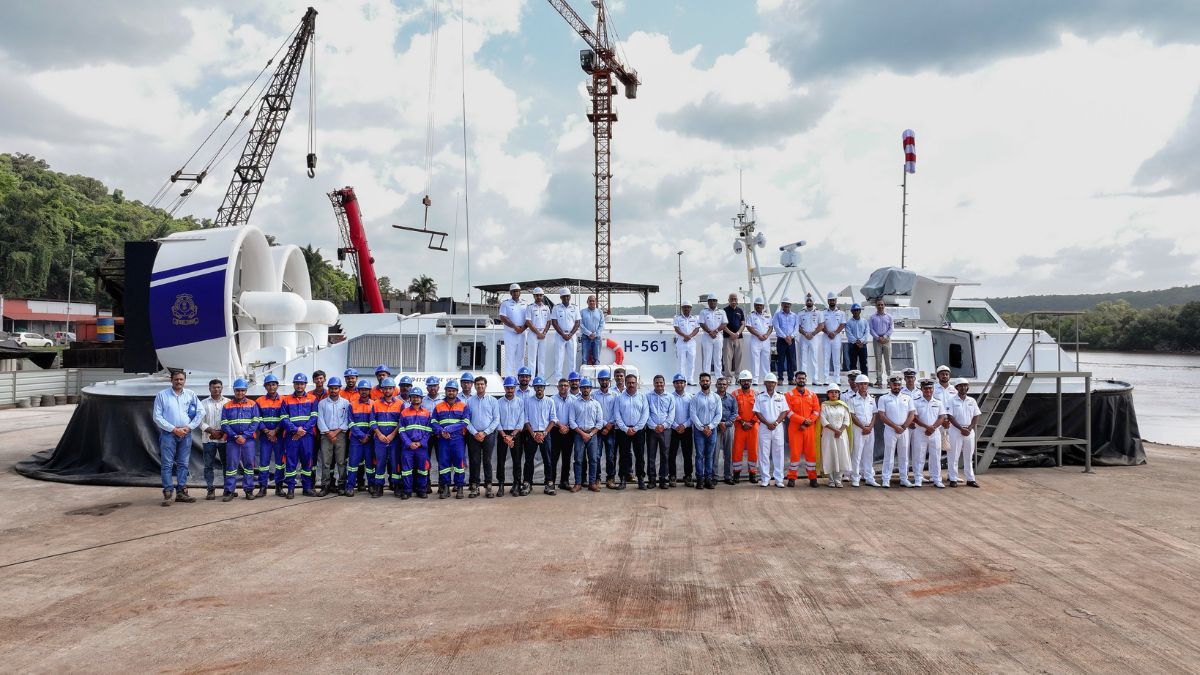
Goa's Chowgule Shipyard on Thursday delivered the first Indian-made Air Cushion Vehicle (ACV), also called a hovercraft, to the Indian Coast Guard, touted as a major move for both the defence and maritime sectors.
This is part of the ICG's six-hovercraft deal with the shipyard, worth Rs 387.4 crore, under which the remaining five vessels will be delivered every three months, as per Gaurish Parab, the assistant manager for the shipyard's Rassaim facility, a Times of India report said.
The contract will also see the shipyard maintain the vessels for a period of five years after they are delivered.
With a cruising speed of 52 knots—that has gone up to 52 knots in sea trials, which is four knots more than the ICG requirement—the hovercraft can carry up to 42 personnel, in addition to an 8-tonne payload.
It also has an operational endurance of up to nine hours, as per the UK-based ACV builder Griffon Marine Ltd, which contributed to the technology licence for the construction of the hovercraft.
This vessel will be stationed in West Bengal's Haldia, from where it will boost the ICG's capabilities in maritime security, law enforcement missions, and rapid response tasks.
Apart from its surveillance duties, its versatility also makes it suitable for flood relief, disaster response, and humanitarian assistance missions in hard-to-reach areas.
Apart from being a major push for the country's Make in India goals, given that more than 50 per cent of the hovercraft's components are of Indian-origin, the construction of the ACV also shows that the shipbuilding sector has become more adept at absorbing foreign tech.
What is an ACV?
An ACV, also called a hovercraft, is one whose weight is either partially or fully supported by a continuously generated cushion of slow-moving, high-pressure air.
The air is often produced using fans directed downwards, kept inside a cushion attached to the hull, which produces lift that acts against the vessel's weight, making these capable of moving over land, water, mud, ice, and various other surfaces.
These are now used throughout the world for disaster relief, coast guard, military, and survey applications, in addition to use in sports and passenger services.
