



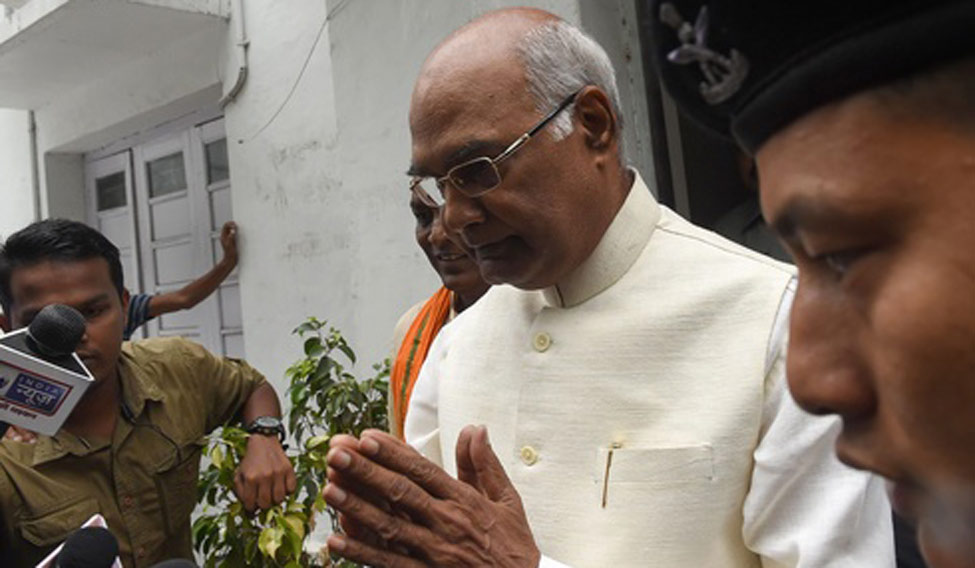
Born into a family of weavers in a backward village in Uttar Pradesh, Ram Nath Kovind always possessed a strong will to advance in life.
He took over as general secretary of the Akhil Bhartiya koli Samaj at the age of 26. Kovind continued his education even as he discharged his organisational duties quite efficiently.
Kovind, who worked in the office of the then prime minister Morarji Desai during the rule of the Janata Party, has had a proclivity for politics. However, he wanted to establish himself as a lawyer first.
He was appointed as the pleader of Central government in Delhi High Court in 1977. He became advocate on record in the Supreme Court in 1978. In 1981, he was posted as the government’s junior pleader in the apex court. During this time, he became active in the Depressed Classes Legal Aid Bureau, after having come to know about the troubles that dalits, scheduled castes, scheduled tribes and other backward classes faced in litigation.
Kovind chose to continue as lawyer even after passing the Civil Services examination. However, at the age of 45, he switched over to politics. Now, after 25 years, the decision has paid off as he has been made the presidential candidate of the ruling National Democratic Alliance (NDA).
Kovind, who took a BJP membership in 1991, was noticed by leaders Atal Bihari Vajpayee, L.K. Advani and Murali Manohar Joshi. In 1994, he was elected to the Rajya Sabha from Uttar Pradesh. Three years later, he was made a member of the BJP’s national executive committee.
His performance in Parliament was noteworthy as he had been a member of three committees—the Committee on Welfare of the Scheduled Castes and the Scheduled Tribes, the Committee on Social Justice and Empowerment, and the Committee on Law and Justice. Kovind was in the forefront of a strong agitation against certain orders that were harmful to the scheduled castes and the scheduled tribes, issued by the Central government in 1997.
When Vajpayee-led National Democratic Front (NDA) came power, Kovind took the initiative to modify the previous government’s orders through Constitutional amendments. Thanks to his remarkable speeches in the Rajya Sabha, the Centre, in 2002, deputed him to speak for India in the General Assembly of the United Nations.
Kovind has been a strong campaigner for the party in all elections in Uttar Pradesh. However, the party did not give him a Lok Sabha seat or the post of a union minister. After retiring from Rajya Sabha in 2006, he continued to work for the party without holding any official post. Later, he was made the party spokesperson by former BJP president Nitin Gadkari.
In 2015, Prime Minister Narendra Modi appointed him as the governor of Bihar.
An affable, soft-spoken politician, Kovind was careful to stay off controversies and never went after positions of power. Instead, the positions, including the presidential candidature, came to him.
Kovind’s style of politics is toughened and tempered by the rugged path he has tread on.