



-
Modi has effectively de-hyphenated India’s policy towards Israel and Palestine in the past three years, but needs to strike a balance in the bilateral relations with them.
Prime Minister Narendra Modi’s day-long visit to Ramallah on February 10 has been described as a “historic first” by his Palestinian hosts, for it will be the first time that an Indian Prime Minister would be visiting Palestine. India has been a longstanding supporter of the Palestine cause since even before the formation of the Israeli state in 1948. In recent years, India’s flourishing relations with Israel have dimmed the old ties with Palestine. But Modi’s visit would reaffirm India’s traditional support to Palestine.
Modi will fly to Ramallah via Jordan for a day-long tour that will be the first leg of his West Asian tour to the United Arab Republic and Oman. It will be Modi’s second visit to the UAE, where he will address the sixth World Government Summit. India is the guest country at the annual conference.
Modi has effectively de-hyphenated India’s policy towards Israel and Palestine in the past three years, but needs to strike a balance in the bilateral relations with them. India-Israel ties have visibly warmed since 2014 when Modi came to power. The BJP has traditionally favoured closer ties with Israel; state BJP leaders have long admired for its muscular diplomacy. There has been a regular exchange of high level visits between New Delhi and Tel Aviv in the past three years. India and Israel cooperate in agriculture, water conservation, science and technology, innovation, counter-terrorism with Israel emerging as one of India’s main defence suppliers.
In July 2017, Modi paid a visit to Israel without visiting Palestine. It was followed by a high-profile visit by Israeli Prime Minister Benjamin Netanyahu to India in early January. In October 2015, President Pranab Mukherjee was the first Indian President to visit Israel and Palestine, and Israeli President Reuven Rivlin paid a return visit to India in November 2016.
As ties with Israel have grown, they have seemed to eclipse India-Palestine relations. In 2015, India for the first time abstained on a Palestine sponsored resolution calling for a probe by the International Criminal Court into war crimes during Israeli offensive in Gaza. The abstention was strongly criticized with opposition parties charging government with reversing India’s traditional backing to the Palestine cause. India abstained on a similar resolution a year later but supported other resolutions that were critical of Israel the same year.
In 2017, India backed the Palestinian cause by voting for a UN resolution that condemned the US for recognising Jerusalem as Israel’s capital. India’s vote came as a surprise, especially as Washington’s rhetoric against the resolution was reaching a high pitch and Netanyahu was to arrive in Delhi barely a month later.
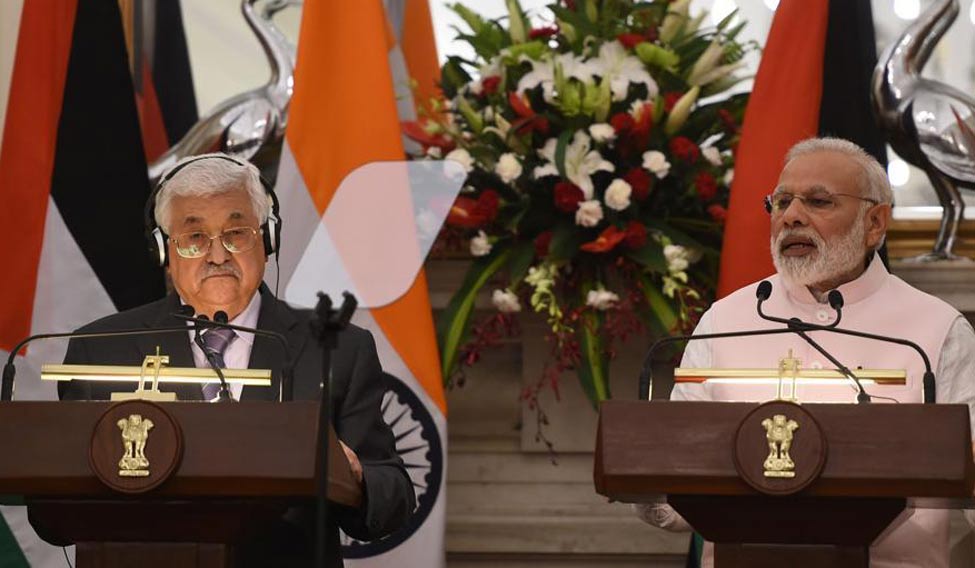
India recognised Palestine in 1988 to become one of the first few countries to do so. India has carefully weighed its relations with Palestine and Israel ever since diplomatic relations were established with Israel in 1992. Palestinian President Mahmoud Abbas visited India in May 2017 when Modi had assured Abbas of India’s “unwavering support” to Palestine.
In December 2017, New Delhi was miffed when reports appeared that Palestine’s Ambassador to Pakistan, Walid Abu Ali was seen sharing stage with Lashkar-e-Taiba chief Hafiz Saeed. But the Palestine administration responded promptly to the complaint and recalled its envoy from Islamabad.
India’s relationships with Palestine and Israel need to be assessed on their own merit. One is a long term support for the cause of a repressed people while the relationship with Israel is based on specific interests, trade and investment and cooperation in critical areas. Ties with Palestine are also tied to India’s approach to West Asia as part of the Look West policy. West Asian governments may waver in their support to the Palestinians on occasion, but the Palestine cause has widespread support among the people in the region.
The Gulf region is of critical importance to India. It supplies almost 70 percent of India’s crude oil requirements, it is a major trade partner, and over 7 million Indian expatriates work in the region who remit about half the total annual remittances to India. In the past three years, Modi has initiated a greater engagement with West Asian countries, having travelled for highly successful visits to Saudi Arabia and the UAE. Saudi Arabia’s Aramco has plans to make mega investment of billions of dollars in a large refinery in India as well as downstream oil and gas in India. The Abu Dhabi Investment Authority, UAE’s sovereign wealth fund (one of the largest in the world) has signed an agreement to invest $1 billion in the National Investment and Infrastructure Fund.
Modi will inaugurate the $4.5 million Indian assisted Palestine Institute of Diplomacy, a centre for the training of Palestinian diplomats, while he is in Ramallah. Agreements will also be signed on capacity building and the agriculture sector.