



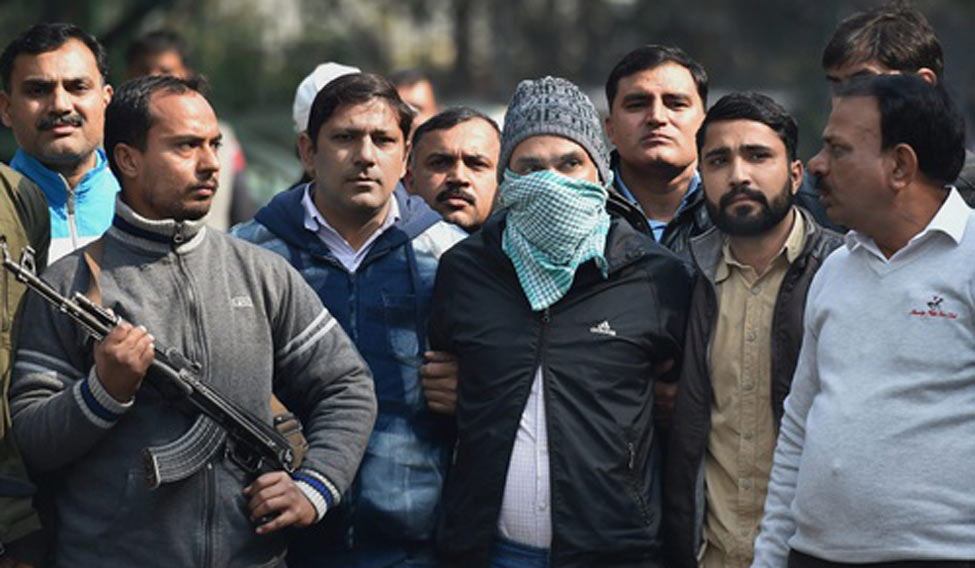
In the year 2010, the union home ministry prepared a dossier of 19 Indian Mujahideen operatives who were on the run. The security agencies believed that they were hiding in Pakistan or in the neighbouring countries. Despite sustained efforts, these terror operatives had managed to evade arrests and remained a potent security threat. High on its list figured the name of Abdus Subhan Usman Qureshi.
The home ministry dossier said Qureshi, Abu Faizal and Mohsin Choudhary hailed from Maharashtra. A software engineer by profession, Qureshi had associated with the Students' Islamic Movement of India (SIMI) in late 1990s and went on to become one of the biggest faces of the homegrown terror outfit Indian Mujahideen.
The dossier also named eight IM operatives from Azamgarh in Uttar Pradesh, four from Karnataka and two from Gujarat besides others.
There was apprehension in the security top brass that IM may have developed new modules with new leaders, regrouping into a new avatar, after the September 2008 Batla House encounter by the Delhi police had managed to break the backbone of the IM. The homegrown jihadi terror outfit had been carrying out audacious attacks across the national capital and other cities from 2002.
Investigators said that Qureshi's arrest by the Delhi Police Special Cell after a long chase of nine years has given a shot in the arm to the ongoing trials and investigation in other IM terror related cases. The NIA officials said the agency will be able to join the dots after his interrogation which is likely to shed light on the bomb making capabilities of the homegrown outfit, its funding channels, and most importantly its support base in Pakistan.
Notably, Iqbal and Riyaz Bhatkal, the alleged founders of the IM, are believed to be hiding in Pakistan. Qureshi himself fled to Nepal and Saudi Arabia after the Ahmedabad blasts. His name figures in terror attacks that have taken place in Delhi 2008, Bengaluru and in Mumbai in 2006. The NIA had registered a general FIR against the absconding IM members and Qureshi's arrest will also give a boost to this case which has been waiting for a breakthrough.
The National Investigation Agency, set up in January 2009 after the Mumbai attacks, slowly begun taking over cases of banned SIMI and IM operatives to probe the larger conspiracy of terror attacks in the country. That is when Abdus Qureshi alias Thaukir, son of Zubeda Qureshi first came under the radar of the agency in the Vagamon SIMI camp case.
A resident of Meera Road, Dongree in South Mumbai, Qureshi was accused of being a member of the banned SIMI that organised a secret training camp at Thangalpara at Vagamon in Kottayam in Kerala in December 2007. In the Vagamon training camp, the participants were engaged in physical training, arms training, firing practice, manufacture of petrol bombs, motor bike racing and rope climbing among others. In the camp, they also conducted classes on 'Jihad in India' , according to the NIA.
He was part of a list of 37 accused drawn up by the NIA which said the accused were involved in a number of terror acts, including the serial bomb blasts in Gujarat in 2008.
The NIA, in its chargesheet against Qureshi and others, said the intention of organising such training camp by the banned SIMI outfit was to wage war against the country. The NIA alleged that they conspired to disrupt communal harmony and posed a threat to national security. The case is under trail at an NIA court in Kochi.
Investigators said it is when SIMI general secretary Safdar Nagori was arrested in 2008, Qureshi joined hands with the IM founders Iqbal and Riyaz Bhatkal. Qureshi soon grew to become fund raiser-cum-bomb maker and mastermind of some of the most audacious terror strikes in the country.