



For most of independent India’s administrative history, the state’s default posture toward the citizen has been one of seated indifference. The architecture of governance was designed to wait behind frosted-glass counters and high secretariat walls. If a landless labourer in a drought-prone district or an elderly widow in a coastal village needed a social security pension, the burden of bureaucratic stamina fell squarely on their shoulders.
They had to scrape together bus fare, locate a village patwari who was perpetually "in the field," plead with a sub-district magistrate’s clerk for an income certificate, secure an attestation from a gazetted officer who barely glanced up from his tea, and then wait months as paper files drifted through the departmental pipeline. In the sterile lexicon of development economics, this is termed "compliance friction." In the lived reality of rural India, it functions as a regressive tax, paid most painfully by the poor, the elderly, and the geographically isolated.
The instinct to fix this broken equation is not entirely novel. Decades ago, the late Sheila Dikshit sensed this growing chasm in the national capital and championed Dilli Sarkar Aapke Dwar. The political premise was noble: bring the city’s administrative machinery directly into residential colonies and resettlement clusters through weekend outreach camps. Yet, for all its goodwill, the experiment faltered in implementation. It degenerated into chaotic, episodic melas - publicity-heavy spectacles where citizens queued for hours under canvas tents only to hand over paper petitions that were dumped back into the same departmental labyrinth. The camps lacked statutory teeth, inter-departmental workflows remained fiercely siloed, and the permanent bureaucracy treated the exercise as an annoying weekend imposition rather than a structural reform. Once the tents were packed away, the citizen was left precisely where she began: waiting outside an administrative window.
Subsequent state governments have grappled with the same demon, trying to reconcile the rhetoric of doorstep delivery with the stubborn inertia of the civil service. West Bengal under leadership of then Chief Minister Mamata Banerjee launched Duare Sarkar, organising massive outreach camps across every gram panchayat. While effective at generating unprecedented footfall and clearing backlogs for schemes like Lakshmir Bhandar, its campaign-style cadence means when the circus leaves town, routine administrative gridlock returns.
Andhra Pradesh attempted a more permanent structural intervention through its village and ward secretariats, deploying a vast cadre of grassroots functionaries. Yet that system faced chronic anxieties around political capture and the risk of turning local party volunteers into unaccountable neighbourhood gatekeepers. Meanwhile, Delhi’s later experiment with doorstep delivery of public services relied on private gig-economy facilitators – a slick courier model well-suited for urban professionals renewing driving licences, but fundamentally incapable of navigating the discretionary complexities of rural welfare entitlements.
Enter the quiet institutional laboratory of Goa. Under the Swayampurna Goa initiative, the state bypassed the temptation to create parallel contract armies or stage performative weekend festivals. Instead, it instituted a structural reform of its existing administrative cadre.
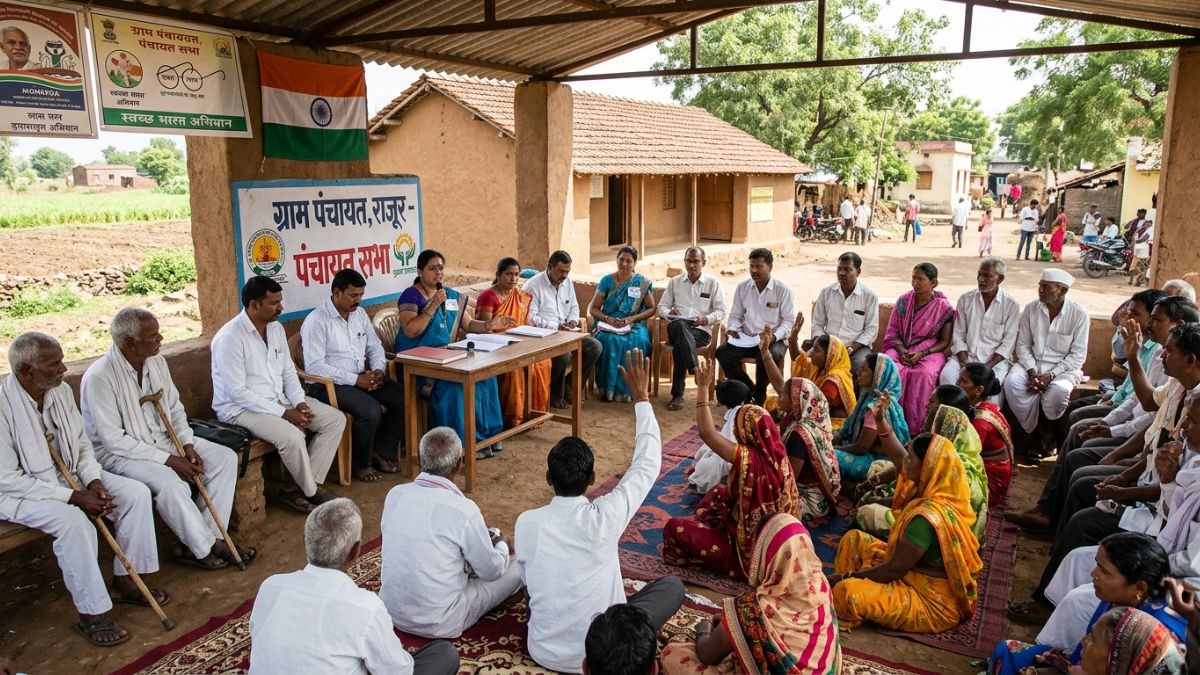
The state designated mid-career gazetted officers – drawn from across line departments – as dedicated rural ombudsmen, titled Swayampurna Mitras. Crucially, it mandated that they spend Saturdays not behind mahogany desks in Panaji or Porvorim, but inside assigned village panchayat halls in hinterland talukas like Sattari, Dharbandora, and Sanguem. Rather than forcing villagers to embark on expensive pilgrimages across multiple distant administrative offices, the state planted the machinery of inter-departmental verification and grievance redressal squarely in the village square.
The genius of this approach lies in how it dismantles bureaucratic silos in real time. In conventional governance, government departments operate like feudal baronies. The Directorate of Agriculture does not communicate with Social Welfare; Animal Husbandry has no daily institutional link to Rural Development; and the water resources division drafts blueprints oblivious to local health centres. The citizen is forced to act as the exhausted, unpaid coordinator trying to stitch these fragmented bodies together.
A visiting gazetted officer rewrites this dynamic on the spot. Backed by statutory authority and a direct reporting line to District Collectors and the Chief Minister’s office, the visiting officer acts as an administrative aggregator.
On any given Saturday, a marginal farmer seeking assistance under a crop compensation scheme does not merely slip an application into a drop box. The officer reviews the file in the open panchayat room, turns to the local Krishi Sahayak to cross-verify crop losses, consults the village talathi on land records, and checks whether the family has been enrolled in complementary central schemes. If the applicant’s bank account faces back-end transfer mapping glitches, the representative from the local cooperative bank or postal payment branch seated at the adjacent desk is pulled into the conversation. The breakthrough here is not technological flash; it is the sheer elimination of friction through physical proximity.
More profoundly, the model alters the internal psychology of the civil service. Bureaucrats who spend entire careers cocooned within state secretariats rarely confront the human misery engineered by their delays. When an officer is assigned a specific village and given direct ownership of its welfare saturation metrics, a pending file ceases to be an anonymous application number on a screen. It acquires a face, a neighbour who will be standing across the table next Saturday morning, looking them in the eye and asking why the file stalled.
To be sure, doorstep governance carries systemic hazards. If not carefully calibrated, an officer-led model risks paternalism, inadvertently eroding the Constitutional authority of elected Sarpanches and local self-government institutions under the 73rd Amendment. An assigned bureaucrat must function as a bridge for the panchayat, not an executive substitute for it.
Over the past decade, India has engineered breathtaking digital architectures – direct benefit transfers, payment bridges, and real-time dashboards. These have curbed leakages, but digital pipes cannot repair themselves when a citizen’s paperwork falls into an administrative blind spot.
The author is a public policy consultant.
