



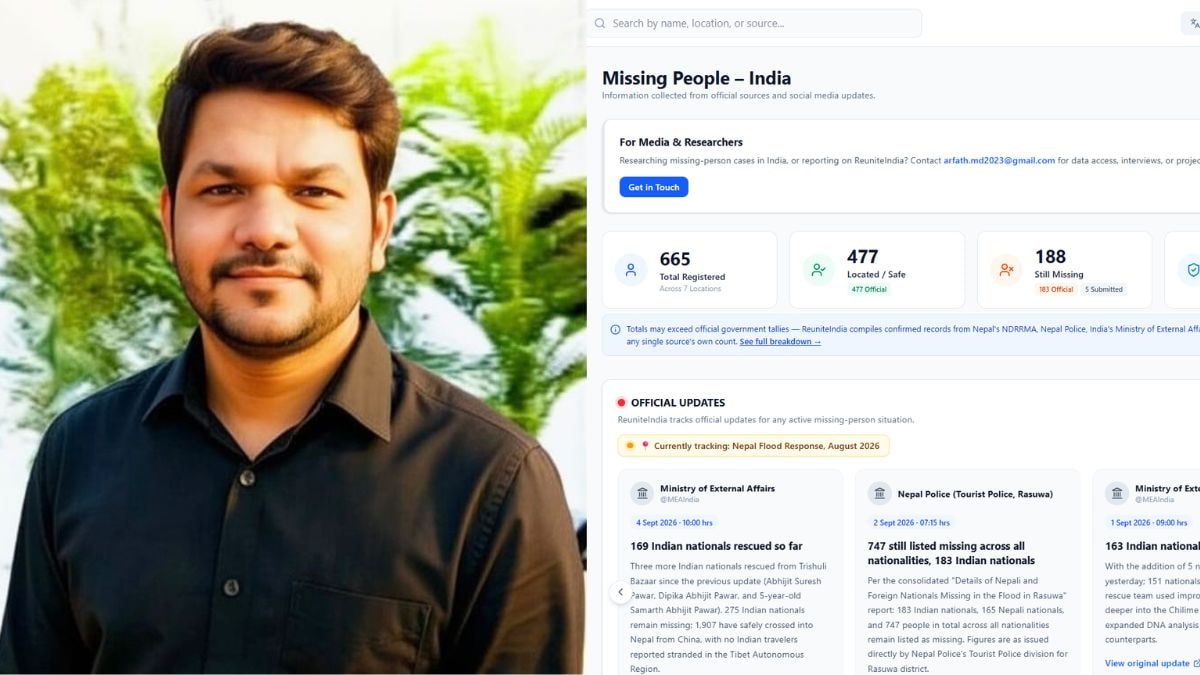
A few years ago, Hyderabad-based techie Arfath Mohammad watched helplessly as a close friend's family attempted to track down their father. His friend’s father was diagnosed with dementia and had wandered away from home. The incident left him so disturbed that he created a website to help others track down their loved ones. Years later, that same website is helping families list and track missing individuals who went missing during the devastating 2026 Nepal floods.
In the aftermath of the floods, Reunite India, the software tracking platform, has helped list 665 individuals reported missing, safe or located. The website was designed entirely by Mohammad, a senior solutions architect and subject matter expert in programming languages.
With the help of an AI-assisted layer, the website combined data from India's Ministry of External Affairs (MEA), Nepal Police and Nepal's National Disaster Risk Reduction and Management Authority (NDRRMA) to identify around 477 people listed as located or safe.
“Families and individuals can also submit a case through the website,” Mohammad told THE WEEK, adding that he handchecks each data entry before publication.
The platform helps families piece together scattered information by collating MEA updates, disaster authority bulletins and even social media posts, regardless of the language. It locates hospitals and police stations near the last seen location of the person. The website also provides guidance on filing a missing person case for those who need assistance.
Mohammad developed a QR feature, which differentiates the website from regular missing lists. The feature helps families access updated information about the missing individual. Posters generally cannot be modified, but the QR code shows the latest information about the individual, even if it was printed weeks ago.
There is a second QR feature for vulnerable individuals who might get lost, such as senior citizens, young children and disabled people. The family can set up a “safety profile” on the website, which then generates a QR code that can be printed on the individual’s bracelet, wallet card or tag.
“ReuniteIndia.com was built from day one to work for any missing person case. A child who wanders off, someone with dementia who leaves home or anyone missing after a flood or other emergency. Nepal was where the need was most urgent, so it became the platform’s first real-world test,” he added, while explaining his plans to expand the website. The platform can also track missing or stolen vehicles.
The next step for Mohammad is to develop a range of QR-linked physical products. A trial line is already open to interested customers, including safety bracelets, wallet ID cards, and iron-on clothing labels. He shared his hopes of collaborating with state or central government bodies in the future, emphasising that it can prove beneficial to both sides.
