



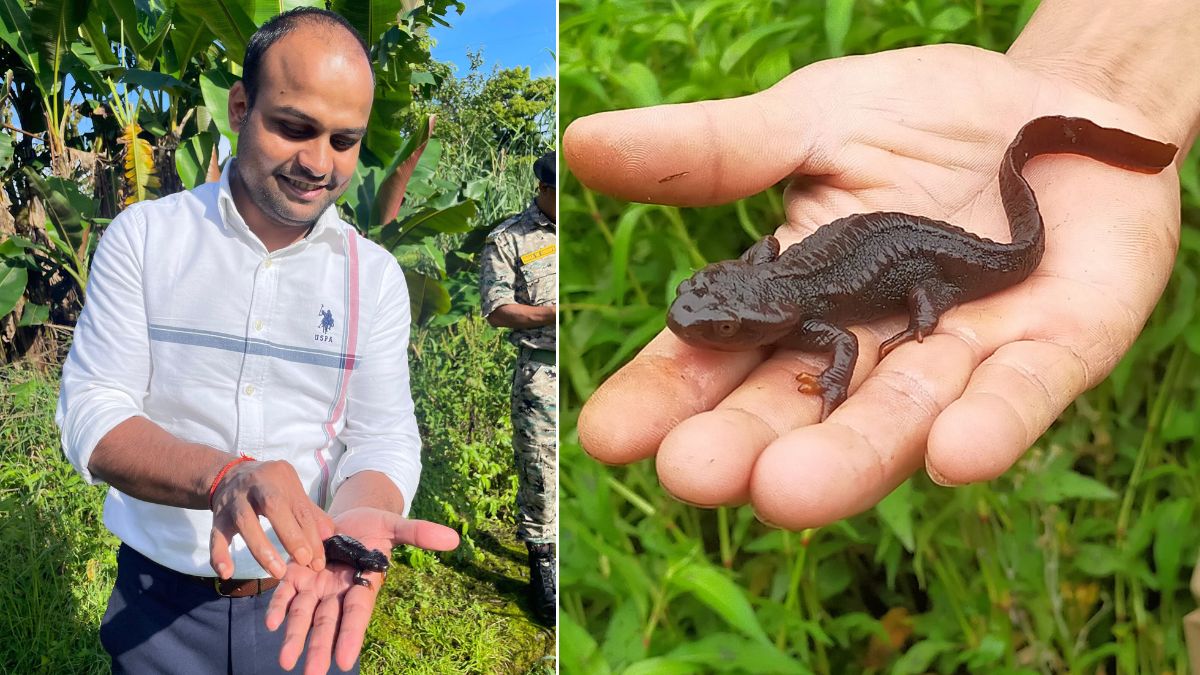
In the misty hills of Kurseong, an unusual conservation battle is taking shape for a creature that has quietly survived for millions of years. The Himalayan salamander, or Himalayan newt (Tylototriton verrucosus), is facing a modern threat: the rapid disappearance and degradation of the small mountain wetlands it needs to breed.
Leading the effort to save the species is Devesh Pandey, a 2020-batch Indian Forest Service officer and Divisional Forest Officer of Kurseong. His ambitious plan is to create a dedicated sanctuary for the Himalayan salamander and protect its remaining breeding habitats through a combination of habitat restoration, scientific research, and community participation.
A detailed proposal prepared by the Kurseong Forest Division has already been submitted to the Union Ministry of Environment, Forest and Climate Change and the Central Zoo Authority. The process of establishing the protected area is now at an advanced stage.
If the proposal is approved, it would be the first sanctuary of its kind dedicated specifically to the conservation of the Himalayan salamander.
The proposed conservation landscape will centre around three important locations: Namthing Pokhari, Pokhriatar, and Panch Pokhri. Namthing Pokhari, a high-altitude biodiversity heritage site, is presently under the district administration, but the process of transferring the land to the forest department is nearing completion. The other two proposed areas are already under the department.
“The Himalayan salamander is a highly sensitive indicator species. Its presence tells us that the water quality and the surrounding ecosystem are healthy. So, when we protect the salamander, we are actually protecting the wetlands and the larger ecosystem of the hills,” Pandey told THE WEEK.
The species is among India's most unusual amphibians. Growing to around 16-18 cm, it has a dark brown body marked by prominent granular ridges. Its ancient evolutionary lineage and distinctive physical characteristics have led researchers to describe it as a “living fossil”.
Locally known as Pani Tiktiki, the salamander depends heavily on clean, undisturbed water bodies for breeding. Scientific studies have documented its presence in the Eastern Himalayas and adjoining regions.
In India, the species has legal protection under Schedule I of the Wildlife (Protection) Act, 1972.
According to the forest officials, the salamander was historically known from more than a hundred locations across the Darjeeling and Kurseong hills. Today, the number of known viable locations has fallen severely, with officials working with an estimate of around 20 remaining sites.
Unregulated construction, expansion of settlements, tourism pressure, pollution, plastic waste, and changes in land use have gradually affected the small ponds and wetlands where the salamander breeds.

It was this habitat crisis that prompted Pandey to bring scientific expertise into the forest department's conservation programme. He particularly credits conservation scientist Dr Barkha Subba for working closely with the department and helping bring scientific rigour to the initiative.
“I am grateful to Dr Barkha Subba for joining hands with us. She has helped us in carrying out this meticulous work. From understanding the habitats and studying the breeding grounds to developing a scientific conservation approach, her contribution has been extremely important in bringing us to this stage,” Pandey said.
The proposed sanctuary will not simply protect existing habitats. The forest department also plans to restore degraded breeding grounds and create artificial ponds at suitable locations to expand the species' available habitat. Areas critical to breeding could also be designated as “no-go” zones to prevent activities that may destroy or disturb the wetlands.
The department is simultaneously trying to bring local residents, particularly young people, into the conservation effort through initiatives such as “Screen to Green”.
“We are hopeful that within five years we will be able to move from around 20 locations to 40. It is a difficult task, but if we can secure the habitats, restore the breeding ponds, and involve local communities, we can give the species a much better chance,” Pandey said.
His work has also earned recognition beyond the Darjeeling hills. Pandey has been nominated for the Eco Warrior Awards 2026 in the Wildlife Protection and Conservation category for his efforts to restore the salamander's breeding habitats, develop artificial water bodies, and introduce scientific and community-based conservation measures.
For Pandey, the ultimate measure of success will not be the creation of a sanctuary alone. It will be whether the tiny mountain wetlands once again become suitable for the return and breeding of the Himalayan salamander.
