



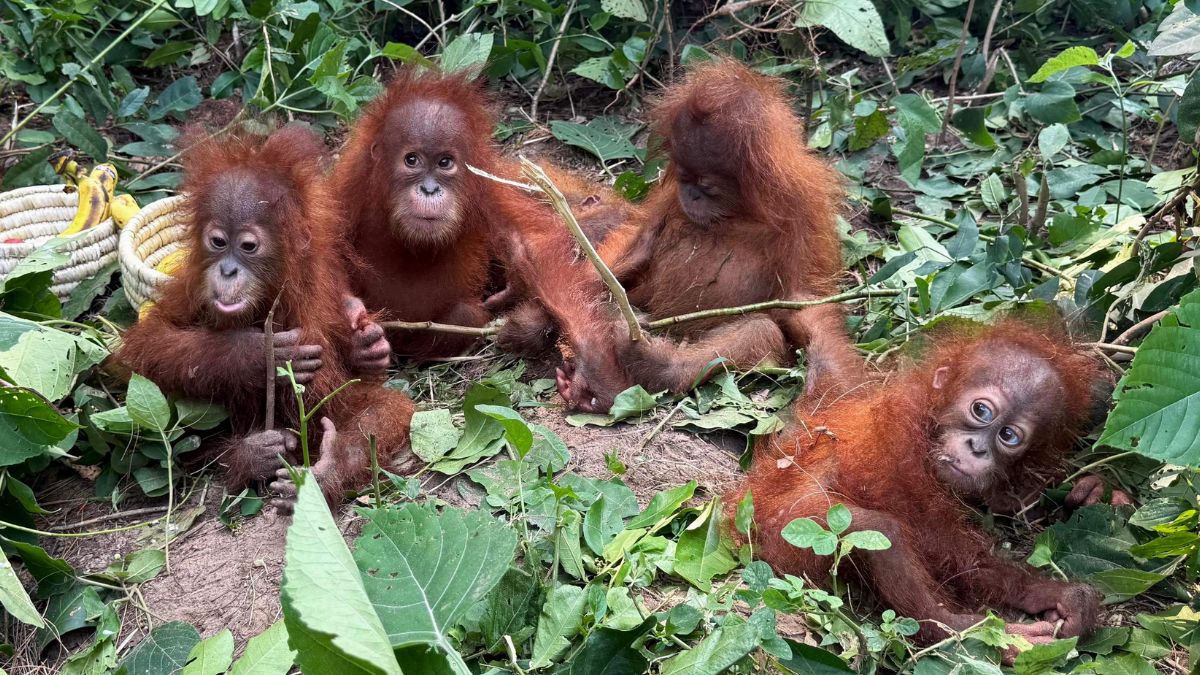
Five young orangutans rescued from a forest in Odisha’s Balasore district are under quarantine at Nandankanan Zoological Park, as officials investigate how the animals, which are not native to India, came to be in the state.
The orangutans were spotted early on Tuesday by residents of Badapai village forest in Bhograi. The unusual sighting drew thousands of people to the area, prompting the Forest Department to step in and rescue them. They were taken to the divisional forest office before being shifted to Nandankanan.
“We have rescued five baby orangutans and brought them to the forest office. After preliminary examinations by veterinary doctors, we handed them over to Nandankanan officials. They are now under quarantine at Nandankanan,” Balasore Divisional Forest Officer Pratik Prakash Indalkar told The Week.
The animals’ exact ages are yet to be established. Forest officials believe they are juveniles based on their size and physical characteristics. At Nandankanan, they are being kept under observation while veterinarians assess their health and condition.
How did they reach Odisha?
The discovery has raised questions about how the five orangutans reached Balasore. Orangutans are native to the rainforests of Borneo and Sumatra and have no natural range in India. All three recognised species are classified as Critically Endangered on the International Union for Conservation of Nature (IUCN) Red List.
With no natural route connecting Odisha to their native habitats, officials consider it highly unlikely that the animals reached the state on their own. Investigators are looking into whether they were transported by humans and may have been part of an illegal wildlife trade.
The state government has handed the investigation to the Special Task Force (STF), which is trying to trace the animals’ journey to Balasore and identify those responsible for bringing them there. A formal complaint has also been lodged under relevant wildlife protection laws, with police assisting the Forest Department.
Trafficking concerns
Young orangutans are particularly vulnerable to wildlife trafficking because of demand for exotic pets and private collections. Their small size and appearance can make them attractive in the illegal exotic-animal trade. Removing young animals from the wild can further threaten already endangered populations.
For now, the five juveniles remain under quarantine at Nandankanan, away from the crowds that gathered around them in Badapai. The investigation will focus on establishing where they came from and how they ended up in Odisha.
