



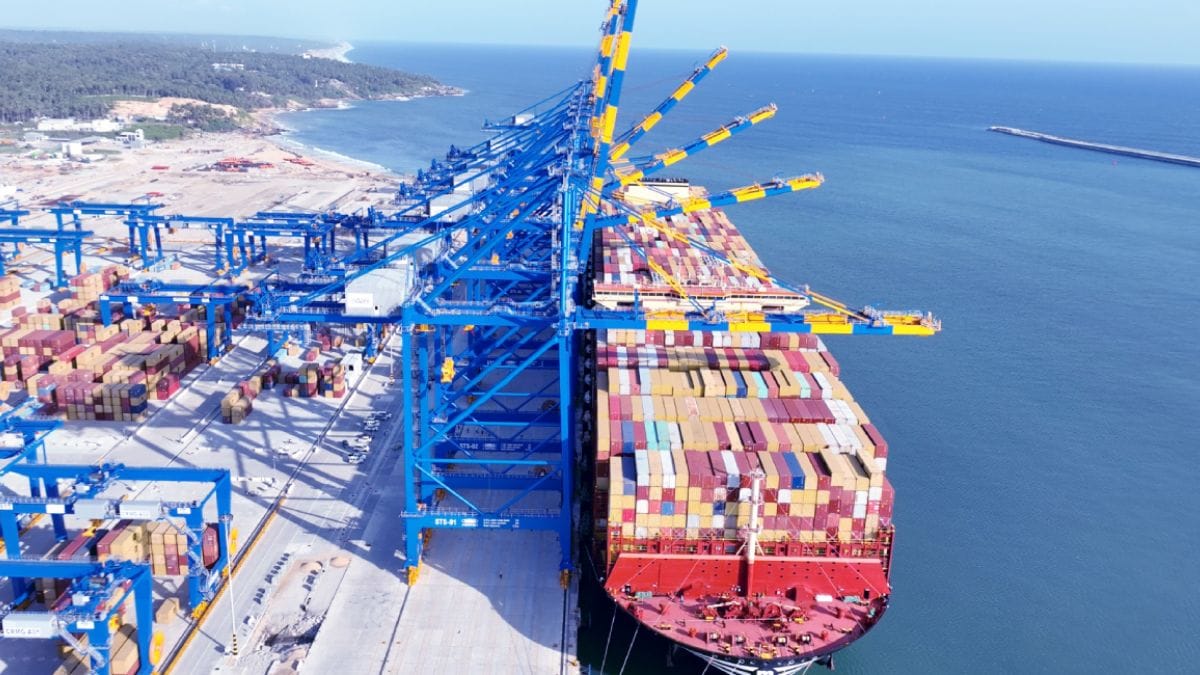
Global shipping shocks and rising freight costs are forcing Indian businesses and policymakers to treat maritime supply chains as an urgent economic priority.
The Strait of Hormuz was closed from late February to mid-June of this year. Indian companies learned what naval strategists have long argued: every coastline has a cost line. Before the crisis, India sourced about 40 per cent of its crude and 60 per cent of its LNG imports through the strait. The risk has now returned. On October 6, a tanker was hit near Oman, and eleven Indian crew members were injured. Since October 3, at least five commercial ships have been attacked in the strait.
Almost 95 per cent of India’s trade by volume and some 70 per cent by value is transported by sea. Government estimates, however, say only about 5 per cent of India’s EXIM cargo is carried on Indian ships. Consequently, the nation pays foreign shipping lines close to $75 billion a year in freight bills. This is a drain on the services account in normal circumstances. It becomes a vulnerability during a crisis as Indian shippers are price takers when carriers change routes, levy surcharges, or withdraw capacity.
Hormuz is the second chokepoint to fall in three years. The Houthi attacks from November 2023 onward have disrupted Red Sea traffic. Around 80 per cent of India’s merchandise trade with Europe normally passes through the Red Sea. Diverting around the Cape of Good Hope adds two weeks or more to transit times. Container freight rates on key Asia-Europe routes have jumped more than 200 per cent, and war-risk insurance premiums on ships in affected zones have risen as much as tenfold. For exporters, this has meant thinner margins, more working capital tied up and delayed contracts.
India is responding by embedding maritime security into its broader economic architecture. A ₹69,725 crore package approved in September 2025 extends shipbuilding support to 2036, establishes a ₹25,000 crore Maritime Development Fund and seeks to unlock 4.5 million gross tonnage of capacity. In February, state-owned firms agreed to form the Bharat Container Shipping Line. The Navy deployed Operation Urja Suraksha at sea in March to secure energy shipments to India, building on its Red Sea deployments under Operation Sankalp in 2024.
There are three priorities. The first is closing the cost gap. Indian-flagged ships are about 20 per cent costlier to run due to crewing, tax and regulatory requirements, but under right-of-first-refusal rules, owners are still required to match foreign freight rates to win cargo. And resilience should be treated as an insurance premium that the country chooses to pay, not a subsidy that it pays grudgingly. Indian shipowners get the predictable cash flows that lenders look for when state-owned importers of energy and fertiliser give them long-term charters. The second is a domestic marine and war-risk insurance pool, so that crisis premiums are not determined abroad alone. The third is route diversification – domestic transhipment capacity, coastal shipping and stronger port links with Africa and South-east Asia reduce dependence on any single chokepoint.
Maritime security is no longer a military mandate. It is a business approach that will determine India’s ability to sustain industrial growth in an uncertain world. Building long-term supply chain resilience will require closer working relationships between the state, logistics players and private enterprise.
The author is Professor of Economics at Great Lakes, Chennai.
The opinions expressed in this article are those of the author and do not purport to reflect the opinions or views of THE WEEK.
