



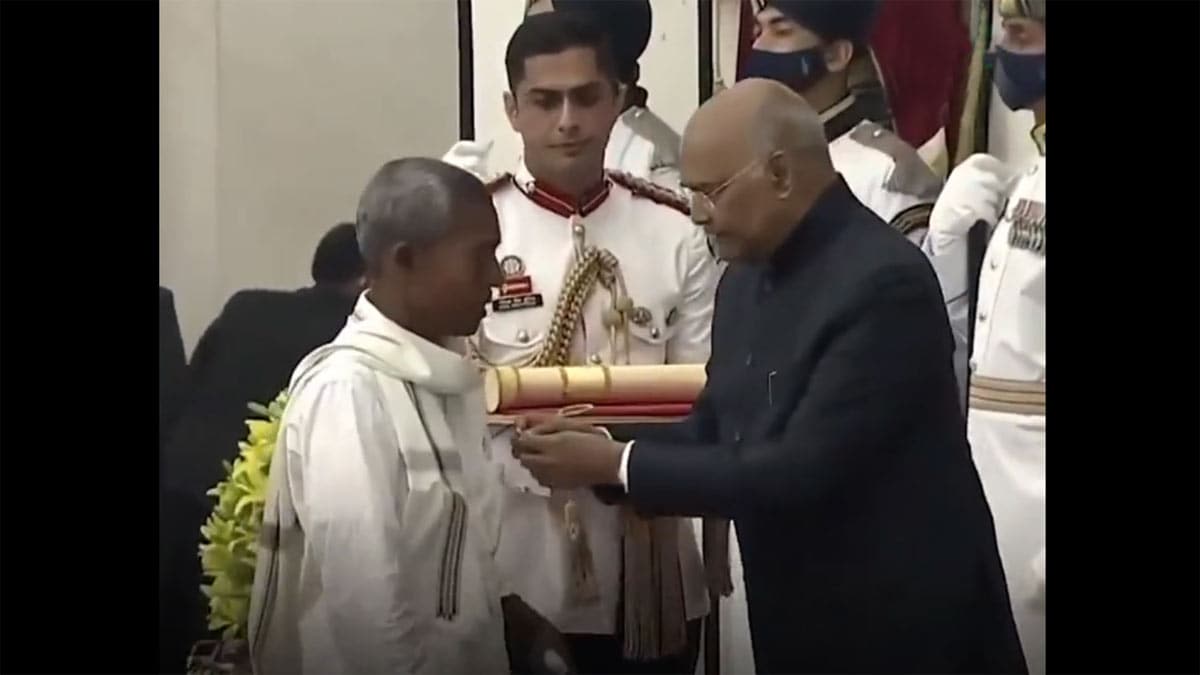
Padma Shri awardee Harekala Hajabba, popularly known as the ‘Akshara Santa’ (literacy saint), has found himself caught in Karnataka’s ongoing Special Intensive Revision (SIR) of electoral rolls after a name discrepancy triggered a notice from election officials.
Hajabba is a former orange seller from Harekala village near Mangaluru in Dakshina Kannada District. Having grown up without access to formal education, Hajabba began saving money from selling oranges in Mangaluru and worked towards establishing a school in his native village.
His efforts eventually led to the establishment of a school at Newpadapu, which later expanded into a high school and a pre-university college. His contribution to education and social work earned him the Padma Shri, India’s fourth-highest civilian award, in 2020. He received the award from then President Ram Nath Kovind.
Despite his national recognition, Hajabba was recently served an SIR notice over a name discrepancy after officials found a mismatch between his name in the 2002 electoral roll and his current documents. While the old voter list recorded him simply as ‘Hajabba’, his present voter ID and other official documents, including his Aadhaar, ration card and passport, carry the name ‘Harekala Hajabba’.
The discrepancy was flagged during the SIR verification process as a logical anomaly, prompting officials to ask Hajabba to produce original documents for verification. Officials asked him to appear at the gram panchayat on September 11.
The notice was subsequently withdrawn after the issue received media attention and election officials reached out to him. Officials visited Hajabba’s residence and collected the necessary documents to resolve the discrepancy, meaning the 70-year-old would not have to appear before the authorities.
The incident has nevertheless drawn attention to one of the concerns surrounding the SIR exercise — the possibility of genuine voters being flagged because their names or other details do not exactly match older electoral records.
The Election Commission has maintained that the SIR is intended to authenticate electoral rolls and identify ineligible, duplicate, shifted or deceased voters. But the exercise has also triggered concerns among political parties and civil society groups over the documentation burden being placed on voters.
Hajabba’s case has attracted immediate attention because he is a recipient of one of the country’s highest civilian honours. But it also raises a larger question: what about lakhs of ordinary citizens whose names may have been recorded differently years ago because they were provided orally, without initials, surnames or full names, when electoral rolls were prepared?
