



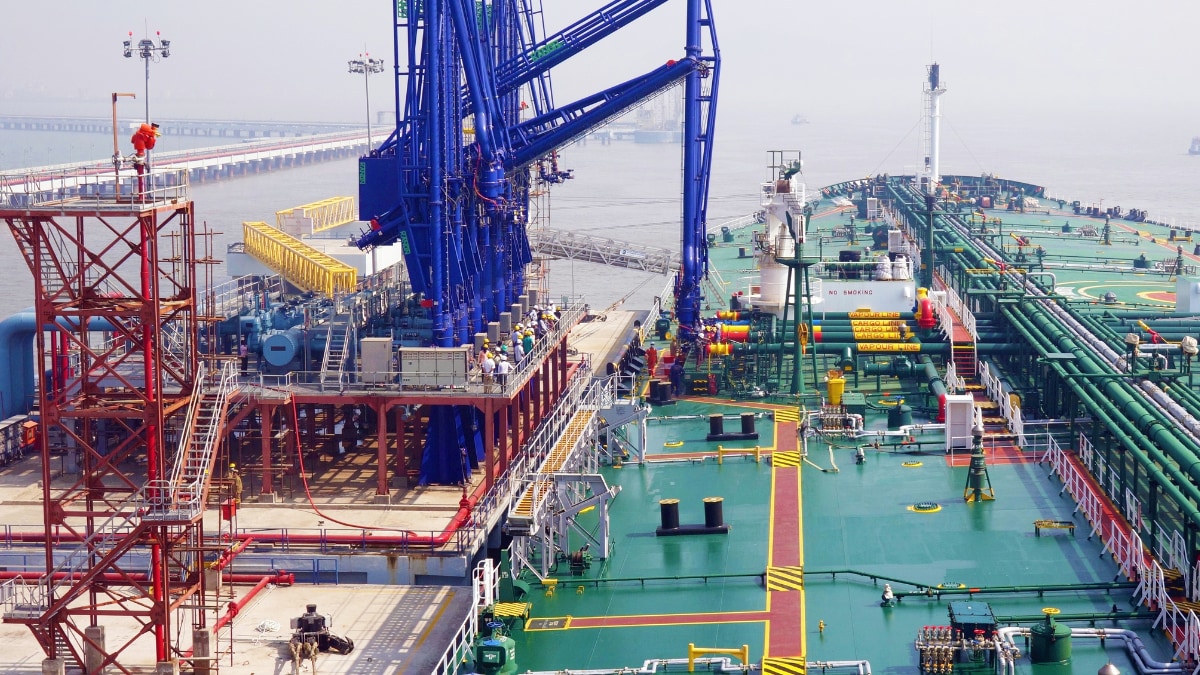
The Mumbai Port Authority (MbPA) declared on Friday that its Jawahar Dweep Marine Oil Terminal had gone plastic-free, marking a major milestone in India's efforts to clean up its maritime sector.
The oil terminal is now the first in India to completely cut single-use plastics, as per the MbPA's declaration made at the Swachhata Abhiyan 2026, a cleanliness programme held at the Grey Gate in Indira Dock to mark the birth anniversary of Mahatma Gandhi.
The new milestone also marks a key push under the port authority's plans to cut single-use plastics across all of its operations.
As a result, the MbPA has said that it will continue to push for similar reductions at its docks, residential colonies and coastal areas over the rest of the year.
"A plastic-free Jawahar Dweep is proof that India's ports can grow and stay clean at the same time," said Union Minister for Ports, Shipping and Waterways (MoPSW), Sarbananda Sonowal, at the programme.
He also dedicated the port's Oil Spill Response (OSR), facilities to the nation during the programme. These are the hubs within ports and oil firms responsible for handling accidental spills of petroleum, crude oil, or other hazardous liquids.
About the Jawahar Dweep terminal
The Jawahar Dweep Marine Oil Terminal handles crude oil and petroleum products, and comprises five jetties.
Construction on the fifth jetty, JD5, was completed in December 2020. Measuring 470m long with a draft depth of 17m, JD5 is capable of handling vessels carrying up to 1,50,000 metric tonnes (MT) of cargo.
Despite being one of the country's oldest ports, terminals like Jawahar Dweep and Pir Pau are highly digitised. In fact, automated SCADA systems were key to liquid bulk handling at these terminals reaching 37.04 million metric tonnes (MMT) in FY 2025-26.
SCADA, which stands for Supervisory Control and Data Acquisition, blends real-time data acquisition, automated valves, and integrated safety networks.
This contributed a lot to the Mumbai Port's overall cargo throughput of 75.15 MMT in that fiscal year.
In May this year, Sonowal had reviewed shore protection and reclamation work at the terminal as part of the MbPA's plans to increase crude oil storage capacity by 2,80,000MT.
The proposed sixth oil berth at Jawahar Dweep aims to handle Suezmax vessels, and is expected to add 22 million tonnes per annum (MTPA) of crude capacity. A proposed interconnecting trestle between the Jawahar Dweep and Pir Pau terminals—envisaged as a 5km-long offshore connection—is also expected to support heavy cargo movement and pipeline corridor requirements, and boost operational resilience.
