



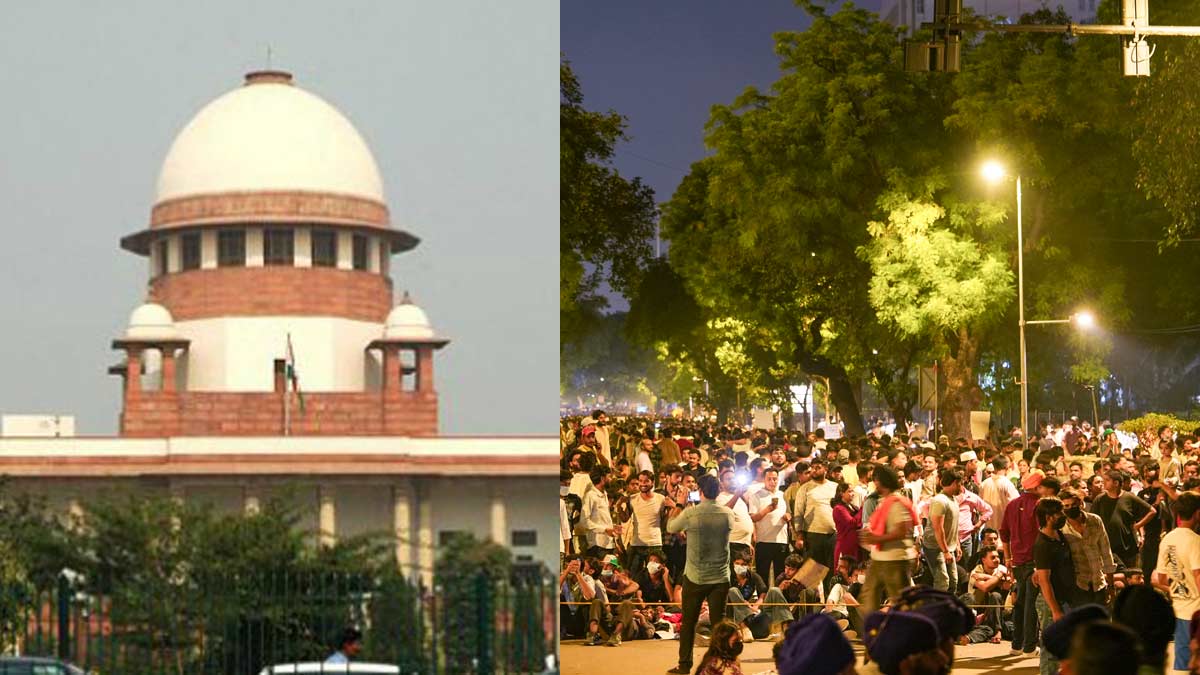
The Supreme Court on Monday asserted that the right to hold peaceful protests is guaranteed under law and said the mere fact that an agitation is taking place cannot be used to justify excessive police action, including indiscriminate lathi charge.
A Bench comprising Chief Justice of India Surya Kant and Justices Joymalya Bagchi and V Mohana made the observations while hearing a batch of petitions seeking pan-India guidelines for dealing with public demonstrations and ensuring that peaceful protests are allowed without disproportionate use of force by police.
“Right to peaceful protest is absolutely guaranteed. That cannot be denied. Merely because there is agitation cannot justify police excesses,” CJI Surya Kant orally remarked.
The Chief Justice stressed the need for restraint as well as self-evolved discipline during demonstrations, observing that both were essential to the democratic process.
“Just because there is an agitation does not mean there should be a lathi charge. Self-evolved discipline is needed, which is essential to the democratic process,” the CJI said.
At the same time, the bench underlined that the safety of police and security personnel could not be ignored. When a lawyer told the court that police officers had also been attacked during protests and sought an opportunity to place their concerns before the Bench, Justice Bagchi said, “Life of every individual irrespective of who they are is important.”
The petitions were filed against the backdrop of recent police action against protesters at Jantar Mantar in Delhi and during demonstrations in Bihar. The petitioners have sought a uniform framework governing police response to protests across the country.
Advocate Fauzia Shakil, appearing for one of the petitioners, alleged before the court that an AK-47 automatic weapon had been used by security forces in Siwan during the Bihar bandh.
Senior Advocate Vikas Singh, appearing for another petitioner, referred to alleged attacks on students in Bihar and argued that the issue required directions applicable across India rather than measures restricted to individual states.
The Bench appeared receptive to the larger question of establishing a common protocol governing demonstrations.
“There should be a protocol in place. There should be proper space and no restriction. But if there are some anti-social elements etc that can be taken care of. This is not a question of Delhi only. Uniformity of protocol is needed,” the CJI observed.
Solicitor General Tushar Mehta told the Bench that the government would assist the court dispassionately on the issue.
The court directed that all petitions concerning the issue be taken up together on Tuesday, July 28.
The proceedings come after weeks of student-led protests at Jantar Mantar over repeated question paper leaks and demands for accountability in the education system. The protests, which began in June following a call by the online collective Cockroach Janta Party, intensified after climate activist Sonam Wangchuk joined the agitation and began a hunger strike in solidarity.
Wangchuk was subsequently removed from the protest site by Delhi Police and taken to hospital on health grounds. He ended his 26-day hunger strike at Medanta Hospital late on July 23.
Tensions escalated further after protesters called for a “Sansad Chalo” march towards Parliament on July 20. Police had said that permission had not been granted for the march. Clashes were subsequently reported, with protesters alleging lathi charge, use of tear gas and excessive force against students.
The Jantar Mantar protests were called off on July 25 after Union Education Minister Dharmendra Pradhan tendered his resignation.
Similar demonstrations and allegations of police excesses have also emerged from Bihar, bringing the larger question of how law-enforcement agencies should balance maintenance of public order with the constitutional right to peaceful assembly into focus.
