



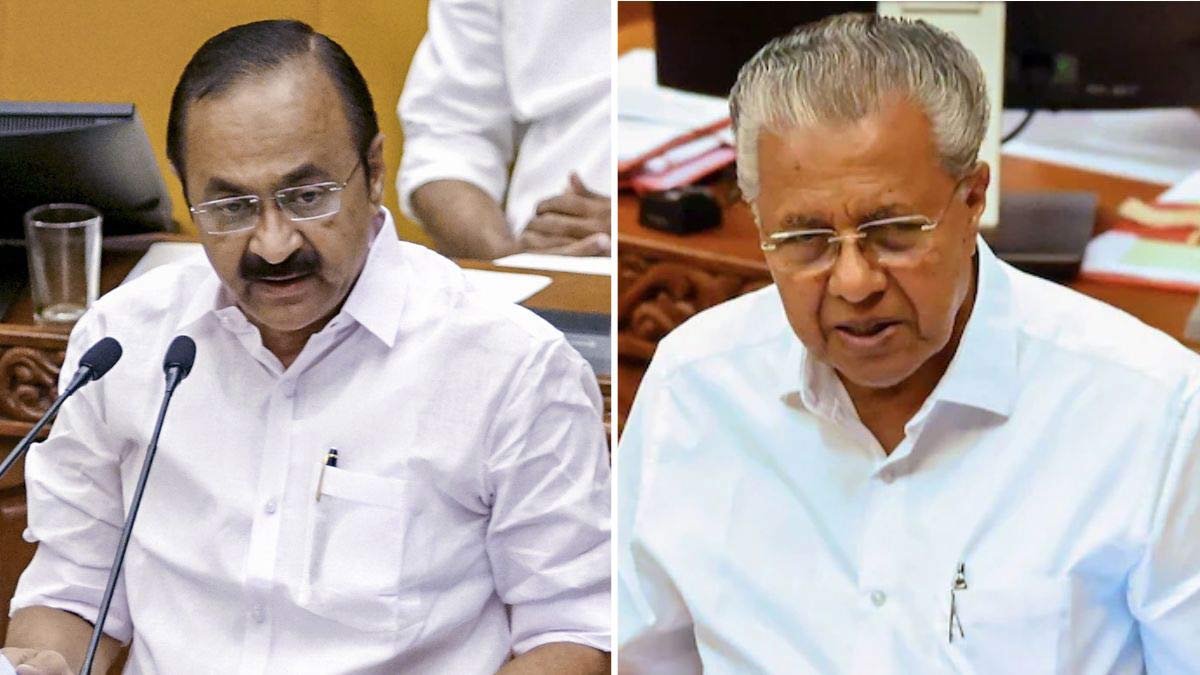
Kerala Leader of the Opposition Pinarayi Vijayan recently accused the V.D. Satheeshan government of facilitating the inclusion of non-Muslim members in the Kerala Waqf Board.
Responding on Wednesday, Chief Minister Satheeshan accused the Opposition leader of running a "communal campaign" aimed at creating anti-Muslim sentiments and turning the community against both the UDF and the government.
The controversy stems from the constitution of the Kerala Waqf Board under the Unified Management, Empowerment, Efficiency and Development (UMEED) Act, which overhauled the Waqf Act, 1995, through amendments passed in April 2025. Satheeshan argued that the previous LDF government itself had stated in its notification constituting the Waqf Board that two non-Muslim members would be appointed to the board at a later stage. Former law minister and CPI(M) leader P. Rajeeve, however, countered that the Chief Minister's claim was false and accused him of misrepresenting the previous government's position.
The exchange has reignited debate over how both the previous LDF government and the present UDF government have interpreted and implemented the central legislation, particularly the provisions relating to the composition of the Waqf Board.
Here's what happened
The controversy has its origins in the LDF government's decision to constitute the Kerala Waqf Board under the UMEED Act in February 2026. While the amended law mandates the inclusion of two non-Muslim members, the government appointed only nine Muslim members, leaving two positions vacant and stating that the remaining appointments would be made later. The Board's constitution was subsequently challenged through multiple petitions, one of the principal objections being the absence of the mandatory non-Muslim members.
On July 15, the Kerala High Court restrained the Waqf Board from taking any major decisions until the dispute over its constitution was resolved. The court observed that the Board was prima facie not constituted in accordance with Section 14 of the UMEED Act. It also recorded the state government's submission that it was willing to reconstitute the Board in compliance with the law. Pending a final decision, the High Court barred the Board from taking policy decisions or incurring capital expenditure without the court's permission and directed that it function under the supervision of the Joint Secretary handling Waqf affairs.
Six days later, on July 21, the Supreme Court set aside only the supervisory arrangement imposed by the High Court, allowing the Board to function without bureaucratic oversight. It, however, left the remaining interim restrictions intact and asked the High Court to dispose of the matter expeditiously. Significantly, the Kerala government has filed an affidavit before the High Court stating that the Board would be reconstituted in strict compliance with Section 14 of the UMEED Act.
Defending his government's stand, Chief Minister V.D. Satheeshan argued that the previous LDF government had itself accepted the requirement to appoint two non-Muslim members. He pointed to the February 2026 notification, which stated that the appointments of the remaining members under clauses (d) and (f) of Section 14(1) would be made shortly. Satheeshan said the appointments had been deferred because the Bar Council elections were underway.
The notification states: "The appointment of the remaining one member under clause (d) and one member under clause (f) of sub-section (1) of Section 14 of the Act shall be made shortly." Clause (d) covers persons with professional experience in fields such as business management, finance and social work, while clause (f) provides for a representative from the State Bar Council.
Since the Board already comprised nine Muslim members, the two remaining vacancies would, under the amended law, have to be filled by non-Muslims. However, the LDF government left both positions vacant, saying the appointments would be made later. Satheeshan argued that by expressly committing to fill these two statutory categories, the previous government had effectively acknowledged that the remaining appointees would necessarily be non-Muslims.
Satheeshan, meanwhile, also noted that the present government had informed the High Court that it would examine the objections raised by the petitioners, reconstitute the Board in accordance with the law and simultaneously seek dismissal of the petitions. He added that the Waqf Board had taken the same position before both the High Court and the Supreme Court, expressing its willingness to comply with Section 14.
The CPI(M), however, has rejected the Chief Minister's interpretation. Former law minister P. Rajeeve argued that while the notification spoke of filling the two remaining vacancies, it never explicitly stated that the appointees would be non-Muslims. "If you read the notification, it merely states that the appointment of the remaining two members shall be made. It nowhere says those two members will be non-Muslims. The government's own notification does not contain the words 'non-Muslim'," Rajeeve said.
Rajeeve accused the Chief Minister of making factually incorrect claims and reiterated the CPI(M)'s long-standing position that non-Muslims should not be part of the Waqf Board because it administers matters of Islamic faith. "Including non-Muslims in Waqf management is irrational and violates Articles 14, 25 and 26 of the Constitution. That has been the LDF government's position," he said.
He also accused Satheeshan of misrepresenting the Congress's own stand. According to Rajeeve, the position that only Muslims should serve on a body dealing with Muslim religious affairs has been endorsed by several political parties, including the Congress. He argued that by branding this position as communal, the Chief Minister was effectively echoing the BJP's arguments.
Rajeeve further challenged Satheeshan's claim that Kerala was the first state to notify the amended Waqf Act. "Tamil Nadu issued its notification on November 28, 2025. Kerala's gazette notification came only on February 4, 2026," he said.
It is for sure that the task of Waqf Board's re-composition could leave the United Democratic Front walking a political tightrope. With the Indian Union Muslim League (IUML) as one of its key allies, the UDF faces competing legal, electoral and coalition pressures in reconstituting the Board.
If the government proceeds with appointing the two non-Muslim members mandated under the amended law, it risks a backlash from sections of the IUML and parts of the wider Muslim community. Such a move would also expose the government to criticism from the LDF, which is likely to accuse it of repeatedly capitulating to the BJP's political agenda. At the same time, following the path adopted by the previous LDF government—constituting the Board while leaving the two statutory positions vacant—could invite accusations of circumventing the Central law and reinforce the BJP's charge of minority appeasement.
The legal position appears increasingly difficult to ignore, especially after the state's affidavit indicating its willingness to reconstitute the Board in line with Section 14. The question now is whether Chief Minister V.D. Satheeshan can navigate these competing pressures, or whether attributing the present predicament to the previous LDF government will be enough to defuse the political fallout.
