



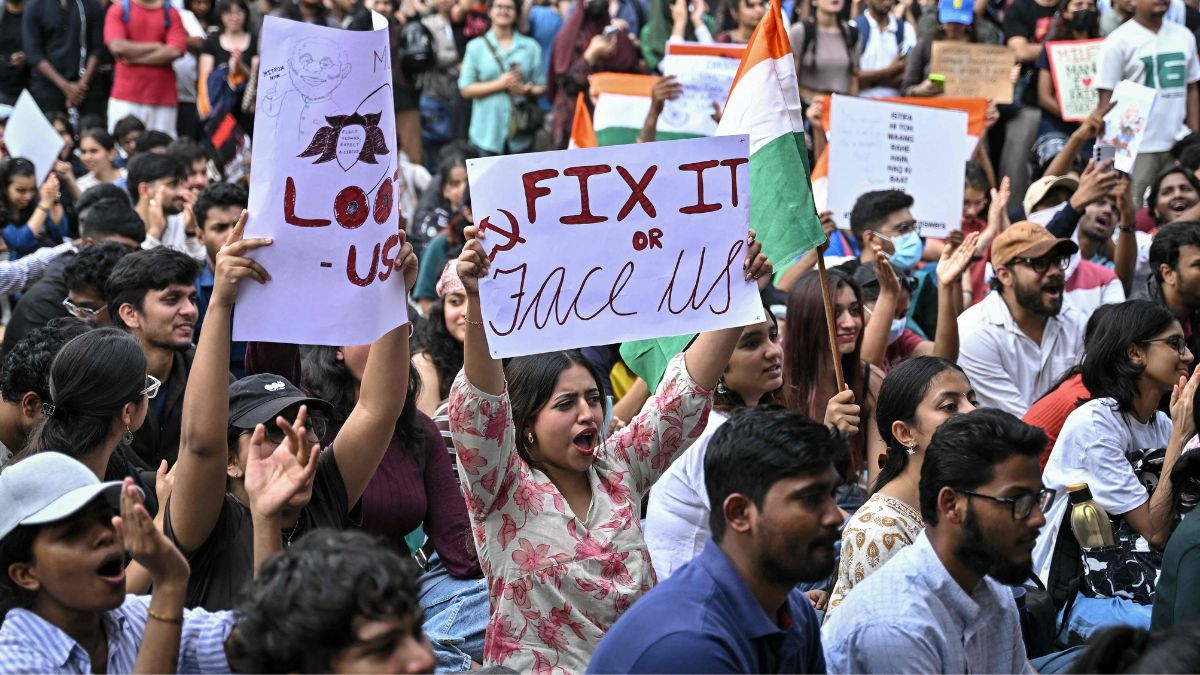
As the ‘Chalo Sansad’ movement marched towards the Parliament, demanding the resignation of Union Education Minister Dharmendra Pradhan, mobile internet services were suspended.
This suspension of the internet, which remained in effect until the evening of July 20, has raised eyebrows in various civil societies.
Through its social media handles, the CJP shared a photo of an SMS which stated: "As per government instructions Internet services have been stopped in your area till further notice. REGINF."
The Internet Freedom Foundation (IFF) condemned the action and argued that no order regarding the same had been made public by the government. It also opined that no copy of any suspension order had been published by the Ministry of Home Affairs, the Department of Telecommunications, the Delhi government, or the Delhi Police.
It further pointed out that the shutdown was a breach of the Anuradha Bhasin and the Suspension Rules, 2024.
These rules emerged out of a Supreme Court case titled Anuradha Bhasin v. Union of India (2020), which held that the freedom of speech and expression, and the freedom to carry on trade or business through the medium of the internet, are protected under Articles 19(1)(a) and 19(1)(g) of the Constitution.
The Court had directed that every order suspending telecom services must be published, along with reasons recorded in writing.
In 2024, the Parliament replaced the Indian Telegraph Act, 1885 with the Telecommunications (Temporary Suspension of Services) Rules, 2024. Under this Act, every order must be published, and a suspension order may be issued only by the Union Home Secretary or the State Home Secretary.
An officer not below the rank of Joint Secretary may act in unavoidable circumstances, subject to confirmation by the competent authority within 24 hours.
Every order must also clearly define the geographical area and the specific services suspended, and cannot remain in operation beyond fifteen days. A Review Committee must then meet within five days of the order and record its findings.
In that regard, the IFF questioned how "no recorded reasons are available to the public, despite little to no reports of violence and consistent calls for the protest to be peaceful by the CJP and other organisers".
“The developments of today are of immense consequence to the future of our democracy ... The precise areas and services covered are undisclosed and so is the duration. Whether the competent authority even issued the order cannot be known. Whether the Review Committee will examine it cannot be verified," it added in an X post on Monday.
Apart from the internet shutdown, the Delhi Police had also imposed Section 163 of the Bharatiya Nagarik Suraksha Sanhita (BNSS) on the day of protest, which bans any assembly of more than four people, carrying any weapons, or any unauthorised protests—this later led to the police using lathi charges and tear gas to disperse the crowd.
The suspension was effective in parts of Central Delhi, including the area around Jantar Mantar. The police sealed the routes to the Parliament and metro stations including Patel Chowk, Rajiv Chowk, and Janpath.
Protesters were lathi charged, and tear gas was used to disperse the crowd. As per a video shared by the CJP on July 21, a police official by the name Sandeep Lamba could also be seen allegedly slapping a female protester.
There are also media reports of protesters with physical injuries caused during the lathi charge.
According to a report by the Software Freedom Law Centre (SFLC), India has recorded 926 internet shutdowns since 2012.
Jammu and Kashmir, since 2019—the year Article 370 was abrogated—has recorded the highest in India with 324 internet shutdowns. Rajasthan at 115, and Manipur with 62 incidents of internet shutdowns stood at second and third places on the list published by the SFLC.
Their data also showed that Kerala, Goa, Mizoram, Sikkim, and Himachal Pradesh are the only states in India to report no internet shutdowns since 2012.
