



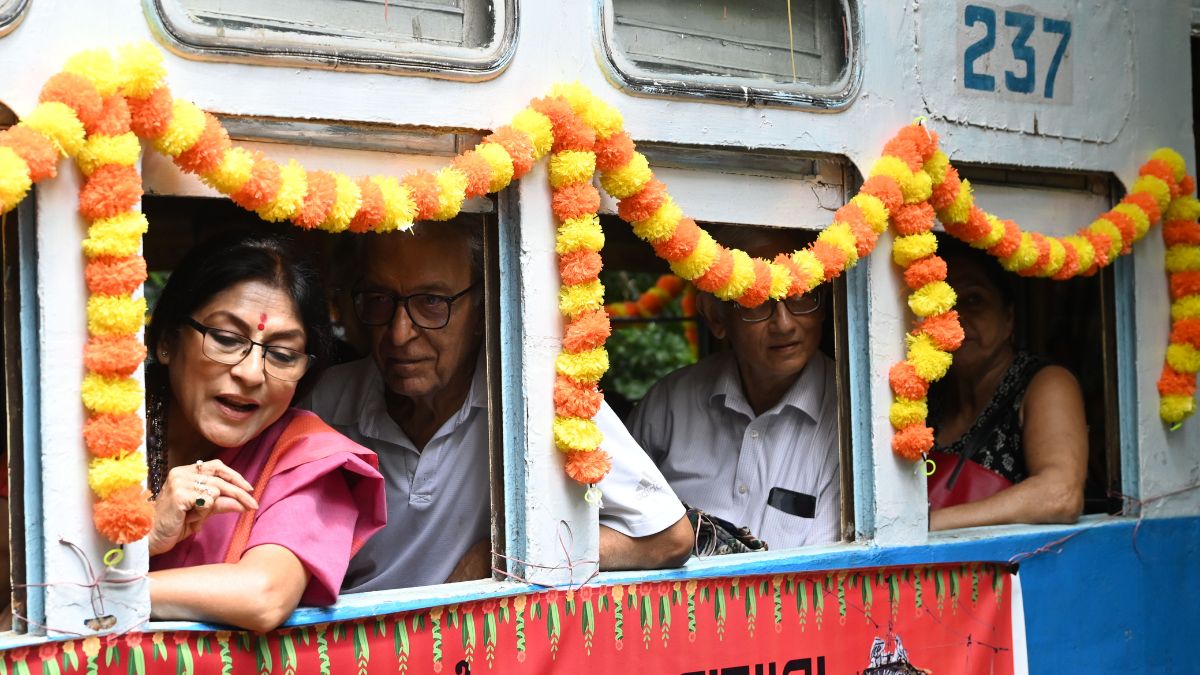
When people gathered to watch the Rath Yatra chariots roll through Kolkata on Thursday, another procession quietly captured the city's imagination. A vintage tram, adorned with marigold garlands and vibrant images of Lord Jagannath, made its way from Gariahat to Shyambazar, turning a festive ride into a powerful reminder of a transport system that once defined the city.
Organised jointly by Tramjatra, a citizens' campaign dedicated to preserving Kolkata's tram heritage, and the Calcutta Tram Users Association (CTUA), the city's leading advocacy group for tram commuters and enthusiasts, the special journey wound its way through Esplanade before reaching North Kolkata.
At every stop, curious crowds paused to photograph the decorated tram, while older residents smiled at a sight that was once part of everyday life but has now become increasingly rare.
The celebrations, however, carried a larger message. For the organisers, the ride was not simply an exercise in nostalgia but a public appeal to revive Kolkata's iconic tram network—one of the oldest electric tram systems in Asia and one of the city's most enduring symbols.
Among the passengers was BJP MLA and actress Roopa Ganguly, who recalled travelling by tram during her college years. Calling it one of Kolkata's most dependable and affordable modes of transport, she urged the state government to restore the Ballygunge-Tollygunge route, describing trams as an environmentally sustainable solution for a city grappling with congestion and pollution.

The campaign comes at a time when the West Bengal government has commissioned RITES Ltd. (Rail India Technical and Economic Service), the country's premier transport infrastructure consultancy, to undertake a comprehensive assessment of Kolkata's tram network.
The study will evaluate the condition of existing tracks, depots and related infrastructure while identifying corridors that can be restored and integrated into the city's present-day transport network. For tram enthusiasts, the exercise represents the first substantive step towards moving beyond preservation to a meaningful revival of the iconic network.
CTUA president Debasis Bhattacharya believes restoring Route 24/29 offers the quickest path to revival, with most of the infrastructure already in place. He also identified the BBD Bag loop and the Esplanade-Khidirpur stretch as practical candidates for early restoration, arguing that reopening these corridors would demonstrate a serious commitment to bringing trams back into Kolkata's transport network.
For nearly three decades, Tramjatra and the CTUA have campaigned to preserve the city's tramways, insisting they are more than heritage attractions.
In an era of climate concerns and growing urban traffic, they argue that electric trams remain a viable, low-emission mode of public transport.
The symbolism of Thursday's ride was hard to miss. Rath Yatra celebrates journeys of faith and hope. On the same streets, a century-old tram carried a different aspiration: that Kolkata's tracks, silent for far too long, may yet hear the familiar clang of trams once again.
