



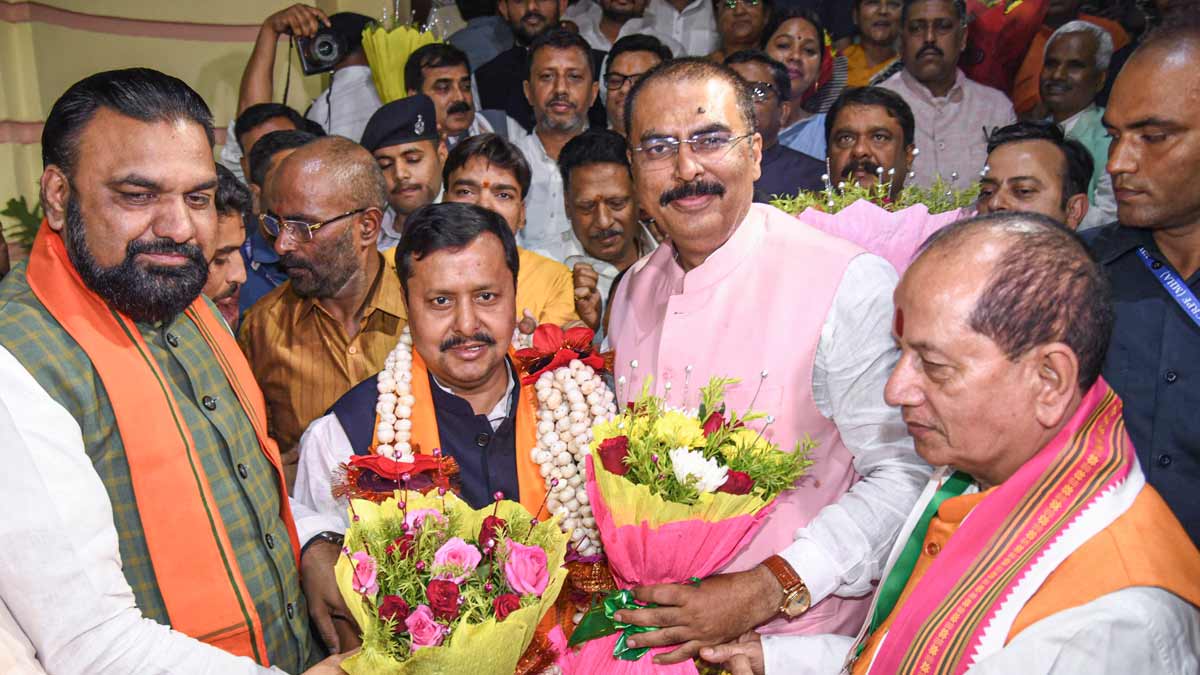
The opposition suffered a significant setback in the latest round of Rajya Sabha elections, with cross-voting, absenteeism and internal coordination failures helping the BJP-led National Democratic Alliance (NDA) expand its strength in the Upper House.
Elections were held for 11 seats across Bihar, Odisha and Haryana, while 26 candidates were elected unopposed earlier, effectively settling most contests in advance. The NDA emerged as the principal gainer, winning eight of the contested seats, including one Independent backed by the BJP, further consolidating its position in the Rajya Sabha.
The sharpest blow to the opposition came in Bihar, where the NDA swept all five seats. Those elected included Chief Minister Nitish Kumar, BJP president Nitin Nabin, Union Minister Ram Nath Thakur, BJP’s Shivesh Kumar and Rashtriya Lok Morcha chief Upendra Kushwaha.
The outcome exposed serious lapses within the opposition Mahagathbandhan, where four MLAs, three from the Congress and one from the Rashtriya Janata Dal (RJD), remained absent during voting. That absence proved decisive. RJD candidate Amarendra Dhari Singh lost despite efforts by Tejashwi Yadav to secure additional backing from AIMIM, the BSP’s lone legislator and an Independent MLA. While Yadav accused the BJP of engineering defections, the arithmetic indicates that the opposition failed to keep its own numbers intact.
The episode has revived familiar tensions between the RJD and Congress, with coordination failures once again undermining the alliance in a high-stakes contest.
In Odisha, the elections produced an equally damaging outcome for the opposition, driven by cross-voting across party lines. BJP candidates Manmohan Samal and Sujeet Kumar were elected along with BJD nominee Santrupt Misra. The biggest upset came when BJP-backed Independent Dilip Ray defeated joint BJD-Congress candidate Datteswar Hota, who was widely expected to win based on declared support.
Reports indicated that several MLAs from both the BJD and Congress voted against their party lines, significantly altering the result. The scale of cross-voting has triggered internal unease within both parties and raised fresh questions about their decision to have an alliance. The victory has come as a shot in the arm for the two-year-old BJP government in the state.
In Haryana, where elections were held for two seats, the outcome was more aligned with existing numbers despite allegations of cross-voting and procedural violations. BJP candidate Sanjay Bhatia and Congress nominee Karamveer Singh Boudh were elected, while Independent candidate Satish Nandal, backed by sections of the BJP and Independents, fell short.
The contest was marked by complaints from both the BJP and Congress alleging violations of vote secrecy, leading to a delay in counting. The Election Commission eventually cleared the process, and the results were declared late in the night. Despite the acrimony, the final outcome reflected the Assembly’s numerical balance rather than any major upset. But the issue of cross-voting is set to haunt the Congress.
These contests were important in terms of how parties were able to keep their flock together. The chinks were visible in the Opposition space in all three states where polls were held. The NDA has managed to hold its ranks and benefit from fragmentation within the opposition, while opposition parties have struggled with coordination, discipline and turnout in closely fought contests.
Apart from these polls, the broader picture of the Rajya Sabha elections had already been shaped by unopposed victories in several states. Of the 37 vacancies, 26 candidates were elected without a contest. Prominent among them were Congress leader Abhishek Manu Singhvi from Telangana, AIADMK’s M. Thambidurai and PMK’s Anbumani Ramadoss from Tamil Nadu, DMK leader Tiruchi Siva, and Trinamool Congress leaders Babul Supriyo and Derek O’Brien from West Bengal, and Sharad Pawar from Maharashtra.
