



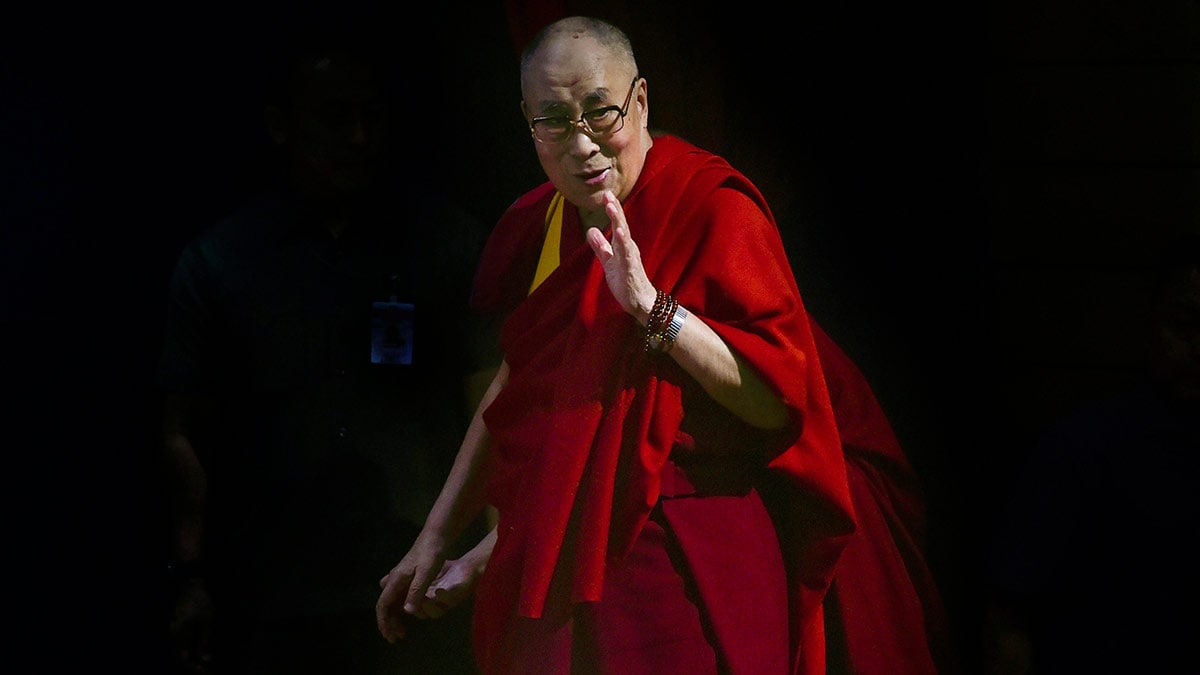
A few days ahead of the swearing-in of Penpa Tsering as Sikyong (President) of the Central Tibetan Administration on May 27, a spokesperson for the Chinese Embassy in India issued a statement on the social media platform X dismissing the legitimacy of the Tibetan administration in exile. The spokesperson asserted that the body is “not recognised by any sovereign country,” lacks authority to represent the Tibetan people, and has no role in overseeing the reincarnation process of the Dalai Lama.
She added in her statement that, “The issue of the Dalai Lama’s reincarnation is purely an internal matter of China and should not be subject to external interference. The reincarnation of the Dalai Lama follows long-established religious rituals and historical conventions that have, for centuries, required the approval of China’s central government.”
“It is worth noting that the 14th Dalai Lama himself was recognised through this established process,” she noted.
Interestingly, in 2025, a controversy erupted on the issue of the successor of the 14th Dalai Lama. Tibetans adhere to a traditional and rigid system for identifying the reincarnations of departed high lamas, including that of Dalai Lama. Although the Dalai Lama himself has made varying statements on his reincarnation in the past, in July 2025, during his 90th birthday celebrations organised at Dharamsala, he categorically stated that the next Dalai Lama would be chosen by following the traditional process of finding and anointing a reincarnated successor. Prior to this, the Dalai Lama made another statement in March 2025 that stressed any search for new Dalai Lama must take place in a free world, signalling that the next spiritual leader should be selected from outside China.
These two statements have rattled Chinese leadership, and as expected, they came up with a strong statement that the next Dalai Lama would be selected with the consent of the Chinese government. The statement of Yu Jing, spokesperson of the Chinese Embassy in New Delhi, echoed the stated position of the Chinese government on the issue of the Dalai Lama and the reincarnation of the Dalai Lama in the event of the ultimate passing of the 14th Dalai Lama.
Signals from Beijing indicate that China is preparing to anoint the next Dalai Lama of their choice by invoking the Golden Urn tradition to legitimise its claim over the succession. Historically, the Golden Urn has played only a limited role in the recognition of Dalai Lamas. Recorded history shows that it was symbolically used only once, which was in the selection of the 10th Dalai Lama. In contrast, several Panchen Lamas were confirmed through this method. In 2007, Beijing mandated through an order that all religious reincarnations of Tibetan Buddhist Lamas (“living Buddhas”) must receive government approval.
The Dalai Lama and the wider Tibetan community firmly reject the Golden Urn practice, regarding it as blatant political interference in Tibetan affairs. For them, reincarnation is a sacred spiritual process guided by Tibetan Buddhist traditions, not a matter to be dictated by state decree.
This tension came into sharp focus in 1995 during the contentious selection of the 11th Panchen Lama, when Beijing’s appointment clashed with the candidate recognised by the Dalai Lama, underscoring the deep divide over religious authority and legitimacy. The Dalai Lama, as per the prevailing custom, recognised Gedhun Choekyi Nyima as the rightful reincarnation. However, the boy mysteriously disappeared from the scene and has not been located since then. Meanwhile, China invoked the Golden Urn system to appoint Gyancain Norbu as the Panchen Lama of the Chinese version.
This episode illustrates how the Golden Urn has been wielded not as a spiritual instrument but as a tool of political legitimacy, underscoring the deep divide between Tibetan religious tradition and Chinese state authority.
The Dalai Lama’s statements last year on the selection of his successor should be viewed in the context of Chinese actions during the selection process of the 11th Panchen Lama and also reflect deep concern and anguish over China’s insistence on using the Golden Urn, bypassing the traditional practices of Tibetan Buddhism. This raises profound questions for the Tibetan leadership.
Following the demise of the 14th Dalai Lama, the Tibetan leadership and senior High Lamas will inevitably face profound questions that will shape the future of Tibetan Buddhism. According to tradition, a search must be undertaken to identify the reincarnated boy, followed by a series of sacred rituals and tests to confirm that he is indeed the true reincarnation of the departed Lama. The foremost challenge confronting the Tibetan leadership, however, lies in whether the Chinese government will permit such a search to be conducted within its borders.
Secondly, another scenario could involve conducting a clandestine search to identify the reincarnation. Even if the boy is confirmed through traditional rituals, the challenge would then be how to bring him out of China for further ceremonies. The Chinese government has already declared that the selection of all reincarnations is an internal matter, making it highly unlikely that they would permit the boy to cross their borders. Historically, only once has a Dalai Lama been chosen outside Tibet, the 6th Dalai Lama, who was a native of Tawang.
Lastly, the Tibetan leadership may pursue the option of searching for the reincarnation within the free world, as proposed by the 14th Dalai Lama last year. Yet, the viability of this path remains uncertain, as consensus among the Tibetan leadership in India and across the diaspora is not guaranteed. Moreover, Tibetans living inside Tibet are likely to resist such a move, making it a deeply contested issue within the broader Tibetan community.
Undoubtedly, the question of the 14th Dalai Lama’s reincarnation will pose a formidable test for India’s diplomacy. The challenge would become particularly acute if the reincarnation were identified within India or in the free world, as envisioned by the 14th Dalai Lama, and subsequently allowed to reside in Dharamshala. Such a scenario would place India at the centre of a sensitive geopolitical and religious debate, demanding careful navigation of both international pressures and domestic responsibilities.
Considering the potential scenarios that could arise following the passing of the Dalai Lama, India must formulate a clear and comprehensive plan to address the challenges and eventualities that would unfold during the succession process.
(The writer is a a senior fellow with Centre for Public Policy Research.)
(The opinions expressed in this article are those of the author and do not purport to reflect the opinions or views of THE WEEK.)
