



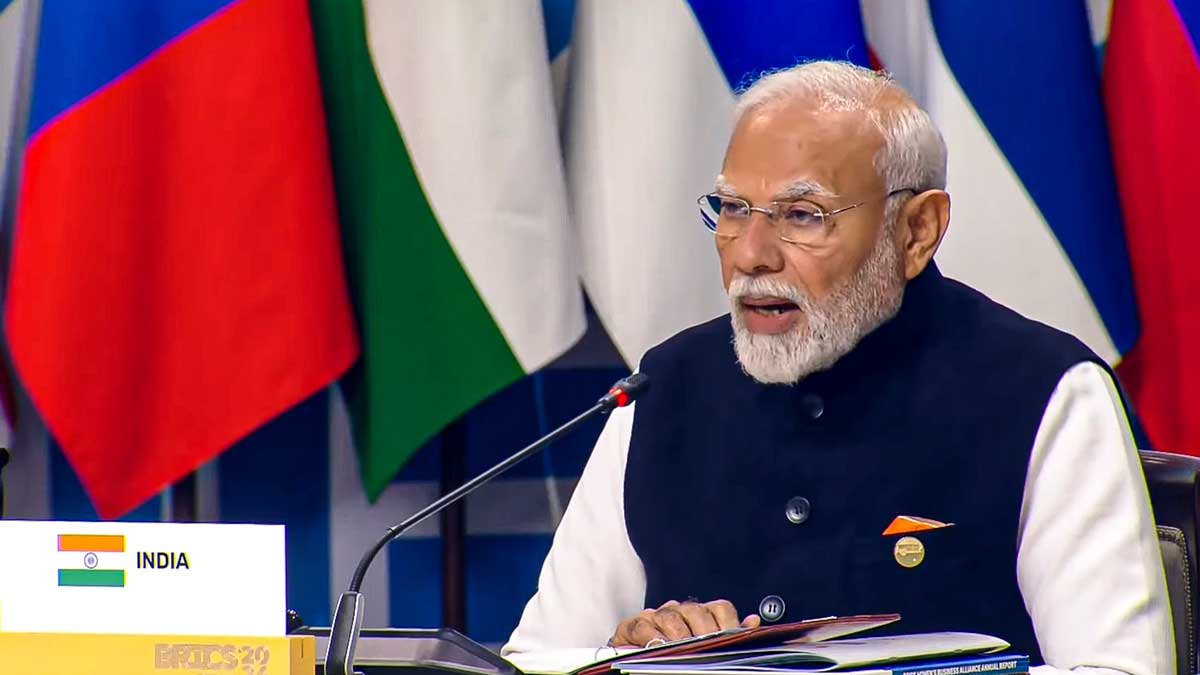
The diplomatic skills of India, which assumed the chairmanship of the increasingly powerful BRICS on January 1, 2026, will be tested to the fullest as challenges posed by the raging war in West Asia between the US-Israel front and Iran threaten to transform the entire region into a fiery battlefield.
At the core of it lies the nightmarish scenario unfolding right in front of India’s eyes. This is happening at a time when the Rupee’s value has fallen, and the price of crude oil is scaling new heights almost on a daily basis.
Brent crude, the most important benchmark for global oil prices, peaked at $106 a barrel on Sunday (March 15), even as global oil prices have risen more than 40 per cent since February 28.
This is besides the fact that West Asia was very much a land of promise for Indians, both the rich and the not-so-rich. The latter mostly comprising a labour force that sends back home substantial remittances.
It is increasingly becoming very clear that if the state of affair continues for a few more months, the global economy faces a risk of slowdown and India may be looking at a recession not much different from the one that the Covid pandemic led to.
But even more critical is the strategic push-back of India into a corner.
With Brazil, Russia, India and China as the founding members, BRIC began in 2009 with South Africa joining in 2010, making it BRICS. Significantly, Iran joined in 2024. Now, BRICS comprises 10 full members who make up for 54.6 per cent of the world’s population and 42.2 per cent of the global GDP (on a PPP basis).
Increasingly being seen as an anti-US platform, India was the one that had stood up against a de-dollarisation move, which other countries like China, Russia, and Iran were keen on. A de-dollarisation move had for its key agenda the breaking of the monopoly of the petro-dollar
China and Russia have a lot of interest in Iran. Because it is through a land route in Iran that China plans to reach out to West Asia, and a 2021 strategic pact for 25-years between the two signifies that intent. Russia also looks to Iran as the key connector for the 7,200-km multi-modal International North-South Transport Corridor (INSTC) that would connect India, Iran, Russia, and Central Asia.
With Iran being a key player in the Russian and Chinese scheme of things, the war-hit country is becoming the central pivot on which the BRICS de-dollarisation policy would move.
But of late, India’s gradual distancing from traditional friend Iran and a decipherable drift towards the US-Israel front may erode its credibility within BRICS, not to speak of the dilution of the opportunity to play mediator between the warring parties.
Without doubt, even after the conclusion of the ongoing war in West Asia, things are never going to be the same for India in West Asia.
Let us look at the two possible post-war scenarios. First is that Iran gets defeated, and the US has the upper hand in Iran. This situation will contribute to India becoming a vassal state for the US, as it will mean the US will also control the oil riches. The second scenario is that Iran keeps standing up to the US with no clear victor, which means Iran’s dominance over the Persian Gulf will increase.
In both cases, India’s quest for strategic autonomy takes a hit.
That is why, in pursuance of national interest, it would bode well for New Delhi to open back channel and Track 2 diplomacy with Tehran so as to hedge against the future. And in this, India already has a rich diplomatic resource base of old Iran and Russia hands who can answer to the call of the nation.
What would help matters is the fact that Iran has already termed India a friendly country and has allowed safe passage for Indian ships through the Strait of Hormuz. The quid pro quo is the expectation that India leads a statement condemning the US-Israel offensive.
Therefore, the trillion-dollar question is how will India wriggle out of such a situation, and to what extent will Russia weigh in for India.
