



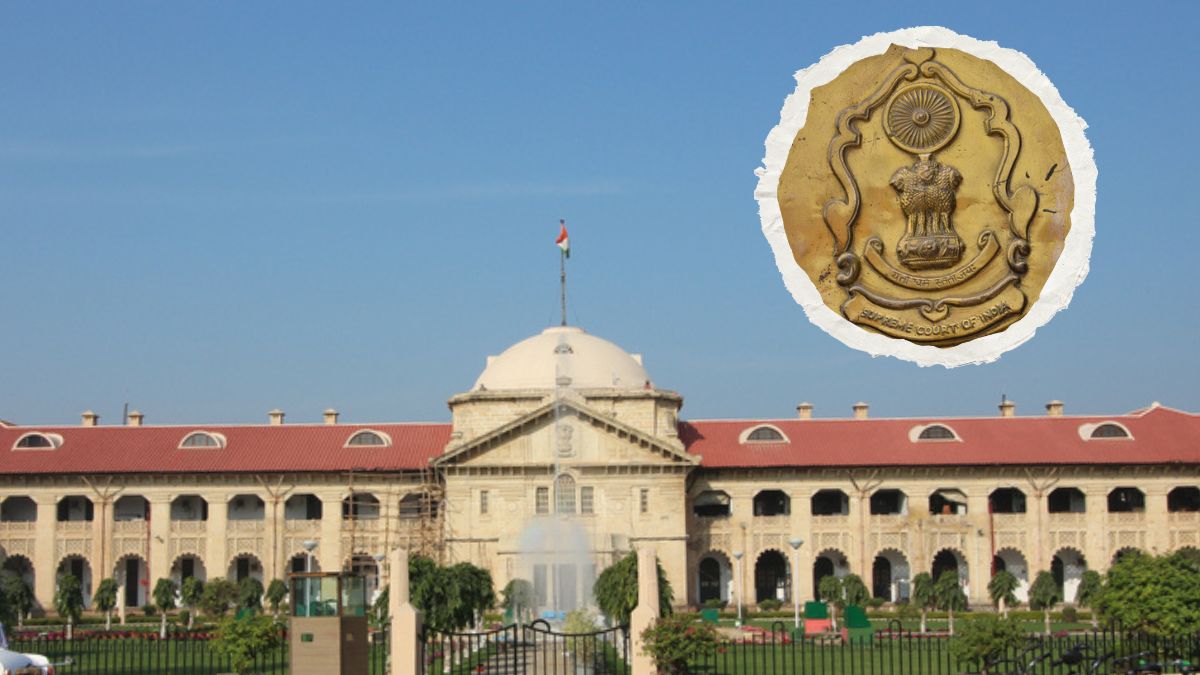
A judge of the Allahabad High Court has picked up a fight with the Supreme Court of India, and he is being supported by 13 sitting judges.
On August 7, Justice Arindam Sinha, in his personal capacity, took up cudgels on behalf of fellow Justice Prashant Kumar, who was lambasted by the apex court for dishing out ‘one of the worst orders’ and asking that he not be given any criminal cases to preside over henceforth.
Here is a brief of the original case. A respondent had supplied thread worth Rs 52,34,385 to M/S Shikhar Chemicals, but the company failed to pay the full amount. When the supplier couldn’t recover the money, they filed a criminal complaint alleging breach of trust under Section 405 of the Indian Penal Code. Shikhar Chemicals then approached the Allahabad High Court, asking Justice Kumar to quash the criminal proceedings, arguing this was purely a civil commercial dispute.
Justice Kumar examined the case and dismissed their petition, allowing the criminal proceedings to continue. In his reasoning, he noted that asking the complainant to pursue a lengthy civil remedy would be ‘very unreasonable’ when criminal proceedings could resolve the matter more quickly.
But when the case reached the Supreme Court, everything changed. “We are shocked by the findings recorded in paragraph 12 of the impugned order,” the Supreme Court said, using language that legal observers are calling unprecedented in its harshness.
The Supreme Court Bench of Justice JB Pardiwala and Justice R Mahadevan didn’t stop there—they noted “repeated erroneous orders” and restrained Justice Kumar from hearing criminal cases “till he demits office” after he “wrongly upheld summons of criminal nature issued by a trial court in a civil dispute.”
The Supreme Court called Justice Kumar’s order “one of the worst” and stripped him of all criminal jurisdiction, while declaring that his ruling “amounted to a mockery of justice.”
In the eyes of his fellow judges, this is a public humiliation, and now, as Justice Sinha has pointed out, he was shamed for simply applying what legal principles were established by the Supreme Court itself.
Sinha’s letter reads: “I, being a Judge of the Allahabad High Court and part of the institution, extended to be the Judiciary, was shocked and pained”. He goes on to elaborate that the apex court got into territory it had no business venturing into.
Justice Prashant Kumar took oath as an Additional Judge on February 27 2023. That makes him relatively new to the High Court and yet thrust into a constitutional storm.
The Supreme Court went so far as to ask, “What is wrong with the Indian Judiciary at the level of the High Court?”
Justice Sinha, in his letter, has methodically shown that his colleague was following Supreme Court precedent to the letter. In a case called Lee Kun Hee vs. State of UP, the Supreme Court had clearly stated that ‘in offences of the nature contemplated under the summoning order, there can be civil liability coupled with criminal culpability.’ This means you can have both a civil case and a criminal case for the same incident.
Even more damning, in another case (Syed Askari Hadi), the Supreme Court had declared: ‘It is, however, now well settled that ordinarily a criminal proceeding will have primacy over the civil proceeding... disposal of a civil proceeding ordinarily takes a long time and in the interest of justice the former should be disposed of as expeditiously as possible.’
So when the Supreme Court criticised the High Court judge for not sending the matter to the civil court, it was essentially suggesting the exact opposite of what it had done earlier.
Then there is the issue of how the apex court Justices—JB Pardiwala and R Mahadevan approached the matter. They handed out harsh criticism “without direction for issuance of notice” and attacked a judge who wasn’t even there to defend himself. Justice Sinha quotes the Supreme Court’s own warning from another case about such conduct: it ‘creates a concavity in the hierarchical system and brings the Judiciary downhill’ and represents ‘an incurable cancerous cell which explodes out at the slightest imbalance.’
Justice Sinha has raised fundamental questions about the constitutional relationship between India’s higher courts. While the Supreme Court can reverse High Court decisions through appeals, it cannot, according to Justice Sinha, dictate how High Courts run their internal administration. It’s the difference between being a higher court and being a boss.
Unprecedented pushback
Thirteen sitting judges of the Allahabad HC have signed onto his call for a Full Court meeting, seeking a resolution that ‘directions made in paragraphs 24 to 26 in the subject order dated August 4 2025, are not to be complied with as the Supreme Court does not have administrative superintendence over the High Courts.’
This level of institutional pushback against the Supreme Court is unprecedented.
The timing makes this even more significant. Justice Sinha wrote his letter on August 7 2025, the same day the Allahabad High Court was swearing in five new District Judges.
Justice Sinha is not defending a colleague but the idea that even in a hierarchical system, there are lines that shouldn’t be crossed.
The legal community is watching closely.
