



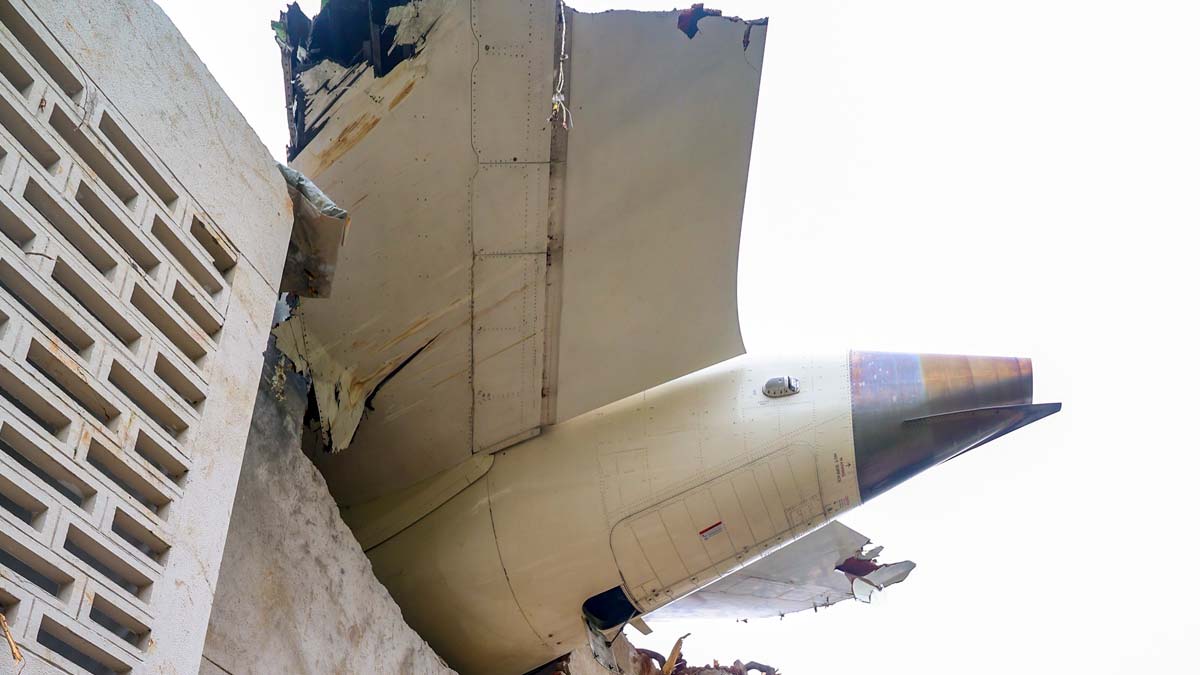
Even as the reasons that led to the crash of London-bound Air India flight in Ahmedabad continue to be unknown, aviation expert and journalist Jacob Philip pointed out an aspect of the crash that is yet to be highlighted.
In a lengthy Facebook post, he said there was a sound that was barely noticed in the video that showed the aircraft's wheels down at an altitude of 600 feet and the flaps leveled—a low murmur, which could be the sound of the Ram Air Turbine (RAT)—a small emergency electricity generator that activates only in the most critical situations to power the aircraft’s essential systems.
The RAT operates only when all primary power systems—those drawing power from the engines—fail. It also activates if the Auxiliary Power Unit (APU) does not work, and even the battery unit fails. Only then does the RAT begin functioning, he wrote.
Unlike in other aircraft, pilots in Dreamliner planes cannot manually switch on the RAT—it activates automatically in extreme emergencies, he pointed out.
So what does it mean that the RAT got activated on the ill-fated London-bound flight?
According to Philip, this indicates that all major power systems on the Boeing 787 Dreamliner, which depends entirely on electric systems, may have failed at that altitude of 625 feet.
This could happen in two scenarios:
1. Both engines failed, along with the generators they power.
2. The engines were running, but both Integrated Drive Generators (IDGs) were not functioning, and the APU also failed, along with insufficient battery power.
The pilot's message—“No thrust… plane not taking lift”—must be understood in this context. Notice the pilot did not say the engines failed. Saying “no thrust” and “no lift” more likely means that although the engines were on, they were not producing thrust or lift, he pointed out.
This could mean the engines were in idle mode and not generating enough power, or only one engine was working, he claimed.
“No lift” could also point to the flaps being in a neutral position.
Additionally, an imbalance in the distribution of cargo and passengers could make it harder for the plane to gain altitude, leading to such a scenario.
Since the engines are ultimately controlled by the electrical system, any failure there can eventually render the engines non-functional.
The fact that the engines alone wouldn’t have triggered the RAT implies that the APU and battery also failed—and how that happened will need to be investigated.
Even software issues in the aircraft’s control systems will come under scrutiny.
It is to be noted that The RAT alone could not have helped this aircraft land. It only provides temporary power until the other systems are restored. The fact that the pilots could not identify or fix the root cause in that short span led inevitably to disaster, he opined.
