



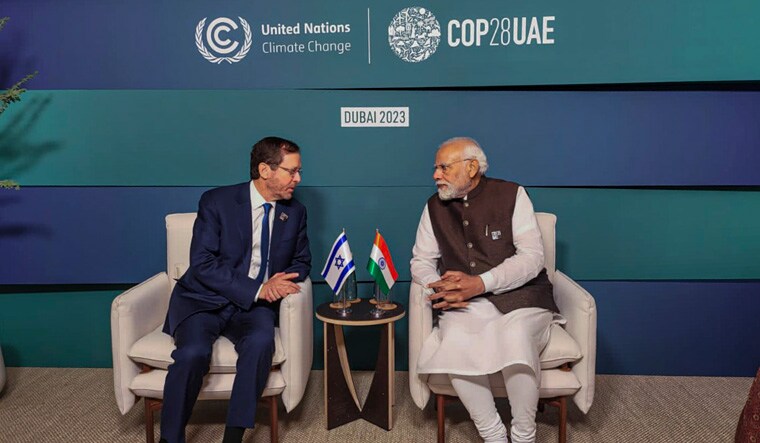
The gaze has shifted to Gaza. Prime Minister Narendra Modi raised “early and durable resolution” for the Israel-Hamas conflict through diplomacy and dialogue with Israeli President Isaac Herzog on the sidelines of the COP 28 summit on Friday.
India batted for the two-state solution to Israel spelling out a position long held—the optics of the situation matter, especially as it is their first meeting after the attack on October 7. It also comes at the backdrop of the virtual BRICS meeting called by President Cyril Ramaphosa on November 21. The summit was attended by Egypt, Ethiopia, Argentina, Iran, Saudi Arabia and the UAE. But Modi did not attend, which was seen as a signal for Israel. India was represented by the External Affairs Minister S. Jaishankar. India’s top diplomat at the BRICS summit had done the same. Jaishankar batted for humanitarian aid to Gaza but also added that “hostage-taking is equally unacceptable and cannot be condoned”.
On Friday, Modi however "reiterated the need for continued and safe delivery of humanitarian aid for the affected population." "He emphasised on India’s support for a two-state solution and early and durable resolution of Israel-Palestine issue through dialogue and diplomacy,’’ said Arindam Bagchi, spokesperson of the ministry of external affairs.
But Modi ensured that he kept the balance by expressing his condolences on the loss of lives in the “October 7 terror attacks and welcomed the release of hostages’’.
This is a fine balance India has maintained. Especially at a time when China is being wooed by the Arab countries to put pressure. The delegation is also likely to visit India but no date has been fixed. Beijing, however, was number one.
On November 20, a delegation of Saudi Arabia, Egypt, Indonesia, Palestinian Authority and Organisation of Islamic Cooperation visited Beijing to “exert pressure to launch a serious political process to achieve lasting comprehensive peace.” The delegation was also pushing for an immediate ceasefire—which was brokered for a few days by Qatar later.
China’s top diplomat Wang Yi has been quoted as saying China is a “good friend and brother of Arab and Muslim countries," adding it has "always firmly supported the just cause of the Palestinian people to restore their legitimate national rights and interests."
Unlike India, China has chosen to read from the same script as the rest of the 100 odd countries of the Global South. The Gaza conflict is different from India’s position on Ukraine—where India echoed the same language of the Global South—the position with Palestine for India is a little more nuanced. "We all are witnessing that new challenges are emerging from the events in the West Asia region," said Modi.
The other countries like South Africa, Maldives and Brazil have firmly been on the Palestinian side. South Africa, a long time supporter of the Palestinian cause, has called for an immediate cease fire. India has maintained the two-state solution, but abstained from the United Nations vote in October for a ceasefire.
He stressed that India had denounced what he described as the "heinous terrorist attack" on Israel but also "pushed for dialogue and diplomacy, along with restraint." It is this sort of balancing act that India has perfected.
