



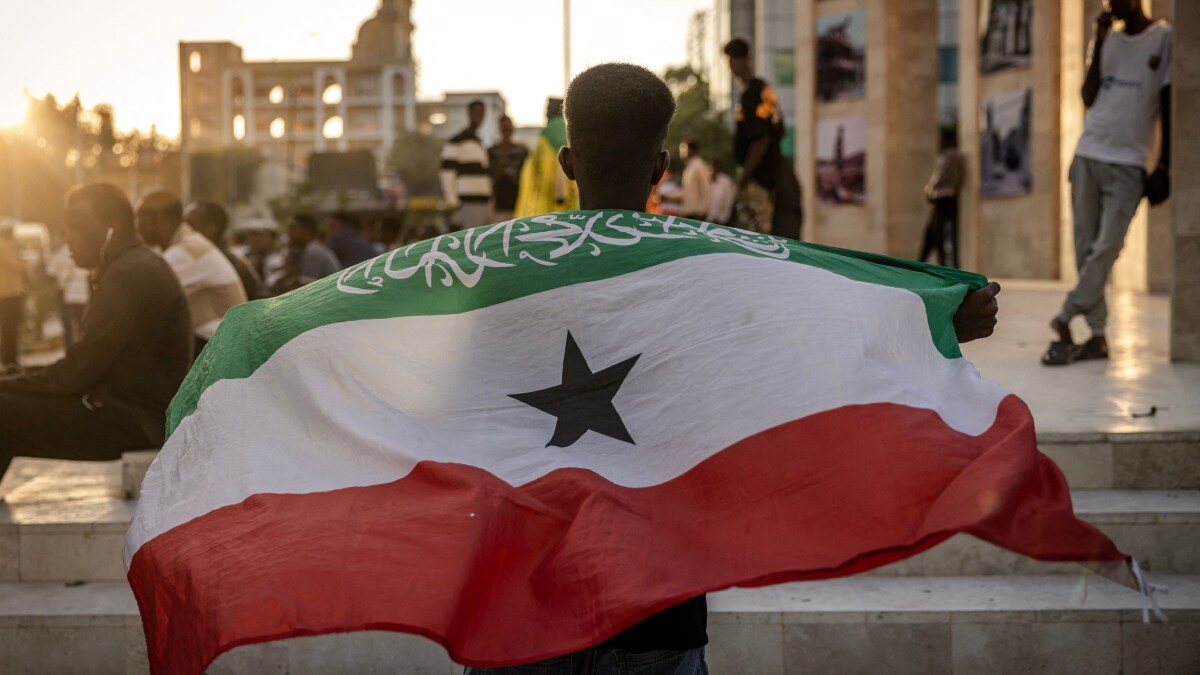
Israel has formally recognised the breakaway region of Somaliland as an independent and sovereign state, a move that represents a major diplomatic shift in the Horn of Africa. The announcement was made yesterday by Prime Minister Benjamin Netanyahu and Foreign Minister Gideon Sa’ar, making Israel the first country in the world to grant official recognition to Somaliland since it declared independence from Somalia in 1991. The decision sparked celebrations in Somaliland, anger in Somalia and swift condemnation from regional organisations including the Arab League, the Gulf Cooperation Council and the African Union.
Following the announcement, Israel and Somaliland signed a joint declaration establishing full diplomatic relations. The agreement provides for the opening of embassies and the exchange of ambassadors. Israeli officials said the step followed more than a year of intensive discussions and was carried out in the spirit of the Abraham Accords, the US-brokered agreements launched in 2020 that normalised relations between Israel and several Arab states.
Netanyahu held a video call with Somaliland’s President Abdirahman Mohamed Abdullahi, widely known as Cirro, during which he praised his leadership and invited him to visit Israel. Both leaders pledged to expand cooperation immediately in areas including agriculture, technology, healthcare and trade. Abdullahi described the recognition as a historic moment and said Somaliland was ready to join the Abraham Accords, presenting the move as a contribution to regional and global peace.
Somaliland lies in northwestern Somalia along the Gulf of Aden and was formerly a British protectorate. It declared independence in 1991 after the collapse of Somalia’s central government and years of devastating civil war. For more than three decades it has functioned as a de facto state with its own elected government, parliament, police force, currency and travel documents. Despite maintaining relative stability and a functioning democratic system compared with much of southern Somalia, Somaliland had failed to secure recognition from any United Nations member state before Israel’s decision.
Somaliland’s leaders hope the recognition could encourage other countries to follow, rewarding its long record of internal peace and political development. It could open access to international markets, investment and financial institutions. Critics, however, warn that it could embolden other separatist movements.
For Israel, the move helps expand its diplomatic presence in Africa and offers a foothold at one of the world’s most sensitive maritime corridors as Somaliland borders Djibouti and Ethiopia and lies next to the Bab el-Mandeb Strait, a vital shipping lane linking the Red Sea with the Gulf of Aden. It is also close to Yemen, improving its strategic options against the Houthis. Somaliland already hosts a military base operated by the United Arab Emirates, itself a signatory to the Abraham Accords, which has used the facility to support its operations in Yemen.
The Somali federal government reacted with fury. Prime minister Hamza Abdi Barre categorically rejected Israel’s recognition, calling it a deliberate attack on Somalia’s sovereignty and a violation of international law. Mogadishu regards Somaliland as an inseparable part of Somalia and considers any direct engagement with its authorities to be an infringement on the country’s territorial integrity.
The Arab League described the recognition as a flagrant infringement of Somalia’s sovereignty while the Gulf Cooperation Council warned it could undermine stability across the Horn of Africa. The African Union also rejected the move, cautioning that attempts to weaken Somalia’s unity could have far-reaching consequences for peace and security on the continent.
The foreign ministers of Egypt, Turkey and Djibouti held consultations with Somalia’s leadership to coordinate a response and present a united front. They condemned the recognition as a breach of the UN Charter and warned against the creation of parallel political entities. Turkey went further, characterising Israel’s action as interference in Somalia’s internal affairs and aligning it with what it described as expansionist policies. Several of these countries used the moment to reiterate their opposition to any proposals to displace Palestinians, referring to earlier reports, denied by all parties, that recognition might be linked to resettlement plans involving Gaza.
The decision has also sharpened existing geopolitical rivalries in the Horn of Africa. Ethiopia has recently sought access to the sea through an agreement with Somaliland, a move that has already inflamed tensions with Somalia.
The United States finds itself in an awkward position. While the Trump administration is worried that recognising Somaliland could jeopardise security cooperation with Somalia against Al-Shabaab terrorist group, several prominent Republicans have openly supported recognition. Senator Ted Cruz and others have argued that Somaliland is a reliable partner of Israel. During his presidential campaign, Donald Trump had described the issue as complex but indicated it was under consideration, while a conservative policy blueprint known as Project 2025 has recommended recognising Somaliland as a counterweight to growing Chinese influence in Djibouti.
By recognising Somaliland, Israel has upended a long-standing diplomatic consensus. The move offers Somaliland its first taste of international legitimacy and gives Israel strategic depth near the Red Sea, but it also risks deepening Israel’s isolation from influential regional players such as Turkey and Egypt and reignites sensitive debates over borders and sovereignty in Africa.
