



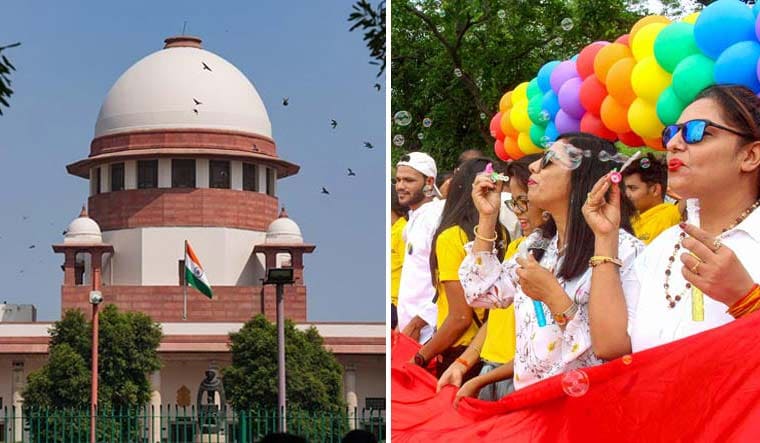
The Supreme Court will deliver on Tuesday the historic verdict on the pleas seeking legal validation for same-sex marriage. A five-judge constitution bench headed by Chief Justice D Y Chandrachud had on May 11 reserved its verdict on the pleas after a marathon hearing of 10 days.
The other members of the bench are Justices Sanjay Kishan Kaul, S Ravindra Bhat, Hima Kohli and P S Narasimha. The judgement will be delivered on Tuesday around 10:30 am.
Here are some key highlights from the hearing:
Case confined to the Special Marriage Act 1954: The SC has already clarified that it will not deal with the Hindu Marriage Act or personal laws despite the petitions collectively challenging the provisions of the Special Marriage Act 1954, Hindu Marriage Act 1955, and the Foreign Marriage Act 1969.
Grounds of maintainability: The Centre urged the Apex Court to dismiss the batch of petitions on grounds of maintainability, arguing that marriage is a socio-legal institution and could only be created, recognised, and regulated by the competent legislative body under Article 246 of the Indian Constitution. Chief Justice DY Chandrachud questioned the validity of this objection, emphasising that its nature depended on the case presented by the petitioners.
Views Of "Urban Elitists": The Centre had argued that marriage was "an exclusively heterogenous institution" and argued that those seeking marriage equality in India merely represent "urban elitist views for the purpose of social acceptance". The court disagreed, stating that it could not dub homosexuality and the idea of marriage equality as an "urban elitist," especially in the absence of any data to back this claim.
Gender fluidity: The court witnessed discussions on gender as the Solicitor General of India Tushar Mehta argued that biological gender defined a person's gender. This was in the context of the Special Marriage Act using the words "man" and "woman". The CJI challenged this notion, stating that the concepts of a biological man and woman were not absolute. He said it was not the question of what your genitals are. "So even when Special Marriage Act says man and woman, the very notion of a man and a woman is not an absolute based on genitals."
British Victorian morality: The Supreme Court said Indian culture had a long history of inclusivity and was inherently diverse and inclusive. It was the influence of British Victorian morality that influenced the exclusion of queer individuals.
Bar Council of India intervention: The Bar Council of India requested the Supreme Court to leave the issue of same-sex marriage to the legislative process. They argued that marriage had traditionally been viewed as a union between a biological man and woman, with procreation and recreation as its primary purpose. It further added that the legislature was better at dealing with the sensitive issue as it reflects the will of the people.
Rights for same-sex couples: The Centre told the court it will constitute a committee to examine the administrative steps that could be taken to address "genuine humane concerns" of same-sex couples without going into the issue of legalising their marriage. This came as the SC asked the Centre whether social welfare benefits like opening joint bank accounts, nominating life partner in provident funds, gratuity and pension schemes can be extended to same-sex couples without going into the issue of legal sanction to their marriage.
States respond: The Centre had also told the court it had received responses from seven states on the issue of same-sex marriage and the governments of Rajasthan, Andhra Pradesh and Assam had opposed the petitioners' contention seeking legal endorsement for such wedlock.
Gender-neutral terms: Inserting gender-neutral terms in the Special Marriage Act was also considered. This resulted in another conundrum as to which partner would be aged 18 years and who would be 21 years old.
(With inputs from Live Law)
