



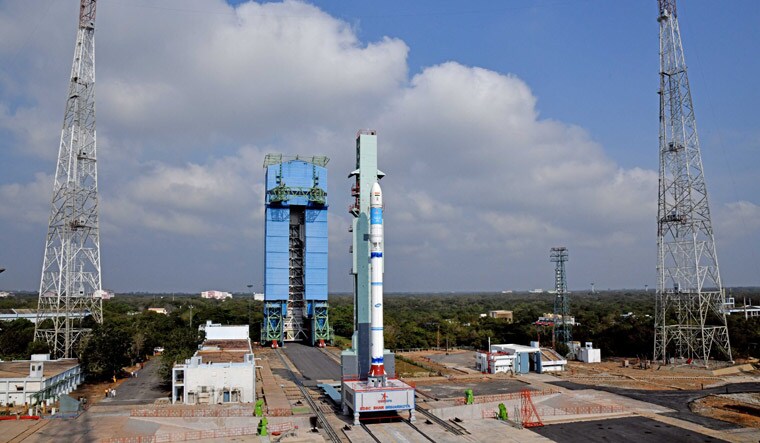
In a big boost to India's space sector, Indian Space Research Organisation (ISRO) has successfully launched Small Satellite Launch Vehicle (SSLV) D2 carrying EOS-07 satellite and two co-passenger payloads on Friday. This was ISRO's maiden mission this year that lifted off from Satish Dhawan Space Centre at Sriharikota.
In its second demonstrator flight, LV D2 carried EOS-07, an earth observation satellite as its main payload and two others—Janus-1 built by US-based Antaris and Chennai-headquartered Space Kidz India's AzaadiSAT-2.
While speaking on the occasion, ISRO chief said that the problems with SSLV-D1 was analysed and they have worked to ensure that the second attempt was successful. “ Congratulations to all 3 satellite teams for making the satellites as well as placing them in right orbit. We analysed the problems faced in SSLV-D1, identified corrective actions and implemented them at a very fast pace to ensure the vehicle becomes successful this time,” said ISRO chief S. Somanath.
At the end of a six and a half hour countdown, the 34-metre tall rocket lifted off from the Satish Dhawan Space Centre here, even as ISRO has pinned hopes on it to lead the space agency to success in tapping the small satellite launch vehicle market.
The maiden flight of LV on August 7, 2022 was a partial failure due to an orbit anomaly and deviation in the flight path of the rocket. LV caters to the launch of up to 500 kg satellites to low earth orbits on 'launch-on-demand' basis. It provides low-cost access to space, offers low turn-around time and flexibility in accommodating multiple satellites, and demands minimal launch infrastructure.
EOS-07 is a 156.3 kg satellite which has been designed, developed and realised by ISRO. New experiments include mm-Wave Humidity Sounder and Spectrum Monitoring Payload.
While, Janus-1 is a 10.2 kg satellite, the 8.7 kg AzaadiSAT-2 is a combined effort of about 750 girl students across India guided by Space Kidz India, Chennai.
The mission objective is to inject these satellites in a 450-km circular orbit.
(With PTI inputs)
