



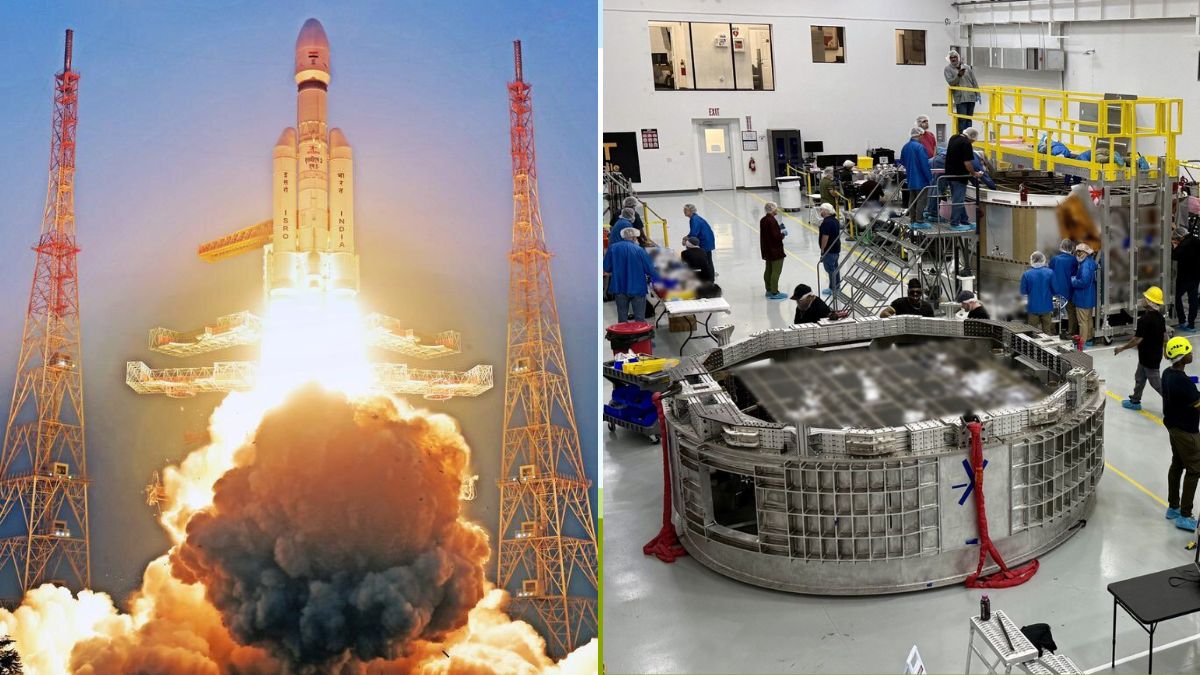
Imagine living in a remote village where mobile signals are weak or don't exist at all. No internet to watch videos, attend online classes, or talk to loved ones.
Now picture a giant satellite hovering above the Earth, beaming strong internet directly to your ordinary phone—no towers, no extra gadgets needed. Sounds like magic, right? Well, that's exactly what's happening on December 15, when India's mighty LVM3 rocket, affectionately called 'Bahubali', will launch an American satellite named BlueBird-6 from Sriharikota.
This isn't just any satellite: it weighs a massive 6.5 tonnes, roughly equal to a fully grown elephant, making it the heaviest American commercial satellite India has ever launched.
This signals India’s graduation into the world’s limited circle of reliable heavy-lift launch providers at a time when global space infrastructure is undergoing its most consequential transformation since the Cold War.
Interestingly, it comes at a geopolitical moment in which India and the United States are managing new tariff disputes, even as their cooperation in strategic technology sectors accelerates.
The trajectory of this single satellite from a Texas production line to a launchpad at Sriharikota captures multiple stories unfolding simultaneously: the rise of heavy Low Earth Orbit (LEO) broadband payloads, the growing dependence of US NewSpace ventures on diversified global launch options, and India’s expanding role as a stable space partner despite economic headwinds.
BlueBird-6 belongs to a new class of massive LEO satellites. Built by AST SpaceMobile, it weighs around 6,500kg and carries a staggering 2,400-square-foot deployable phased-array antenna—the largest commercial communications array ever flown in a LEO.
Unlike conventional satellites serving dishes and terminals, BlueBird-6 aims directly at ordinary mobile handsets, providing 4G/5G connectivity to users without special hardware. This shift to direct-to-device architecture requires unprecedented antenna area, power, and data handling, pushing the mass of these satellites into a territory once reserved for geostationary giants.
With ten times the capacity of its earlier counterparts, BlueBird-6 represents a clear indication of the evolving economics of broadband in orbit: the more data a single satellite can push, the more viable the constellation business model becomes. It is this combination of mass, complexity, and commercial value that makes the mission a milestone for ISRO’s LVM3 rocket—it is the heaviest payload the vehicle has carried to date.
The LVM3 rocket itself is a marvel. Standing 45.5m tall with three powerful stages, it can carry up to 8 tonnes into LEO.
Just last month on November 2, it successfully launched the CMS-3, India's own heaviest communication satellite weighing 4.4 tonnes. This same rocket will also carry Indian astronauts to space during the Gaganyaan mission planned for 2027.
AST SpaceMobile is LVM3's second major satellite broadband customer after Eutelsat OneWeb, proving India's growing reputation in commercial space launches.
“Most satellites at similar heights, like Elon Musk's Starlink satellites, weigh only 1-1.5 tonnes. The heaviest commercial satellites ever built, like Jupiter-3 at 9.2 tonnes, orbit much farther away at 36,000km in geostationary orbit. But in the Low-Earth Orbit, where BlueBird-6 will be positioned (at just 500-700km height) for faster signals, such heavyweight satellites are rare and difficult to launch. This makes the BlueBird-6 a true heavyweight champion, and launching it successfully showcases ISRO's incredible engineering strength,” explained space analyst Girish Linganna.
At the moment, service won't be continuous everywhere. You'll get signals only when a satellite passes over your area, like a bus route in the sky.
However, AST SpaceMobile has big plans. They're aiming to launch five such giant satellites by early 2026, and 45-60 by the end of that year, with launches happening every month or two. More satellites mean better, more reliable coverage turning occasional signals into constant ones. This could be life-changing for millions living in underserved areas, helping bridge the digital divide and bringing opportunities that many of us take for granted.
“This satellite is a huge upgrade from its earlier siblings. AST SpaceMobile had already sent five smaller BlueBird satellites before, but BlueBird-6 is the first of a new, improved "Block-2" version. It's 3.5 times bigger in design and can handle ten times more data than the previous ones," Linganna pointed out.
"Each BlueBird satellite can manage up to 10,000 MHz of bandwidth—that's tech-speak for super-fast internet capable of handling thousands of phone calls, video streams, and downloads simultaneously. The clever part is how it works with existing mobile networks. Companies like Vodafone, AT&T, or Airtel partner with AST SpaceMobile, sharing their licensed radio frequencies. So when you're in a signal-dead zone, BlueBird satellites act like invisible towers in the sky, filling the gap,” he added.
To understand why this matters, BlueBird-6 must be viewed in context of the worldwide heavy-lift ecosystem.
As of 2025, only a handful of agencies and companies operate rockets capable of lifting more than five tonnes to LEO. SpaceX leads with Falcon Heavy, capable of 63.8 tonnes to LEO and over 26 tonnes to a Geostationary Transfer Orbit (GTO)—an unmatched capacity that has enabled the rapid assembly of the Starlink megaconstellation and a series of deep-space missions.
China’s Long March 5, capable of 25 tonnes to LEO, anchors the Chang’e lunar programme and carried the Zhurong rover to Mars, giving China autonomous access to both the Moon and Mars: an exclusivity historically held only by the United States and the former Soviet Union.
Emergent systems like Blue Origin’s New Glenn, with a 45-tonne LEO capacity, are poised to challenge SpaceX’s dominance, while the US government relies increasingly on the Vulcan Centaur, which replaces the recently retired Delta IV Heavy and supports military payloads once reserved for the most secretive intelligence satellites in the world.
“Europe once led the commercial market with Ariane 5, which retired in 2023 after 117 successes, culminating in its flawless launch of the James Webb Space Telescope. Its successor, Ariane 6, carries forward Europe’s need for autonomy in orbit, especially as the EU prepares its IRIS2 sovereign broadband constellation. Russia’s Proton-M, with its long lineage and over 400 launches across variants since 1965, continues to loft heavy geostationary satellites even as sanctions shrink its commercial footprint," explained Srimathy Kesan, the founder and CEO of SpaceKidz India.
"Japan’s H-IIA and new H3 systems, although less discussed, remain essential to regional missions. In this small club, India’s LVM3 occupies a sweet spot: it is not as powerful as the American or Chinese giants, but is highly reliable, sharply priced, and increasingly recognised for mission assurance qualities that are attracting new-age commercial customers such as OneWeb and now AST SpaceMobile,” Kesan added.
Heavy launch vehicles were originally built for a very different eras of purpose. In the Shuttle era, the world’s first reusable heavy system deployed Hubble, built the International Space Station, and returned satellites to Earth for repair.
In the 1990s and 2000s, the heavy-lift race centred on commercial communications—especially dual-launch GEO satellites for television and broadband—where Ariane 5 became the workhorse of the world.
The US Delta IV Heavy carved out a niche transporting enormous classified payloads and optical reconnaissance satellites weighing up to 15 tonnes to unique, high-energy orbits. Russia’s Proton-M became synonymous with vast national broadcast networks and state telecommunications constellations.
The impact of heavy-lift missions is visible across multiple dimensions.
“In 2025 alone, the world saw nearly 300 orbital launch attempts—the highest-ever recorded—and heavy-lift vehicles accounted for nearly two-thirds of the total mass delivered to orbit.
They are essential for enabling the explosive growth of broadband markets, with the satellite megaconstellation sector projected to expand from $5.5 billion in 2025 to over $27 billion by 2032,” Kesan noted.
