


 Add as a preferred source on Google

I first discovered my love of writing because of a humble breakfast food called the idli. I was given the topic ‘My favourite food’ during an extempore competition in the third standard. For the next five minutes, I waxed eloquent about the idli as though it was man’s greatest discovery after electricity. The idli won me my first accolade in school—the second prize for extempore—and became the opening act to my future: a career in writing.
The idli was not the only discovery that day. I also discovered another skill—the ability to faff without any foundation in fact, logic or knowledge. I realised I could write flowery essays in my English composition class on anything from the Cold War to colonial rule, without knowing anything about Soviet communism or the British crown. I could write about Bill Clinton’s impeachment bid from the tabloid tidbits on infidelity I had gleaned from Seventeen magazine. I could write about the historic sinking of the Titanic after watching Kate Winslet and Leonardo DiCaprio share a steamy kiss in the Oscar-winning movie. Composition (which was also called ‘free writing’) was my favourite class. There was a vast gulf between my writing and my actual persona. In person, I was timid, reserved and my speech had a way of sputtering like a car with a faulty engine. I wrote, however, with the confidence of a femme fatale.
English was the only subject I scored above 90 per cent in my 10th boards. But after I left school, my confidence began to flounder. What I thought was razzmatazz in my writing slowly turned into rubbish. I blame two Stanford PhD students for this—Larry Page and Sergey Brin.
Operating out of a Californian garage, they invented a search engine with a funny name that did some serious damage to my writing. When Google became commonplace, so did my writing. I began leaning on it too much and my free writing was no longer free. Today, I can’t write a paragraph without checking Google at least once. I use it to ideate, research and fact-check. Now, I wonder how I could ever have written whole essays without the help of technology. Once upon a time, I could pull out a composition from my imagination like a rabbit out of a top hat. Today, it is a constant tug-of-war between me and my imagination, with the latter not yielding a single word without some serious grovelling on my part.
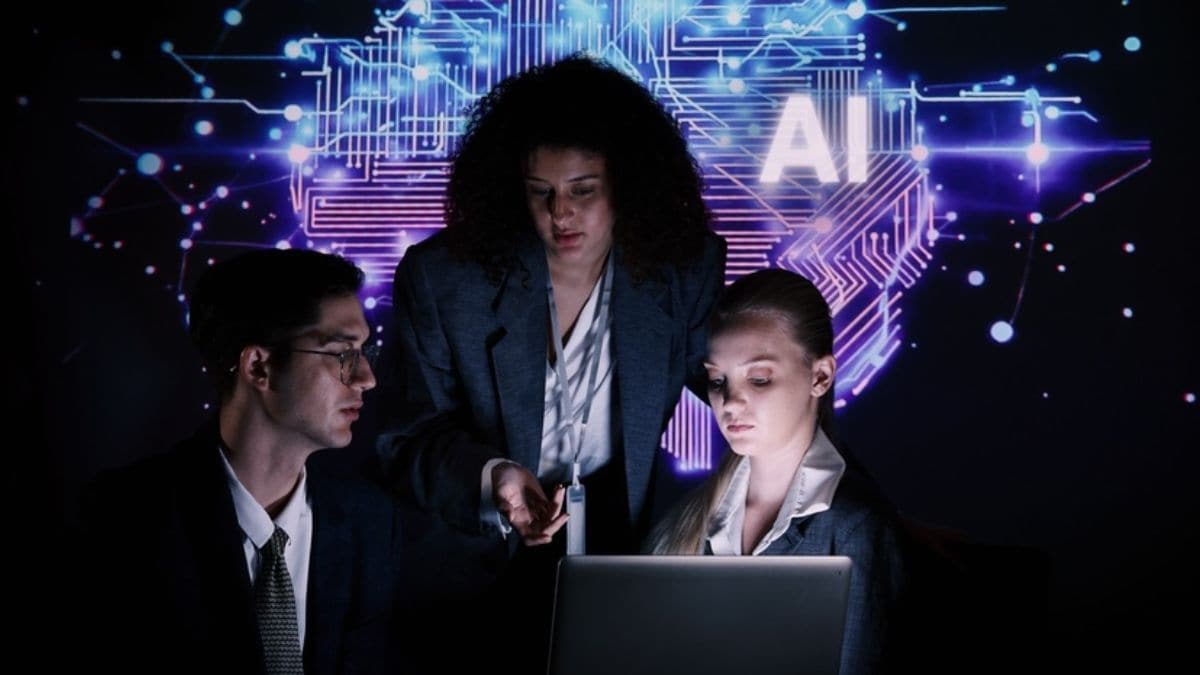
But at least, I comfort myself, I have a Google-free childhood to hold on to. Today’s children not only lack that, but they also have to contend with something ten times worse: AI. If Google was the non-interfering employee that you had to nudge in the right direction, AI is that pain-in-the-neck worker who nudges you in what it decides is the right direction. It doesn’t hand-hold you through your writing; it takes the pen and starts writing itself. Uncles who could not spell ‘umbrella’ are now writing doctrinal theses on the variability of the Indian monsoon. Wedding invitation cards are written with a flair and flourish that their senders clearly don’t possess. Roadside Romeos have become accomplished flirts, sending sonnets to their lady loves that could make a Mills & Boon writer blush.
So, if Google can leave my imagination shaken and stirred, can AI slurp it down bottom’s up? Can ChatGPT kill my creativity? In a recent study, researchers combed through 3,70,000 college admissions essays from before and after the release of ChatGPT in 2022. They discovered that the essays submitted after 2022 were written more creatively, but offered less creative ideas. They concluded that AI could adversely impact our creativity. “It used to be that people could navigate on their own and had a lot of spatial cognitive abilities,” said neuroscientist and one of the researchers, Adam Grant. “GPS has totally changed that, and people cannot navigate without their phone or GPS. As people have lost this spatial ability, it is very likely they’re losing more general cognitive abilities.”
If this happened, it would be a pity indeed. But I still have hope for humankind. According to Daniel Gilbert, writer of the fascinating book Stumbling On Happiness (winner of the Royal Society Science prize), the most creative things man has invented have been because of the brain’s prefrontal cortex, the region responsible for planning the future. Those involved in accidents that damage the prefrontal cortex retain their memory, concentration and other cognitive skills, but lack the ability to plan. If you ask them what they want to do tomorrow, they will stare at you blankly. They’re trapped in a permanent present. Our ability to create is closely tied with our ability to imagine a future that has not yet come into being.
“If you were asked to name the human brain’s greatest achievement, you might think first of the impressive artefacts it has produced—the Great Pyramid of Giza, the International Space Station or perhaps the Golden Gate Bridge,” writes Gilbert. “But they are not the greatest. A sophisticated machine (think AI) could design and build any one of these things because designing and building require knowledge, logic and patience, of which sophisticated machines have plenty. In fact, there’s really only one achievement so remarkable that even the most sophisticated machine cannot pretend to have accomplished it, and that achievement is conscious experience. Seeing the Great Pyramid or remembering the Golden Gate or imagining the Space Station are far more remarkable acts than is building any one of them.”
And this, in the final reckoning, is where we leave our Frankenstein’s monster behind. AI can create, but it lacks the urge to create. AI creates in response to a command; humans create in response to a compulsion. As long as we are the first movers in imagining our future into existence, we have hope.
Will AI one day take this over? Will it start appreciating its own essay on the variability of the Indian monsoon and submit it to the Queen’s Commonwealth Essay Competition (leaving those poor uncles in the lurch)? I don’t know. But one thing I know for sure: I’m not going to ask ChatGPT.
The opinions expressed in this article are those of the author and do not purport to reflect the opinions or views of THE WEEK.
