



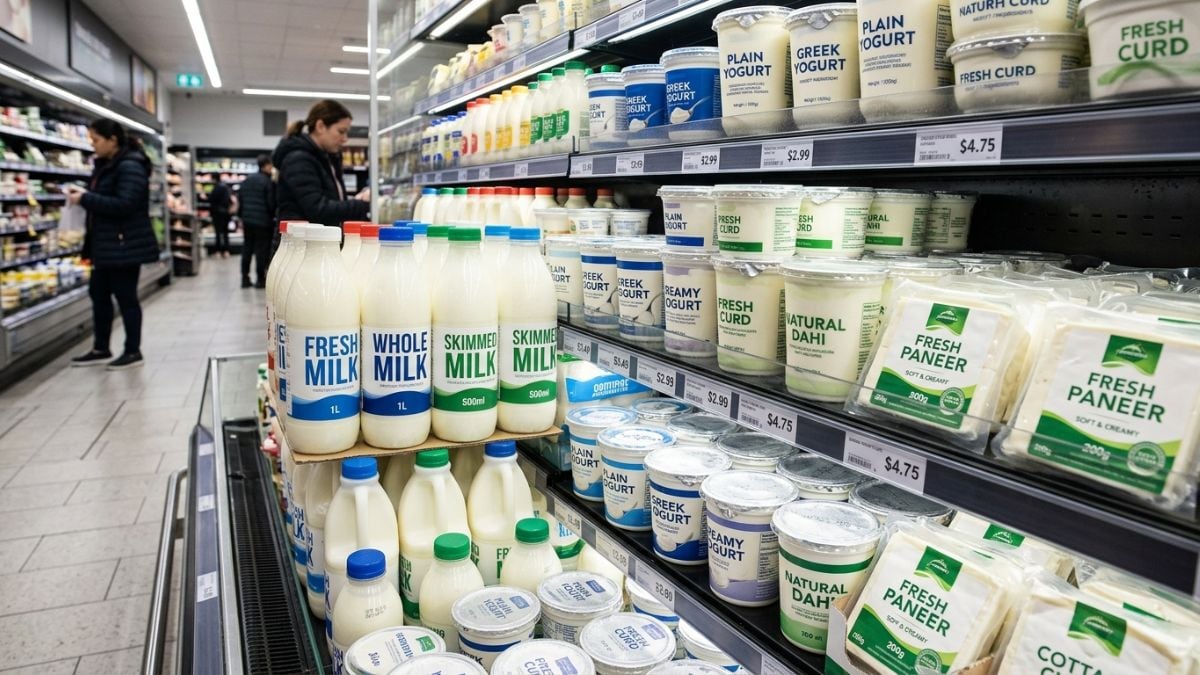
Food adulteration data should worry everyone, not just individual consumers. Government data cited in Parliament shows that roughly one in four food samples tested in India between 2014 and 2026 failed to meet safety standards. Around 71 per cent of tested milk samples showed the presence of urea and 64 per cent of the samples contained neutralisers.
This is particularly concerning because milk and dairy products form the base for everyday staples such as paneer and curd, which are widely consumed in offices, hospitals and campuses.
We are also witnessing chemically substituted copies of staple food products such as paneer. Popularly referred to as analogue paneer, these artificial copies contain high quantities of palm oil, while the calcium and protein content is usually just a fraction of that found in natural paneer.
Nutritional value is further impacted by manual adulteration, with oils often mixed with cheaper substitutes and vegetables treated with oxytocin and copper sulfate. These adulterations can pose serious health risks, including cardiovascular risks, type 2 diabetes, obesity, and nutritional deficiencies.
In an institutional setting, where a single vendor or procurement decision can affect thousands of meals a day, the potential impact is significantly amplified.
The larger industry shift needs to be toward proactive checks, stronger accountability, and greater traceability at the procurement stage itself. This means verified sourcing, batch-level documentation, and regular third-party laboratory testing. The focus should be on preventing adulteration at the source, rather than waiting for it to be identified through inspections or enforcement action.
Food safety has to begin much earlier, with what is procured, from whom, and how it moves through the supply chain. That is becoming increasingly important as India’s food ecosystem faces greater scrutiny around adulteration, ingredient substitution, and authenticity.
The recent regulatory action around analogue paneer is a timely reminder of why this matters. Maharashtra introduced a one-year statewide ban on analogue paneer from July 30, covering its manufacture, processing, packaging, storage, transportation and sale. Gujarat, Chhattisgarh and Madhya Pradesh have also moved towards bans.
The Maharashtra action followed a year-long surveillance drive in which the state FDA found 35.4 per cent of food samples collected during routine inspections to be non-compliant, despite repeated inspections and awareness campaigns. The shift from disclosure to prohibition sends an important message: labels alone cannot create trust when visibility across the food chain is limited.
It raises a larger question for the food industry: can we build consumer trust when visibility across the food chain remains limited?
Analogue products are not inherently unsafe or illegal. FSSAI recognises products where milk fat or protein is partly or wholly replaced by non-milk constituents. The concern arises when substitution is not adequately disclosed, and consumers receive something materially different from what they are ordering.
Last year, 40,023 of 2,23,808 food samples analysed were found to be non-conforming — roughly one in five. This does not mean that every non-conforming sample was unsafe. But it does highlight a fundamental limitation of relying primarily on labels and end-point inspections: by the time an issue is identified, it may already have travelled much further down the supply chain.
For institutional food services, where thousands of meals may be prepared and served daily, this becomes both a food-safety and business challenge. India’s catering services market, valued at $5.3 billion in 2025, is projected to reach $7.7 billion by 2034. At this scale, a single procurement failure can have implications far beyond one kitchen.
Businesses therefore need greater visibility before ingredients reach the plate: supplier verification, defined quality standards, valid licences and test reports, batch and invoice records, temperature monitoring, stock rotation and regular audits.
Technology could help. A digital trail can link an ingredient to its supplier, batch, invoice and destination kitchen. Inventory systems can help monitor stock movement and rotation. Temperature monitoring can flag deviations in storage and handling. Digital audits can identify recurring gaps, while consumer feedback can help organisations spot patterns that may not be visible through individual inspections.
Together, these systems create something that is increasingly valuable in large-scale food operations: a clear chain of accountability.
And that accountability matters not only when something goes wrong. It is about knowing what happened, where it happened and how quickly an organisation can act when something does not look right.
At scale, that visibility is what allows businesses to move from reactive problem-solving to proactive risk management—and from simply meeting standards to consistently delivering them.
Because ultimately, food safety is a promise. Every meal served carries an implicit assurance that what is being served is what was intended, that it has been handled responsibly, and that the organisation serving it is willing to stand behind it.
The author is co-founder & CEO of HungerBox, an institutional food technology company
The opinions expressed in this article are those of the author and do not purport to reflect the opinions or views of THE WEEK.
