



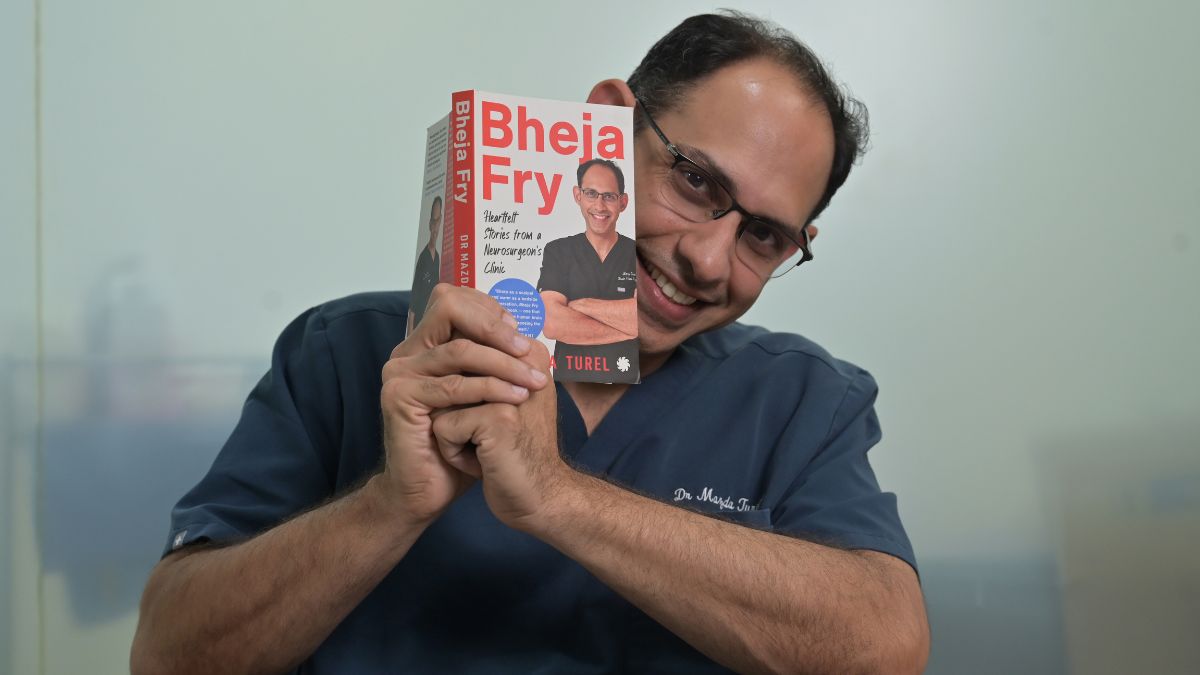
It is rare to have clarity of purpose. Some people are born with it. How else could George Orwell, at five years or so, know for certain that he should be a writer once he grew up? That is also when he wrote his first poem. “I cannot remember anything about it except that it was about a tiger and the tiger had ‘chair-like teeth’—a good enough phrase—but I fancy the poem was a plagiarism of Blake’s ‘Tiger, Tiger’,” writes Orwell in his essay ‘Why I Write’.
Mazda Turel had his ‘Orwellian’ moment at eight. And he wanted to wield a scalpel, not a pen, having watched his neurosurgeon father “operate with an artist’s patience”. His penmanship would show up in the Happy New Year email to his friends. They nudged him to get serious about writing, and so he started writing a column, mostly about his travels, in Jam-e-Jamshed, a Parsi newspaper. Meanwhile, he did his MBBS from Grant Medical College in Mumbai and his residency at the Christian Medical College in Vellore, where he earned the rare Jacob Chandy Gold Medal.
He travelled to Toronto, Chicago and Shanghai for advanced fellowships before coming back to Mumbai. And then the editor of Mid-day, a Mumbai daily, told him to write a series of columns that would give readers an entry into the world of medicine, without sugar-coating the truth. His columns found a loyal readership, and people started pestering him to write a book. And thus was born Bheja Fry: Heartfelt Stories from a Neurosurgeon’s Clinic, a compilation of his Mid-Day columns.
In a conversation with THE WEEK, Turel, consultant neurosurgeon at Wockhardt Hospitals, Mumbai, talks about what writing means to him and why he is in awe of the wonderful organ he operates on.
Excerpts:
Q: What does writing mean to you?
A: It gives me a lot of insight into patients’ lives. It is a catharsis of sorts. It gives you an understanding or a reflection of what you have done. It allows you to express your thoughts and feelings. It allows you to look back at a case and see if you could have done something differently. It allows you to introspect. It allows you to wonder. It allows you to challenge yourself. And it always allows you to try and get better for the next patient, in the hope that you can serve them a little better, be kinder... more compassionate. So when you put all those thoughts down on paper, it gives you a very holistic view of what you have really dealt with that one particular patient. It opens up a Pandora’s box of thoughts, feelings, emotions, and just helps you get a little better for the next patient.
Q: What has years of peeping into other people's brains revealed? What has it revealed to you about yourself?
A: More than about myself, it has revealed to me about what the human brain and the human mind are capable of. You know, this little beautiful three-pound mass of jelly that you can hold in the palm of your hand, is so soft and so gentle, and yet it has so much resilience, so much strength, so much of an ability to withstand the unsurmountable odds that someone goes through.
To withstand surgery after surgery, radiation after radiation, chemotherapy after chemotherapy, to come out stronger after an accident, to be victorious over a deadly infection, to be able to really sometimes unexpectedly even defeat biology and come out victorious. And it just shows us what the human spirit is capable of, and the seat of that beautiful spirit is the mind, the brain. You may be able to talk about them either in unison or separately, but it is this one space that makes us who we are. And that is the beauty of this wonderful organ I am so in awe of.
Q: You say that neurosurgery does not merely test intelligence; it also tests stamina, faith, insomnia, bone marrow and occasionally sanity. How have you kept your sanity?
A: Yes, sometimes the things we do can drive us insane. Sometimes complications can make us think and put us in a shell. Sometimes the unexpected happens—we operate on two patients with the exact same anatomy, we do the exact same operation, and they have a completely different outcome. So, you have to be grounded, and you have to be safe. And what really maintains my sanity is that I have a great social network. I have great friends to fall back on, a great family. I love the outdoors. So I go trekking. I go climbing. I love culture—I am a big buff of theatre and music. I like to surround myself with the arts in any form. So that really keeps me on top of the surface and prevents me from drowning.
Q: You also write that the illusion of closure is a myth, that how a patient leaves always stays with you. How do you move on then?
A: You just put one foot in front of the other and move on. Acceptance is what allows you to do that. You have to accept that you have given your best, your very best. There is not a spot that you have left unturned. There is nothing that you would have done differently. And when you have that conscience, probably after a few weeks or a few months, you can sleep back again. And it is like reaching the summit of a mountain—you just have to put one foot in front of the next, even if it is hard to breathe, even if it is biting cold around you, even if you think that you are not going to make it. You just have to keep at it, with the motto being never to give up.
Q: We are talking about loss, but the buzzword is longevity. What is your take on that?
A: Science is allowing us to live healthier lives, giving us answers to questions we have only speculated, and everybody is jumping in on the bandwagon. Longevity, for me, instead of just a longer lifespan, should mean a longer health span. We can achieve that, with the right amount of diet, correct exercise, sleep, and a good social framework; all of that is what helps us really live fuller, richer and healthier lives.
Q: Ever got a God complex?
A: They ask, ‘What's the difference between God and a neurosurgeon?’ And we say that God doesn't think he is a neurosurgeon.
I don't think any doctor in their sane mind can have a God complex because we all know that medicine is a great leveller—once you think you are above everything, you will have your next complication, and not only will it raze you to the ground, but it will bury you. So I think it is good for the movies. I know there is an Alec Baldwin movie.... I think the movie is called Malice, where he is being interrogated by an attorney for having wrongly removed an ovary for a patient, and the lawyer asks him do you think you have a God complex and he says, "I don't think I have a god complex, I am god...." But this is the cinematic view and appeal of doctors and especially neurosurgeons who, for some fallacious reason, are considered to be at the top of the medical totem pole. I don't believe in that at all. It is amusing to a great extent.
Q: What about imposter syndrome?
A: When you don't personally follow the advice that you give people, you might feel like a fraud on occasion.
Q: Unlike some doctors, you have been quite accommodating of people's beliefs even when they border on superstition. How do you come to terms with people's superstitions and faith in alternative medicine?
A: India is a country that is so deeply rooted in belief systems, and it would be only fair to try to accommodate these patients instead of shunning them because that is what gives them hope. That is their faith. If a Tuesday is a good day for them, you don't want to operate on a Wednesday because if something were to go wrong, they are going to blame it on this system of belief that they are so deeply rooted in and are enchanted by to some extent. So that is why I think we must give in a little bit to these so-called placebo effects that patients have. This is what soothes them. It is like some people like a certain kind of music, some people like a certain kind of sound. A superstition is just like that. It is a bias. It is a perception. As far as possible, we must give in to it because it gives them a certain sense of comfort.
Similarly with alternative medicine. I keep saying that science does not have all the answers, and when we don't have the answers, it is okay for people to look outside the box and to try and get their solutions from so many other modalities of healing that exist today. Sound can heal, light can heal, touch can heal, so many things can heal. Science is now able to prove these things one step at a time. We will have so much more information on alternative modalities of healing that we will be able to incorporate that into scientific rigour and then holistically help people get better. You have heard of people curing their cancers through visualisations, through manifestations. You have heard people who would have been decreed to never walk are able to walk again. I am sure there must be some power of the subconscious mind that these people are able to harness to get back to speed again.
Q: In medicine, you write, you are often told to detach, but no one teaches you how. Have you learnt it yet?
A: No, it is very difficult. You get so emotionally invested in a patient. You get so emotionally invested in a family. You treat every patient like your own family. You want to do your best for them. So when something doesn't go well, it is very difficult to say that it is not my monkey and it is not my circus. You have to get deeply embroiled within all of that. They say that the only way out of a storm is through it. So I get very emotional, but I am learning.
Q: You mentioned that literature is a great coping mechanism. Has it been that for you?
A: Of course. All the arts, for that matter—literature, poetry, music, paintings, movies. Anything that you can surround yourself with, if that gives you a certain sense of joy and happiness, I think that’s a great way to cope.
Q: Which books have shaped your writing, or an author that you really admire?
A: It can never be one. But I love Atul Gawande—fabulously writes medical stories—Siddhartha Mukherjee, Henry Marsh; I also like a lot of Malcolm Gladwell's books, and David Brooks. I prefer a lot of non-fiction. I don't read fiction for some strange reason. And I would like to read much more than I actually do.
Q: We all do. Coming to another form of art—music—you write that your all-time favourite singer is Jagjit Singh. Does he play in the background when you are operating?
A: Uh, no. I, for some strange reason, don't play music while I am operating because I still am not used to being able to do it without getting distracted; though I am going to try some instrumental music. But no, I don't play music. Though I love all of his songs, he is such a legend.
Q: I'll quote from one of my favourite Jagjit Singh songs—Tum itna jo muskura rahe ho, kya gham hain jisko chupa rahe ho.... Is humour also a coping mechanism? Or, is it just the Parsi in you?
A: I mean, it helps us deal with so many things, right? You have to be able to look at life a little lightly. You have to be able to make fun of it. You have to be able to joke. What is the point in being so serious? And that's what helps patients. Humour helps patients also deal with their ailments in a certain fashion, and I think it is extremely important that we use it in our interactions. We try to make light of a situation, but we make things fun, not frivolous. There is an important distinction between the two. You are not downplaying anyone's illness; you are not making fun of them. You are just trying to liven up the situation with a few lines here and there. You are not taking away from the seriousness of the matter, by no means.
Q: Finally, have you tried bheja fry?
A: Yes, it is delicious.
Q: And if you were to recommend a place?
A: The Mohammad Ali Road-Khau Galli serves some delicious bheja fry. My mom makes really nice ones, so feel free to come by.
