



Christopher Nolan has never been interested in making things easy for himself. Whether it was flipping an 18-wheeler through the streets of Chicago for “The Dark Knight”, growing 500 acres of corn for “Interstellar”, or purchasing a real Boeing 747 only to crash it into a building in Tenet, the filmmaker has built a career around making audiences believe what they're seeing. With “The Odyssey”, however, Nolan may have outdone even himself.
An adaptation of Homer's ancient Greek epic was always going to demand gods, monsters and mythical creatures on a scale few filmmakers would attempt without leaning heavily on CGI. Instead, Nolan doubled down on the philosophy that has defined his career for nearly two decades: if something can exist physically in front of the camera, it should. The result is a film that feels astonishingly tactile, not because it rejects visual effects altogether, but because it grounds spectacle in reality before digital artists ever step in.
Speaking to The New York Times, Nolan explained that while three of his films have won Academy Awards for Visual Effects, his goal has always been consistency. "Going on a real boat in a real ocean and filming the actors in that environment," he said, creates a photographic authenticity that visual effects can then build upon, instead of fabricating it from scratch. Rather than relying on green screens, "The Odyssey" employs techniques like forced perspective and practical illusions that fool both the eye and the camera. This approach shaped every aspect of the production.
One of the film's most talked-about sequences involves the towering Laestrygonian giants, who dwarf Odysseus and his crew. Instead of digitally enlarging actors in post-production, Nolan achieved the illusion using forced perspective, pairing seven-foot stunt performers with body doubles under five feet tall. Matt Damon's double during several of these scenes was 4-foot-6 stuntwoman Devyn Dalton, whose smaller stature exaggerated the giants' scale when viewed from carefully composed camera angles. Damon later joked that his double was "a female stunt performer who had the greatest arms I've ever seen," highlighting the unconventional but remarkably effective casting choice.
The same commitment to physical filmmaking extends to the film's monsters. The Cyclops was brought to life using a massive practical creation rather than a fully digital character, complete with a real herd of sheep occupying the cave around him. Circe's transformation of Odysseus' men into pigs was accomplished using elaborate animatronics instead of relying solely on computer-generated morphing. The tentacled sea creature and the whirlpool sequence similarly blended mechanical effects with carefully controlled practical photography, allowing performers to react to tangible objects instead of empty green-screen environments.
Even the Sirens, whose haunting song lures sailors to their deaths, were staged practically. Rather than creating digital figures floating across the sea, stunt performers were positioned atop jagged coastal rocks, enduring the elements to create an eerie, grounded realism that would have been difficult to replicate digitally.
The decision to shoot as much as possible in real environments perhaps made the greatest difference in the film's maritime sequences. Odysseus' voyages unfold aboard actual ships sailing across open waters instead of controlled studio tanks. In one memorable moment during production, a pod of dolphins unexpectedly swam alongside the vessels, creating an unscripted image that no visual effects team could have planned. It is exactly the sort of serendipity Nolan and cinematographer Hoyte van Hoytema embrace—a reminder that nature often produces moments more convincing than anything computers can generate.
That willingness to surrender to the unpredictability of the real world is something both filmmakers actively seek. "You never know what the sea is going to do," van Hoytema told The New York Times. Some days the ocean was rough, other days it resembled glass. Rather than eliminating those variables inside a studio, Nolan welcomed them. "You want to receive the extremities of the world with open arms," the cinematographer explained.
Filming on location presented enormous logistical challenges, particularly when recreating Odysseus's kingdom of Ithaca. The exterior of the Bronze Age palace was filmed at the 15th-century Castle of Santa Caterina, perched 900 feet above the island of Favignana in western Sicily, where the cast and crew had to hike the steep terrain. Meanwhile, helicopters transported IMAX cameras and equipment to the inaccessible site. The palace's interior, including the megaron, which is the grand hall where Penelope is besieged by her suitors, was instead constructed on a three-storey-high soundstage in Los Angeles stretching the length of two football fields, with production designer Ruth De Jong carefully blending the practical set with the Sicilian location so that the transition between exterior and interior remained invisible on screen.
The production also pushed IMAX technology further than ever before, becoming the first commercial feature to be filmed entirely using IMAX cameras despite their well-known limitations. Each camera could capture only around three minutes of footage before requiring a reload, while earlier generations were considered too noisy for dialogue-heavy scenes.
Determined to overcome the problem with the sound made by the camera, Nolan approached IMAX after “Oppenheimer” and asked engineers to develop a workable soundproofing system. The result was a specially designed "blimp" enclosure that dramatically reduced the cameras' noise, albeit at the cost of making the already enormous rigs even heavier. Crew members carried the nearly SUV-sized housings across mountains, through deserts, and even suspended them beneath helicopters to reach remote locations. Nolan described every setup as "an engineering question," while van Hoytema compared operating the cameras to wrestling "a sewing machine" across unpredictable terrain.
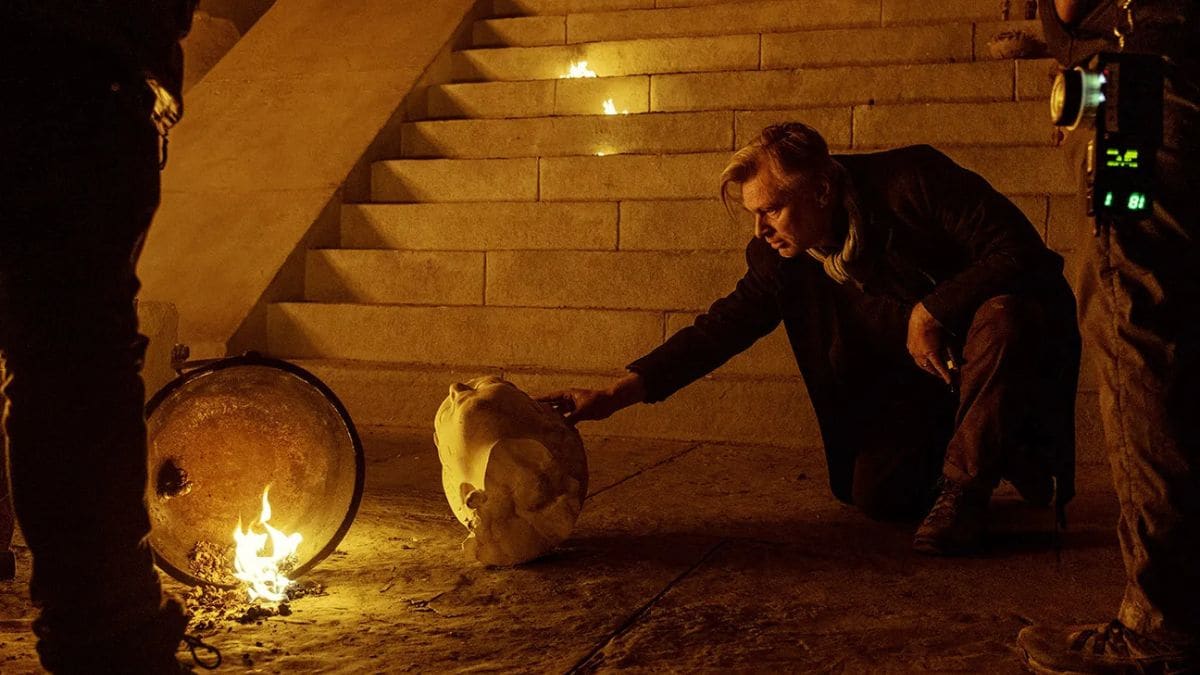
Lighting presented another opportunity to rethink conventional filmmaking. Instead of using massive overhead rigs to simulate moonlight during battle scenes, van Hoytema wanted audiences to experience the world exactly as the characters would: illuminated almost entirely by fire. Real flames proved impractical, so the crew spent months inventing what they called "pyrohedrons", custom-built LED lighting units designed to flicker and behave exactly like real fire. Hidden throughout sets, these lights recreated the warmth and unpredictability of flames while giving actors a genuinely immersive environment to perform in.
“The Dark Knight” famously used a real truck flip instead of computer animation. Interstellar planted hundreds of acres of real corn rather than relying on digital landscapes. Tenet crashed an actual Boeing 747 because, as Nolan later admitted, buying and destroying the aircraft was economically more sensible than creating one digitally. Even Oppenheimer, despite depicting one of history's most destructive events, used little CGI, favouring practical photography throughout.
Rather than asking computers to invent entire worlds, Nolan insists on building as much of those worlds as possible first. Digital work becomes an extension of reality instead of a replacement for it. By combining handcrafted illusions and practical engineering, Nolan has demonstrated that the future of blockbuster filmmaking may not lie in creating more pixels, but in finding ever more ambitious ways to put something real in front of the camera.
