



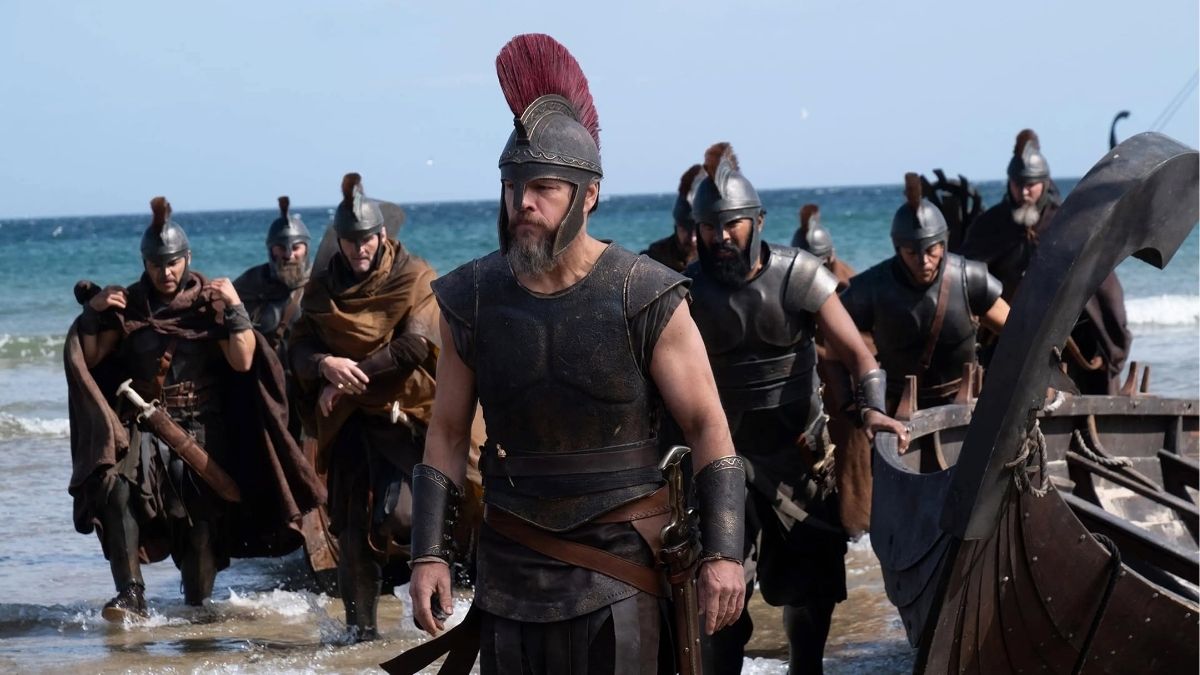
The Odyssey has made its odyssey to India, with legendary director Christopher Nolan and lead actors included, but the movie seems to have already piqued fan fervour even before, like perhaps no other Hollywood film in recent times.
For those living under a rock, Odyssey is the latest film from director Christopher Nolan, maker of the Oscar-winning Oppenheimer (2023) and the cult classic The Dark Knight (2008).
It reprises Homer’s Greek mythological epic of the same name, which charts the eponymous king of Ithaca on his 10-year journey back home after the Battle of Troy (which Homer detailed in his first in the series, The Iliad).
Odysseus’s battle with cyclops, demons, sirens and the like are today eternal literary allegories to perseverance, identity, the importance of the brain over brawn (as highlighted with a direct contrast between the Troy war hero Achilles and Odysseus) and how one has to be focussed and not be distracted in one’s life mission (in this case, to return home to his waiting wife and son).
The movie is reported to have a stupendous advance booking in India—more than 1.5 lakh tickets sold if some reports are to be believed.
Being the first film to be fully shot in the extra giant screen format of IMAX film (as compared to digital cinematography), there is extra demand to catch the movie on IMAX screens, which are far and few in India. Tickets for IMAX screenings are also reportedly going at a premium, at more than ₹2,500 in Delhi and more than ₹3,000 in Mumbai, with screenings slated to start at 6.30 in the morning on Friday.
While mythological/historical big-budget spectacles are nothing new for Hollywood, what has piqued India’s—and the world’s—frenzy is the Nolan name attached to it.
Right from his breakout film Memento in 2000, the innovative film director has played around with not just movie formats, but the very structuring of a cinematic experience. And it caught the eyes of Hollywood moguls right away, though Nolan did have to wait to be sanctioned a blank cheque for his maverick film ideas.
For example, legend has it that he approached Hollywood with the idea for Inception in the mid-2000s, though they found the story about a team of people who enter other people’s dreams to steal their ideas in a sci-fi indictment of the extremities of corporate espionage and losing individual hopes (dreams) too over the top, and refused funding. It took the blockbuster success of his upending of the superhero genre with The Dark Knight in 2008—the movie grossed more than one billion dollars, for them to sanction this project finally. Inception finally came out two years after Dark Knight, and rewarded execs with an $826 million BO reward (besides exultant reviews) on a $165 million budget.
Nolan plays not just with formats like IMAX, but with the audience’s sense of reality itself. And for a change, the masses love his unique take on it, even when many of them don’t fully comprehend it.
His breakout film Memento itself set the standard—it had scenes in colour going back in time, while B&W footage went in chronological order, both eventually meeting up in the climax.
This playing around with time is something of a fascination with the director, apparently. He has tried to play with how time slows in space due to gravity when near a black hole in Interstellar (2014) and how sense of time varies between various battle protagonists in the same battle, from soldiers on the ground (one week), those on a boat (one day) and a fighter plane (one hour), all coming together in the ending in the World War II reprising of Dunkirk (2017).
Even in Inception, time dilation is a reality when one enters a dream.
Nolan, along with his lead actors Matt Damon and Tom Holland, launched the global publicity campaign for the film with screenings in Mumbai on July 10 and 11, telling media how India is the first to watch the eagerly anticipated film.
And just like Nolan’s take of Batman in The Dark Knight was anything but a comic book retelling, there is no doubt anyone walking into cinemas to watch his latest will hardly be expecting just an honest reprising of the Greek bard’s epic.
What they are going for will be that ‘Nolan touch’, the extra layers he will bring to modern cinematic storytelling, be it age-old moral science or modern-day physical science.
