



Modern warfare is increasingly becoming a battle of economics, where the cost of destroying a target can be as important as the sophistication of the weapon used to destroy it, B.K. Das, Director General, Electronics and Communication Systems (ECS), DRDO, pointed out.
Speaking at the inaugural ceremony of NETRA 2026, a two-day national seminar on 'Electronic Warfare, Digital Twin and Mission-Critical System Design', Das said warfare was undergoing a major transformation towards asymmetric and saturation attacks, with drones and emerging technologies playing an increasingly important role
"Today the warfare has transformed. Warfare has transformed to asymmetric warfare. It has transformed to saturation attack. It has transformed essentially to the warfare of economics," Das said.
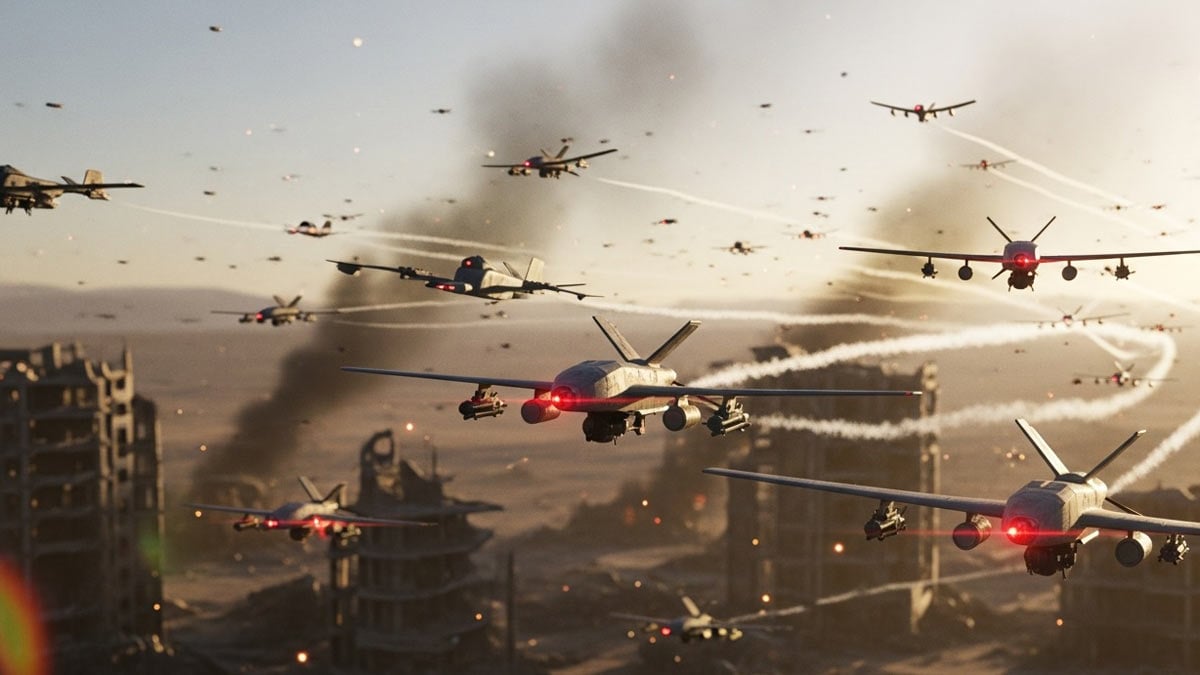
The emergence of relatively inexpensive drones has changed the equation, as even small unmanned platforms are now capable of inflicting damage across different domains.
Das highlighted the potential economic imbalance created when an expensive air defence weapon has to be used to destroy a much cheaper incoming threat.
"Maybe your S-400 can always nullify your Shahed, but you have to compute the cost of a Shahed versus the cost of a 400," he said, according to news agency PTI.
According to Das, this cost equation becomes particularly important during prolonged conflicts, where countries must be capable of sustaining operations rather than merely possessing highly sophisticated weapons.
"So if you want to sustain a warfare, if you want to have a prolonged warfare where you have to be designated to be a global leader, then more accuracy is definitely important. Control algorithm is very important, but the most important is going to be the cheapest way to negotiate the target," he said.
Das further stressed that developing a highly advanced weapon alone would not be enough. India must be capable of manufacturing sophisticated defence systems rapidly and in sufficient numbers while maintaining consistent performance.
"If I create one missile or one tank or one radar or one seeker, maybe that will be the global number one, but that is not going to sustain my country unless I have the numbers," he said.
For India, this would require a layered defence architecture combining a wide range of technologies, including long-range missiles, radars, electronic warfare systems, directed-energy weapons and drones.
Referring to Prime Minister Narendra Modi's "Sudarshan Chakra" vision, Das said, "It is going to be the plethora of technologies which needs to be stitched together to protect this nation."
He also emphasised the role of digital twins and model-based systems engineering in developing future defence systems. Greater use of digital modelling, he said, could reduce the need for physical testing and accelerate development.
"Very soon all our products are going to be digital twin, and all our model-based system engineering is going to define our future systems," Das said.
