



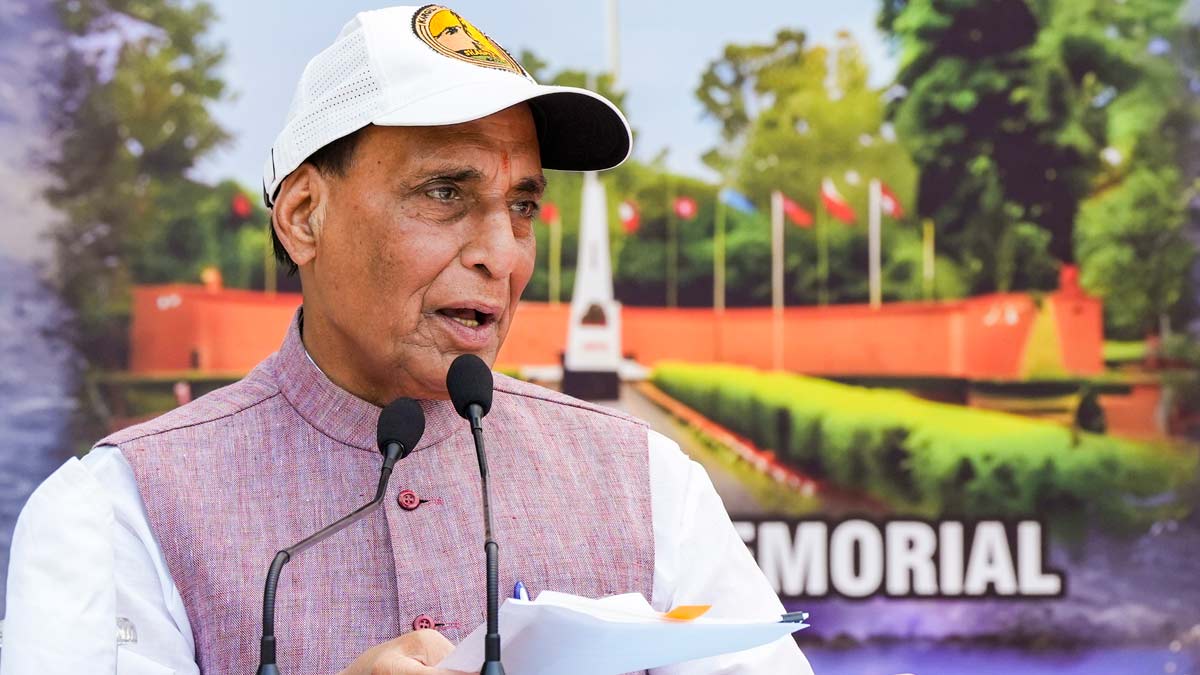
Defence Minister Rajnath Singh, on Saturday, highlighted the Centre's initiatives to boost self-reliance in defence, saying the transformation of the sector over the past 12 years has significantly strengthened India's military preparedness and enabled the successful execution of Operation Sindoor.
Addressing an event in New Delhi, Singh described Operation Sindoor as a reflection of India's modern defence capabilities and the government's sustained efforts to build indigenous military strength.
"Operation Sindoor is testimony to India's up-to-date, up-to-the-mark, and up-to-the-standard defence preparedness, sharpened by the transformation of the defence sector through Prime Minister Narendra Modi-led government's sustained efforts in the last 12 years," he said. He added that systems such as Akashteer, the Akash missile system and BrahMos were effectively deployed during the operation, calling it "a shining example of technological warfare and proof of the government's trust in Indian industries."
The defence minister said the government had taken a series of measures to reduce dependence on imported military equipment and strengthen domestic defence manufacturing. He noted that the armed forces have issued five positive indigenisation lists covering 509 items, while Defence Public Sector Undertakings have notified 5,012 items for indigenous procurement. He added that another such list would soon be released to further accelerate the self-reliance drive.
Highlighting the progress made so far, Singh said annual defence production had increased from around ₹40,000 crore in 2014 to a record ₹1.78 lakh crore in 2025-26, while defence exports had risen from ₹686 crore in 2013-14 to over ₹38,000 crore. He said the government aims to raise defence production to more than ₹2 lakh crore this year and ₹3 lakh crore by 2029, while targeting ₹50,000 crore in defence exports by 2029.
According to Singh, the government has fundamentally changed the approach to defence preparedness by prioritising indigenous manufacturing over imports.
"Since 2014, it has been our endeavour to strengthen defence preparedness through indigenous production of advanced weapons and technologies, with focus on minimising import dependence. We have built a defence industrial ecosystem within the country to fulfill domestic as well as international requirements," he said.
He described Aatmanirbharta in defence as one of the government's most significant initiatives, saying India had moved from being dependent on foreign suppliers to becoming a producer of advanced defence equipment. Singh stressed that strategic autonomy could only be achieved if the country was capable of meeting its own defence requirements during crises.
The minister also outlined reforms aimed at strengthening India's defence manufacturing ecosystem, including simplified export procedures, defence industrial corridors in Uttar Pradesh and Tamil Nadu, and changes to defence procurement that reserve 75 per cent of the modernisation budget for purchases from Indian industry. He said programmes such as iDEX, iDEX Prime and ADITI had boosted defence innovation by encouraging startups and MSMEs to develop advanced technologies, with the number of defence startups growing from only a few dozen in 2018 to more than 2,000 today.
Singh said India was evolving into a credible global defence partner and reaffirmed the government's commitment to building a strong, secure and self-reliant India equipped with indigenous technologies and globally competitive defence industries. "Our aim is to create a nation where soldiers wield indigenous weapons and technologies, scientists have access to new opportunities, youth possess the power of innovation, and industries have the capacity to compete globally," he added.
