



China is rapidly expanding its fifth-generation fighter fleet even as it pushes ahead with the development of sixth-generation combat aircraft, highlighting the widening gap between Beijing and New Delhi when it comes to airpower.
While China's sixth-generation fighter jet programmes have dominated headlines since 2024, the country has also inducted a large number of the Chengdu J-20 "Mighty Dragon" and the Shenyang J-35, strengthening the People's Liberation Army Air Force's (PLAAF) frontline capabilities.
According to an recent estimate by The War Zone (TWZ), the PLAAF could already have as many as 500 J-20 stealth fighters.
In 2025, military observer Andreas Rupprecht identified a J-20 carrying a serial number indicating it was the 300th airframe. Based on subsequent production trends, he assessed that China may have around 500 J-20 fighters a year later, according to TWZ.
The TWZ report says this assessment is supported by the aircraft's deployment across 14 frontline PLAAF units and three Flight Test and Training Bases (FTTBs) operating mixed fleets.
Among the frontline formations, four units have reportedly transitioned to the upgraded J-20A variant, replacing the earlier production J-20 fighters.
Where is AMCA?
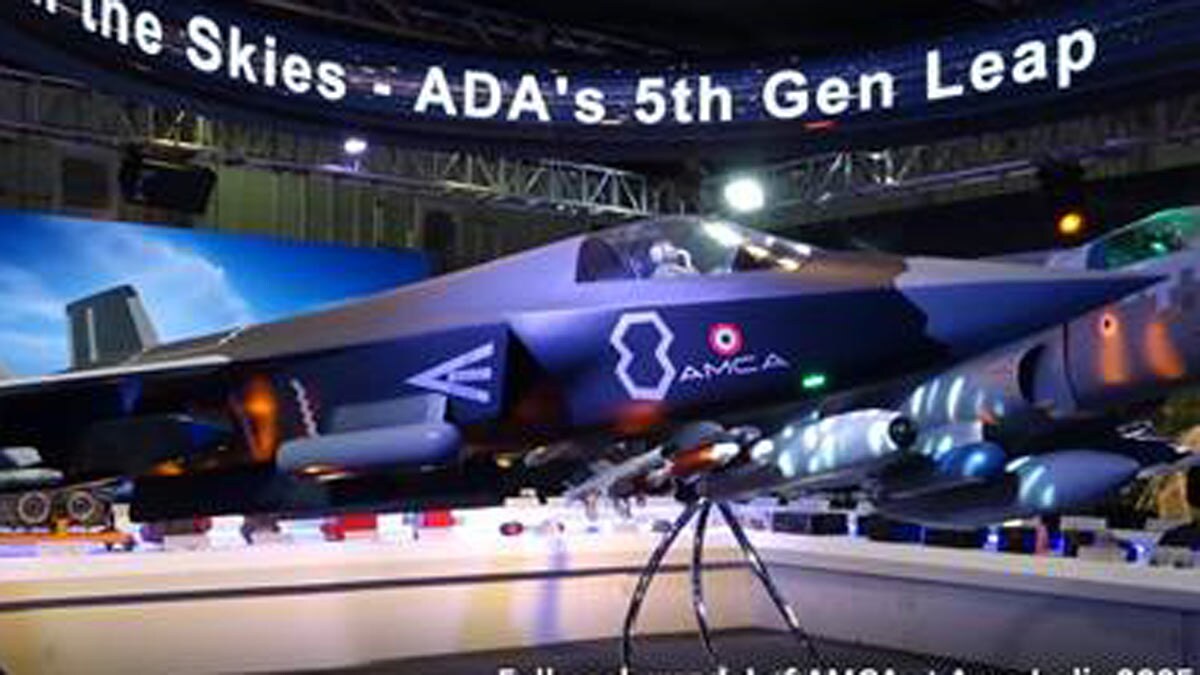
While China continues to induct fifth-generation fighters in large numbers, India's indigenous fifth-generation fighter programme remains several years away from operational service.
The Advanced Medium Combat Aircraft (AMCA) programme has only recently progressed from the design stage into the prototype development and industry selection phase, with the first prototype rollout expected only around 2028-29.
Under the current timeline, the aircraft is expected to enter Indian Air Force (IAF) service only around 2034, while series production is projected to begin around 2035.
A few weeks ago, the defence ministry issued the Request for Proposal (RFP) for the indigenous AMCA programme to the three shortlisted bidders—Larsen & Toubro-Bharat Electronics Limited, Tata Advanced Systems, and Bharat Forge-BEML—marking another step in the project's execution.
The engine continues to be the biggest challenge for the programme. The initial AMCA prototypes are expected to be powered by the GE F414 engine, while India continues to pursue a higher-thrust engine for the production version through international collaboration and eventual indigenous development.
Recent reports have also indicated that negotiations with GE have become more complicated because of cost-related issues.
The Russia pitch
Meanwhile, Russia has been repeatedly pitching Sukhoi Su-57E fifth-generation stealth fighter to India, offering what it has described as a comprehensive package. Moscow has also said it is prepared to provide unrestricted technology transfer for the aircraft, stating that any requirement raised by the Indian side would be "completely acceptable".
While there has been no official confirmation that India plans to procure the Su-57E, HAL Chairman and Managing Director D.K. Sunil had said in April that the Russian side had already briefed the Indian Air Force on the fighter's capabilities.
Speaking to news agency ANI in April, Sunil said the Russian team had also assessed HAL's manufacturing infrastructure and found that nearly 50 per cent of the existing facilities could be utilised for producing the aircraft, although additional investments would be required.
"We are awaiting the Russian quotation about the investment. Then we will approach the Air Force that these are the kind of numbers required to produce these aircraft and these are the timelines," he told ANI then.
