



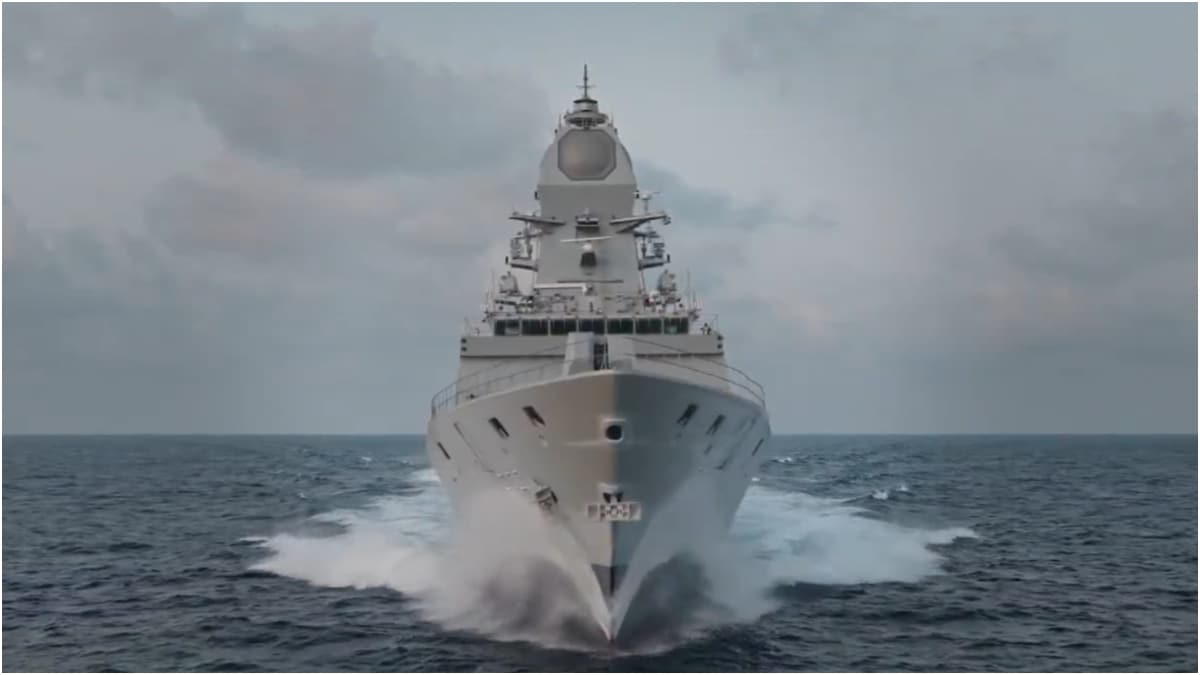
India’s growing naval might got another big shot in the arm with the commissioning of three warships built by the newly crowned ‘Navaratna’ Kolkata-headquartered Garden Reach Shipbuilders & Engineers Limited (GRSE) on Sunday at the Syama Prasad Mookerjee Port.
Prime Minister Narendra Modi inaugurated the tri-commissioning—marking the first-ever commissioning of three surface combatant naval platforms on a single day built by a single shipbuilder. The three warships are the INS Dunagiri—the second ship of the Project 17A Advanced Frigate class, INS Sanshodhak—the fourth Survey Vessel (Large) and INS Agray—the fourth Anti-Submarine Warfare Shallow Water Craft (ASW SWC).
The frenetic tempo of Indian naval shipbuilding can well be gauged by the fact that on January 15 last year too, three naval platforms—a destroyer (INS Surat), a frigate (INS Nilgiri) and a submarine (INS Vaghsheer)—were all commissioned on a single day at the Mazagon Dockyard Ltd (MDL) in Mumbai. On Sunday, it was definitely Kolkata’s turn.
Pointing out that no nation can become a great power without maritime capability, the PM said in his address: “The time has come for India to enter the next phase of maritime power... The stronger a nation’s maritime strength, the stronger its economic and strategic influence. India understands this reality well.”
In recent years, more than 40 ‘Made in India’ warships and submarines have been inducted into the Navy. “This means that almost every few weeks, the Indian Navy has gained new strength. Even now, 45 major naval platforms are under construction. This is not just a number. It is proof of India’s industrial capability. It is a signal of India’s future,” the PM added.
Significantly, while the Dunagiri has been designed by the Indian Navy’s Warship Design Bureau, the GRSE designed the Sanshodhak and the Agray.
READ HERE | INS Dunagiri: Indian Navy to induct another Project 17A stealth guided-missile frigate
With its lightweight torpedoes and rockets, Agray will be the latest addition to the Indian Navy’s growing anti-submarine capabilities.
Not just that, June 2026 may well witness the Indian Navy’s largest single-month induction phase, with two more indigenous platforms—INS Mahendragiri (Project 17A Stealth Frigate) and INS Malvan (Anti-Submarine Shallow Water Craft)—expected to be commissioned soon.
Hosted by the Indian Navy chief, Admiral Krishna Swaminathan, the commissioning of the three warships was attended by the West Bengal Governor, RN Ravi, and the state’s CM, Suvendu Adhikari, among a host of other dignitaries and top officials.
An official release said: “This milestone underscores GRSE’s robust shipbuilding infrastructure, advanced technological capabilities, and efficient project execution. It also reflects India’s growing maritime self-reliance and significantly strengthens the nation’s operational preparedness across strategic, surveillance, hydrographic, anti-submarine warfare, and maritime defence domains.”
To be equipped with the peerless BrahMos missile, the stealth frigate Dunagiri will have advanced weapons and sensors. In comparison to previous frigate programmes, its construction has been completed in less than 33% of the time.
Built to explore the seabed for military and civil applications, Sanshodhak—India’s fourth hydrographic vessel of the Sandhayak class—will be equipped with autonomous underwater and remotely operated vehicles.
Adding state-of-the-art naval platforms in good time has become pertinent for the Indian Navy in view of increasing foreign naval presence in the Indian Ocean region and also because of the speedy growth of Chinese naval might with additional numbers at a very fast pace.
India’s focus has been on producing big naval platforms within the country that are low-cost but high-impact systems.
With more than 370 platforms—far more than the US Navy’s 296 battleships—China’s People’s Liberation Army Navy (PLAN) is the world’s biggest, which includes major surface combatants, submarines, ocean-going amphibious ships, mine warfare ships, aircraft carriers, and fleet auxiliaries. The PLAN is aiming to sail 435 ships by 2030.
The Pakistani Navy fields about 110 small and big naval platforms, including fast attack crafts that have a coastal focus in the sea-denial mode. What could give it real teeth in the times to come will be the Chinese Hangor-class submarines, the first of which has already been inducted, with the remaining seven on order.
On the other hand, the Indian Navy is speeding up its production of major warships and is looking to deploy at least 170–175 major warships by 2035.
