



When Russia invaded Ukraine in February 2022, most analysts predicted Kyiv would fall within days. Four years on, Ukraine still resists one of the world’s most powerful militaries. Similarly, when Israel and the United States intensified pressure and conducted innumerable strikes on Iran and its regional network, many expected Tehran’s capabilities to crumble under technological superiority. Yet Iran remains a consequential strategic actor capable of imposing costs on both adversaries.
The lesson is neither political nor ideological. It is military—and it is also urgent for India.
In an era defined by drones, artificial intelligence, cyber warfare and precision strike systems, conventional superiority no longer guarantees victory. Smaller powers have discovered how to challenge stronger adversaries through asymmetric warfare: a strategy designed not to defeat an opponent outright, but to make victory prohibitively costly, uncertain and politically unsustainable.
The new meaning of asymmetric warfare
Traditionally, asymmetric warfare meant insurgencies and guerrilla campaigns confronting stronger conventional forces. Today, the concept has evolved dramatically.
Modern asymmetric warfare enables weaker states to exploit vulnerabilities rather than confront strengths. Instead of matching tanks with tanks or aircraft with aircraft, they deploy drones against armoured formations, cyber attacks against infrastructure, precision missiles against strategic assets, information campaigns against political cohesion, and artificial intelligence against slower decision-making systems.
The objective is not territorial conquest. It is strategic denial.
The weaker actor seeks to prevent the stronger actor from achieving its objectives while imposing disproportionate military, economic and political costs. Recent conflicts show this approach can significantly alter the balance of power—and India cannot afford to ignore it.
Ukraine’s laboratory of asymmetric warfare
Ukraine offers the clearest example of how a conventionally weaker power can leverage innovation to resist a stronger military adversary.
Recognising it could not match Russia in manpower, industrial capacity or firepower, Ukraine adopted a strategy focused on exploiting vulnerabilities. Rather than attempting to destroy Russian military power outright, Kyiv concentrated on undermining its continued effectiveness.
The most visible instrument has been the widespread use of drones. Cheap commercial drones modified for military purposes have destroyed tanks, artillery systems, logistics convoys and even strategic aircraft worth millions of dollars. The economics of warfare have been inverted: systems costing a few thousand dollars now neutralise platforms costing millions.
Equally significant has been Ukraine’s use of artificial intelligence. AI-enabled systems process vast amounts of data from satellites, reconnaissance drones, electronic intercepts and battlefield sensors. Targets are identified, prioritised and engaged with unprecedented speed. The traditional “kill chain” has been compressed from hours to minutes.
Information has become as important as ammunition. Ukraine has successfully integrated military operations with information warfare, shaping global narratives and sustaining international political support. Every tactical success is amplified strategically.
Perhaps the most important lesson lies in Ukraine’s relentless focus on targeting logistics. Fuel depots, ammunition dumps, rail networks, bridges and command centres have often been targeted ahead of frontline formations. Rather than seeking battlefield annihilation, Ukraine has sought operational paralysis.
Russia’s military superiority has not translated into a decisive victory. Instead, Moscow finds itself trapped in a prolonged war of attrition imposing enormous military and economic costs—an outcome India must ensure no adversary can inflict upon it.
Iran’s different model of asymmetry
Iran’s approach is fundamentally different but equally instructive.
Unlike Ukraine, Iran developed its asymmetric doctrine over decades specifically to counter the military superiority of the United States and Israel. Tehran understood long ago that it could never compete symmetrically against American carrier strike groups, stealth aircraft or Israel’s highly advanced air force.
Instead, it invested in what might be termed distributed deterrence.
Ballistic missiles, cruise missiles, armed drones, cyber capabilities, proxy networks and hardened underground facilities form the backbone of Iran’s strategy. Rather than concentrating military power in easily identifiable targets, Iran disperses capabilities across multiple domains and geographic spaces.
A defining feature is saturation warfare. No air defence system is perfect. Even the most advanced networks can be overwhelmed by simultaneous attacks involving multiple missiles, drone swarms, decoys and electronic warfare systems.
Artificial intelligence is increasingly enhancing this capability. AI-assisted navigation, autonomous target recognition and coordinated drone swarms are making mass attacks more effective and more difficult to defend against. In the future, hundreds of inexpensive autonomous drones may challenge defensive systems costing billions of dollars.
Iran’s objective is not necessarily to defeat the United States or Israel militarily. It is to ensure that any attempt to impose a military solution carries unacceptable costs and risks. In this sense, Iran has achieved deterrence through resilience—a model India must study carefully.
Artificial intelligence: The great military equaliser
If drones are the most visible symbol of modern asymmetric warfare, artificial intelligence is becoming its invisible brain.
AI is transforming warfare in ways comparable to the introduction of gunpowder, mechanisation or nuclear weapons. It enables militaries to process enormous quantities of information, identify targets, predict enemy behaviour and coordinate operations at speeds impossible for human decision-makers alone.
For weaker powers, this is revolutionary.
Historically, military effectiveness depended heavily on industrial capacity and financial resources. AI reduces some of these advantages by enabling smaller actors to maximise the effectiveness of limited resources.
An AI-enabled drone swarm can overwhelm sophisticated defences. AI-assisted cyber operations can disrupt critical infrastructure. Machine-learning systems can analyse satellite imagery, detect troop movements and generate targeting recommendations almost instantly.
The future battlefield will increasingly be a contest between networks of humans and intelligent machines. Those who process information faster and make decisions more rapidly will enjoy decisive advantages. India risks strategic surprise if it treats AI as a support function rather than a core combat capability.
India’s strategic challenge
India’s threat environment is unique but increasingly complex.
China enjoys substantial advantages in manufacturing capacity, missile inventories, shipbuilding capability and defence industrial output. In a prolonged conflict, Beijing’s ability to mobilise resources could significantly exceed India’s.
Pakistan remains a persistent security challenge and could create a two-front contingency in coordination with China. Such a scenario could stretch Indian military resources across multiple theatres simultaneously.
Traditional force-on-force calculations, therefore, offer only a partial answer.
India must certainly continue investing in fighter aircraft, naval platforms, air-defence systems, artillery and armoured formations. Conventional deterrence remains indispensable.
However, recent conflicts suggest that conventional power alone is insufficient. India requires an asymmetric layer capable of imposing disproportionate costs on any adversary. Without it, India risks fighting yesterday’s war while adversaries fight tomorrow’s.
Building India’s asymmetric arsenal
Fortunately, India possesses many ingredients necessary for such a transformation.
Its technology sector is among the world’s largest. Its software talent pool is vast. Its space programme is increasingly sophisticated. Its start-up ecosystem is vibrant and innovative. Few countries possess a comparable combination of technological and human capital. Yet India has not yet converted this advantage into an asymmetric military capability.
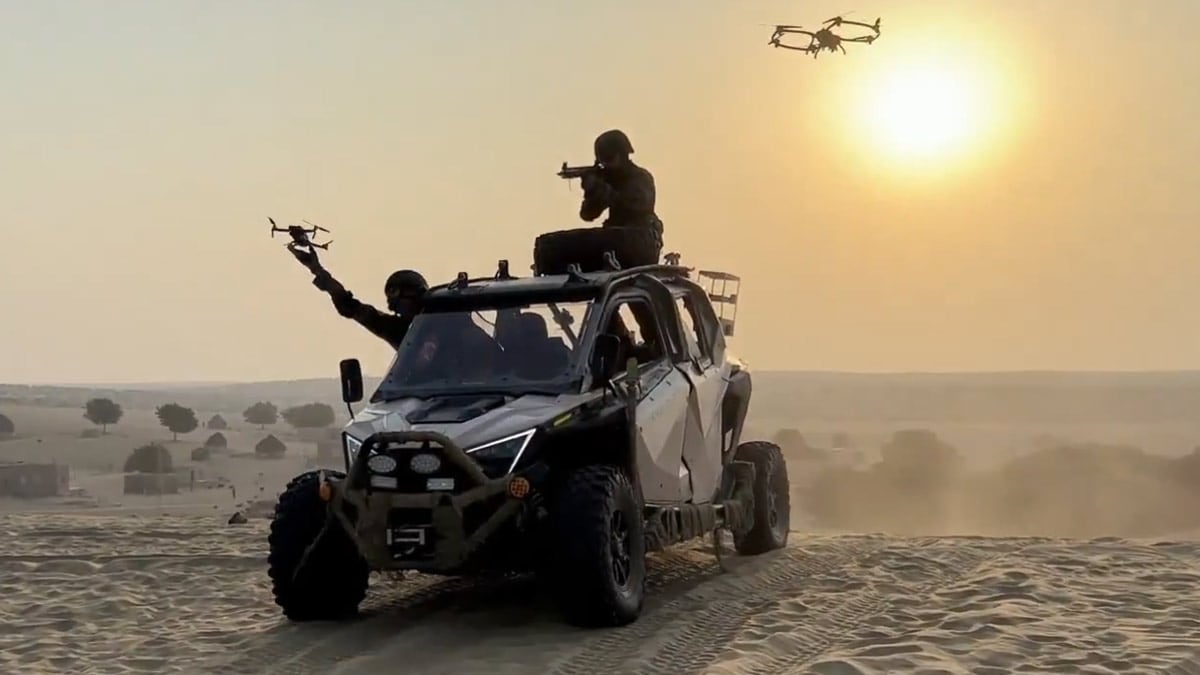
The first priority should be mass drone warfare. India needs thousands of low-cost reconnaissance drones, loitering munitions and autonomous strike systems capable of operating across mountains, deserts and maritime environments.
Second, India must develop AI-enabled command-and-control systems that integrate data from satellites, radars, drones and battlefield sensors into a unified operational picture. Information superiority may become as important as firepower superiority.
Third, offensive cyber capabilities must become a central component of national defence. Future wars will involve attacks not only on military targets but also on communications networks, transportation systems, financial institutions and critical infrastructure.
Fourth, India should invest heavily in electronic warfare. The ability to jam, deceive or disrupt enemy sensors can neutralise technological advantages without firing a shot.
Fifth, the Indian Ocean offers opportunities for maritime asymmetry. Long-range missiles, submarines, autonomous underwater vehicles and unmanned maritime systems can threaten critical Chinese sea lines of communication at relatively low cost.
Finally, India must create large-scale human-machine teams in which soldiers, pilots and commanders operate alongside AI-enabled systems. Future military effectiveness will depend on this fusion.
Towards a new Indian military doctrine
The wars in Ukraine and West Asia suggest that India requires a doctrinal shift as significant as any military modernisation programme.
The first principle should be deterrence through cost imposition. Adversaries must believe that aggression will trigger consequences far exceeding potential gains.
The second principle should be survivability through dispersion. Large concentrations of forces are increasingly vulnerable in an age of ubiquitous surveillance and precision strike systems.
The third principle should be affordable mass. A thousand drones may often provide greater operational value than a handful of expensive traditional platforms.
The fourth principle should be rapid innovation. Defence procurement cycles measured in decades are incompatible with technologies evolving every few months.
The fifth principle should be multi-domain integration. Land, air, sea, space, cyber and information operations must be planned and executed as a single operational ecosystem.
Above all, India must embrace artificial intelligence as a core military capability rather than merely a support function.
Conclusion: Critical nuances of the future battlefield
The central lesson for India is clear. The future will not belong exclusively to the military with the largest army, the most aircraft or the biggest defence budget. It will belong to the military that best combines conventional power with asymmetric capabilities, technological innovation and artificial intelligence.
In the decades ahead, wars may increasingly be fought by networks of autonomous systems, AI-enabled decision platforms, cyber weapons and precision strike capabilities. Nations that master these tools will shape the strategic balance of the twenty-first century.
For India, therefore, asymmetric warfare is not a substitute for conventional military strength. It is the force multiplier that may ultimately determine whether deterrence succeeds or fails against stronger adversaries.
The battlefield of the future is already visible in Ukraine and West Asia. The question is whether India has learned the right lessons from it and incorporated it appropriately into its warfighting strategy and doctrines.
(The writer was Vice Chief of the Indian Army.)
(The opinions expressed in this article are those of the author and do not purport to reflect the opinions or views of THE WEEK.)
