



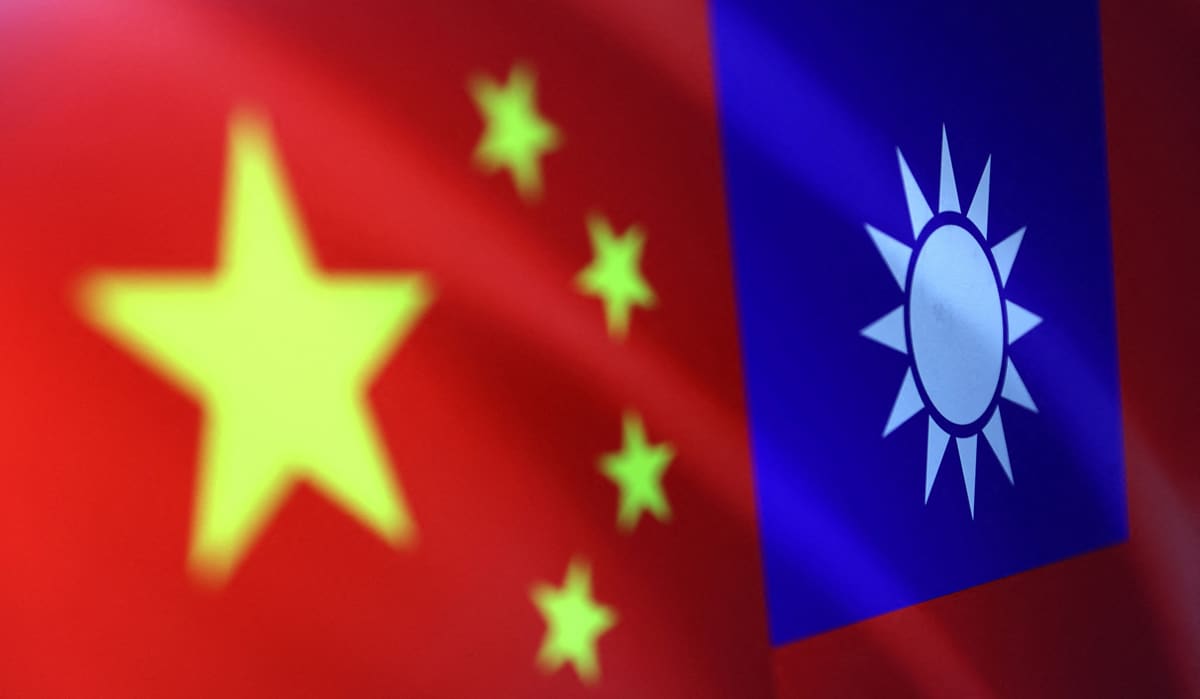
Something shifted in the Taiwan Strait after US President Donald Trump’s two-day visit to Beijing in May. While the geography, military balance and China’s ambitions remain constant, what shifted was the credibility of American commitment. When Trump described a pending $14 billion arms package for Taipei as a “very good negotiating chip” with Beijing and remarked that Taiwan was “9,500 miles away,” he did something that show of force cannot now easily undo: he introduced doubt. In the same Fox News interview, the President followed with a warning against Taiwan “going independent” because “the United States is backing it”. Strategic ambiguity on Taiwan has always left America’s exit route deliberately vague; what is new now is a US President is appearing to assign blame to the democracy being pressured, not the party applying the pressure.
On the other hand, Xi Jinping used the summit to project composure, concede nothing of substance, and restate China’s Taiwan position with the clarity of a man who believes time is on his side. Taiwan is now a diagnostic for the future of the Asian order itself.
Why Taiwan matters
For China, Taiwan operates at four levels simultaneously. It is central to Communist Party legitimacy, framed as the unfinished business of the civil war. It is ideologically inconvenient, being a prosperous, Chinese-speaking democracy that challenges the claim that Chinese civilisation requires one-party rule. It occupies the strategic centre of the First Island Chain, and its control would fundamentally alter China’s naval and air access to the Western Pacific. And through TSMC, which manufactures over 90 per cent of the world’s most advanced chips, it is an irreplaceable node in the global economy. There is a pointed irony: Trump’s push for TSMC to invest $165 billion in Arizona, while economically rational, gradually erodes the ‘silicon shield’ that gives Washington a material stake in Taiwan’s survival. The more advanced chip capacity moves onshore, the weaker the economic argument for defending the island becomes in the USA.
The myth of peaceful reunification
Most states already recognise Beijing as the sole legal government of China. The United States maintains only unofficial relations with Taipei, though the Taiwan Relations Act obligates Washington to provide defence articles necessary for Taiwan’s self-defence. In theory, if Taiwan’s people freely chose union with the mainland, the world would likely accept it. But as a December 2025 survey by Taiwan’s Mainland Affairs Council found, they do not. 82.6 per cent opposed Beijing’s ‘one country, two systems’ formula, 85.1 per cent supported the status quo, and 84.4 per cent rejected the claim that Taiwan is part of the People’s Republic. Taiwan’s own response has been concrete: in late 2025, President Lai Ching-te proposed a $40 billion special defence budget, which was passed by the legislature at $24.8 billion. It was focused on asymmetric capabilities, coastal missiles, drones and an island-wide air defence network. A country building that kind of deterrence architecture is not looking for accommodation.
The Hong Kong experience
Taiwan looks at Hong Kong and draws a lesson no reassurance can counter: once sovereignty is transferred, promised autonomy is narrowed under the elastic logic of national security. ‘One country, two systems’ is politically toxic in Taiwan, not because Taiwanese misunderstand the offer, but because they watched what it produced.
The strategy of deterrence
US deterrence in the Taiwan Strait has rested on a careful combination of capability, ambiguity and credibility. Washington has never promised to fight for Taiwan automatically, but it has long convinced Beijing that coercion carries grave and unpredictable costs. That architecture is now under strain on multiple fronts. If Beijing believes American support is negotiable and is a chip on the trade table rather than a structural commitment, deterrence weakens. If Taipei doubts Washington’s reliability, it hardens politically but grows more anxious militarily. If Japan, the Philippines, Australia and India read US commitments as conditional on presidential mood rather than treaty obligation, the region accelerates hedging and rearmament in ways that generate their own instabilities.
Deterrence is built as much on perception as on platforms. A carrier group and a missile battery matter; so does the adversary’s belief that political leadership will use them. A further vulnerability compounds this now: the US munitions stocks depleted by the Iran war and Ukraine transfers. Production backlogs mean Taiwan’s approved weapons purchases risk arriving too late to matter when deterrence is most strained.
The timing could not be worse. The Pentagon’s 2025 Annual Report assessed that the PLA is targeting 2027 to achieve the capability for ‘strategic decisive victory’ over Taiwan, including in a conflict involving US intervention. This is a capability milestone, not an invasion deadline, but it means that eroding credibility, delivery backlogs and transactional signals from Washington are all converging precisely as China’s military window of opportunity approaches its most consequential phase.
Xi’s signalling, on the other hand, is clear, repetitive, and anchored in sovereignty. For Beijing, Taiwan is not a peripheral negotiating item but the central test of China’s national project—an internal matter on which foreign interference is, by definition, illegitimate. That framing gives Beijing domestic mobilisation power and diplomatic cover among states that avoid taking sides on sovereignty disputes.
The world’s likely response
Since peaceful reunification seems unlikely, keeping in mind the overwhelming domestic sentiment against it, China’s way forward is evident—grey zone. China may not need to storm Taiwan’s beaches if it can make Taiwan politically exhausted, economically vulnerable and strategically doubtful of American reliability. A formal invasion carries enormous military risk, while a prolonged coercive campaign does not. But a settlement reached after sustained military intimidation, cyber disruption, economic punishment, elite capture, information warfare and diplomatic isolation cannot be treated as voluntary. While it may avoid a beach landing, it remains coercive absorption, dressed in the language of dialogue.
And if China avoids a spectacular act of conventional war, many governments will not resist strongly. China’s long-term geo-economic strategy has ensured that a large part of the world is now ensnared economically. But if Taiwan is absorbed by coercion, the Indo-Pacific becomes more militarised and unstable. Japan’s southwestern island chain is exposed, the Philippines faces sharper pressure in the South China Sea, Australia deepens defence alignment, and Vietnam would quietly accelerate its maritime deterrence. India would draw direct lessons for the Line of Actual Control, the Indian Ocean, and China-Pakistan coordination. The real domino effect is not territorial, but it is the precedent that patient pressure, backed by military capability, can redraw the Asian map without triggering a formal war. It would encourage further grey-zone conduct wherever China sees historical claims, strategic advantage or adversary weakness.
Great powers often seek strategic depth as they rise. They attempt to control their near seas, shape neighbouring choices, and prevent hostile coalitions from forming around them. The United States did this in the Western Hemisphere. Russia seeks it in its near abroad. China is doing it in the Indo-Pacific.
India’s Stake: The IOR Is Not Insulated
India is not Taiwan—it is a nuclear-armed continental power with strategic depth and global partnerships. But the notion that Taiwan’s fate is an East Asian problem that stops at the Malacca Strait is laden with danger, as India’s exposure is direct, structural and already in motion. It can pressure India through the Himalayas, through Pakistan, through the Indian Ocean, through cyber operations, through supply-chain dependencies, through influence in the neighbourhood, and through maritime presence from the South China Sea to the Arabian Sea. This is precisely why the Taiwan precedent matters to India. A Beijing emboldened by success in Taiwan has every incentive to press harder in Ladakh, accelerate its IOR architecture and deepen the China-Pakistan military nexus. These would be coordinated instruments of a single strategic logic.
The ‘string of pearls’ analogy has been long debated and established. These naval bases, all around the Indian subcontinent, serve as logistics architecture for a blue-water navy that deploys up to ten warships in the IOR at any given time. Based on its analysis of Chinese strategic behaviour, the Pentagon’s 2025 Annual Report lists Arunachal Pradesh alongside Taiwan and the South China Sea as a Chinese ‘core interest’. In May 2025, China backed Pakistan militarily during the India-Pakistan conflict. The two-front pressure that India has long treated as a theoretical risk briefly became an operational reality.
For India, the lesson is clear. Taiwan is not merely an American problem or an East Asian problem. It is a diagnostic test of the emerging world order. If Taiwan remains free, armed and self-governing, China’s rise will remain contested by a coalition of regional resistance. If Taiwan is coerced into submission, Asia’s power balance will tilt sharply toward Beijing.
The danger of normalisation
The most immediate danger is not war but the normalisation of coercion without war. What the Beijing summit revealed is that the vocabulary around Taiwan is already shifting. Trump’s transactional language is a signal that Beijing reads, Taipei internalises, and every capital between Tokyo and New Delhi watches carefully. Whether Taiwan reunification happens peacefully or through coercion will determine not only Taiwan’s future but also what kind of Asia emerges from this century’s first great strategic test.
(Maj Gen Rambir Mann is a strategic affairs analyst with expertise in Indo-Pacific security and great-power competition.)
(The opinions expressed in this article are those of the author and do not purport to reflect the opinions or views of THE WEEK.)
