



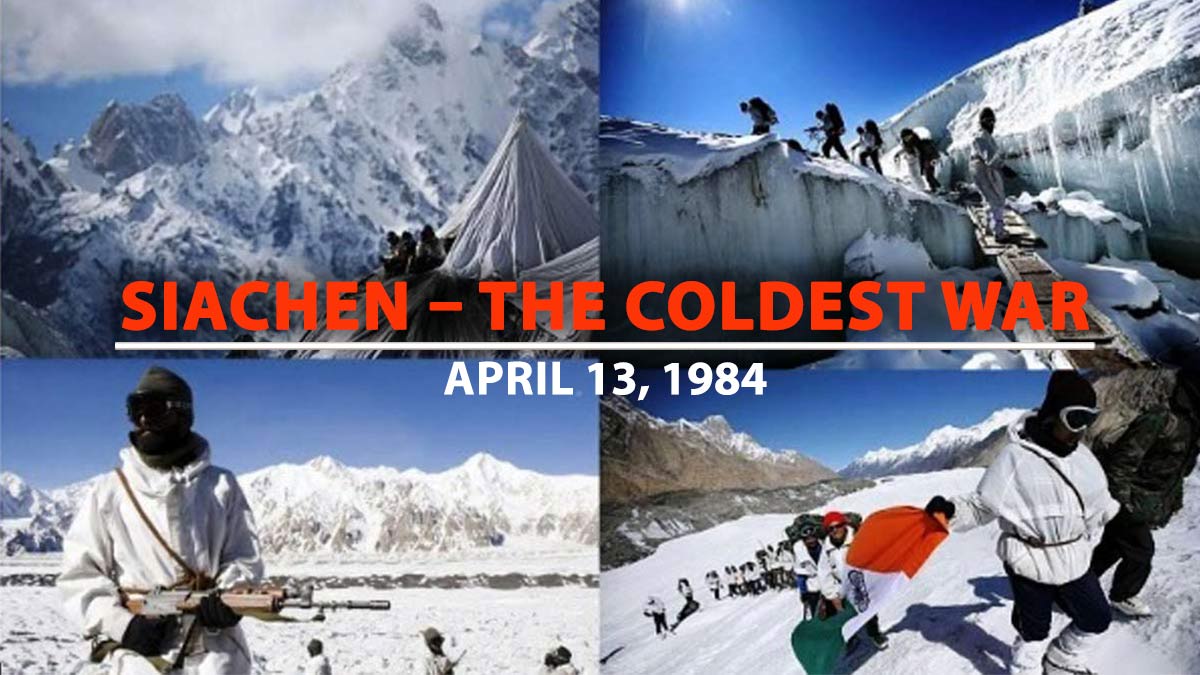
In Balti, they call it Siachen, meaning ‘the abode of wild roses.’ It is a strange name for an icy glacier, 19,000 feet above sea level, where not a blade of grass grows. It is stranger still that this silent, ice-shrouded land should become the highest battleground of the world, where guns have roared since April 1984. Even today, though the guns are silent, Indian and Pakistani armies remain locked in eyeball-to-eyeball confrontation in these forbidding heights.
The roots of the conflict go back to the 1949 Karachi Agreement signed after the ceasefire of the 1947-48 Indo-Pak War. This demarcated the ceasefire line between India and Pakistan at map coordinate ‘NJ9842’ at the foot of the Siachen glacier. Beyond this the line ran ‘thence north to the glaciers.’ These ambiguous lines were interpreted by Pakistan as running Northeast towards the Karakorum Pass, which gave it control over the glaciers. India claimed that from ‘NJ9842’ the line ran along the nearest watershed, the Saltoro Ridge, which put Siachen into Indian territory.
Through all of the 1950s, 60s and 70s, this barren, inhospitable region was ignored by both sides. It was only in the late 70s that Pakistan published maps showing the area as theirs. They also began issuing permits for mountaineering expeditions, often accompanied by a liaison officer of the Pakistan army, de facto claiming the area as their own.

India awoke to this gambit thanks to the efforts of Col Narender ‘Bull’ Kumar, a skilled mountaineer and Commandant of the High Altitude Warfare School. He laid hands on the map, which showed the area as belonging to Pakistan, and decided to counter the Pakistani moves by launching mountaineering expeditions of his own. After much persuasion, he received permission to lead his own expedition in 1978. The expedition detected a huge quantity of debris with Pakistan army markings, which convinced him that Pakistan was subtly laying claim to the glacier. He decided to counter Pak Oropolitics (use of mountaineering expeditions to stake claim) by launching a series of Indian expeditions, and in 1981, led a 70-man team across the glacier, which was tailed by a Pakistani helicopter. Both sides were now awakening to the importance of the glacier.
The Indian expeditions had alarmed the Pakistani planners at GHQ, Rawalpindi, who now decided to occupy the glacier by military force. The aim of the operation was to occupy the heights of Saltoro Ridge, and its main passes of Sia La and Bilafond La and Gyong La. Yet, they made a small but significant error. They ordered large quantities of Arctic weather gear from a supplier in London who was also supplying the Indian Army, and he tipped them off about the large Pakistani order. That set off alarm bells in the Indian Northern Command, which was now convinced that Pakistan was planning something in Siachen.
India began procuring its own Arctic equipment to pre-empt the Pakistanis by occupying Siachen before they did. Intelligence reports stated that they were likely to move in around April 17 and it was decided to move in the Indian troops by April 13. Though considered an unlucky day—it was Baisakhi—the Pakistanis would be least expecting such activity on this day. 4 KUMAON and troops from Ladakh Scouts – hardy troops from the mountain regions—were selected for the operation, codenamed OPERATION MEGHDOOT, after Kalidasa’s famous poem.
Around the end of March, troops of 4 KUMAON and Ladakh Scouts marched out in full battle order through the Zojila Pass towards the base of the glacier. Simultaneously, MI-17 and Chetak helicopters carried provisions to be deployed along the route and began stocking up the base camps. Four teams were deployed for the task under Brigadier V.N. Channa, who was responsible for the operation. One was to occupy Bilafond La, the other Sia La and the third moved towards Gyong La, the three passes leading to the glacier from the Pakistani side. Simultaneously, the positions on the high ground of Saltoro Ridge were to be occupied to deny access to the glacier. Once these positions were occupied, it would be virtually impossible for an enemy to evict them from these heights.
The troops marched up to the base camps in secrecy for the next phase of the move to the heights. Yet, the Arctic equipment, which was essential for survival at these altitudes, and which was being specially procured from across the world for this operation, was delayed. The first sets reached the base camps only around 5 in the evening on April12. (In the final briefing before the operation, the troops agreed to move up even if the Arctic gear was not available.) The next morning, on April 13, Maj. R.S. Sandhu led his platoon on foot to the heights of Saltoro Ridge, being the first Indian officer to be deployed there. Simultaneously, at 0530h, a Cheetah helicopter, piloted by Squadron Leader S.S. Bains, took off from the base camp, carrying Capt Sanjay Kulkarni and his radio operator and winged its way towards the Bilafond La pass. The helicopter could only carry two persons and, in the wind-swept conditions, could not land at the snow-covered heights. The Cheetah hovered a few feet from the ground; Capt Kulkarni and his operator said a small prayer and jumped, their fall cushioned by the soft snow. Seventeen such sorties took place, and by around 10 am, around 30 men, a platoon worth, was on Bilafond La. In a raging blizzard, the Indian tricolour was raised there for the first time.
Yet, the first day was a forerunner of things to come. In just three hours, the radio operator contracted pulmonary oedema and had to be evacuated. By noon, the weather packed up as well, making any operations towards Sia La and the other heights impossible. At heights of over 19,000 feet, another soldier, Lance Naik Ramesh Singh, fell to the dreaded high-altitude illness and passed away on April 16. Although radio transmission was strictly forbidden, Capt Kulkarni made a single transmission to his HQ informing them of his situation. That transmission was picked up by the Pakistanis, and now they were alerted. In spite of the terrible weather, they too began moving troops of their elite Special Services Group and Northern Light Infantry on foot towards the glacier.
After three days, the weather cleared, and on April 17, the IAF launched 32 sorties to drop Major Bahuguna and his platoon of Ladakh Scouts in the vicinity of the next objective, Sia La Pass. The platoon walked five kilometres in knee-high snow and secured the pass by midday. Indian troops also occupied important heights around Saltoro Ridge, and the glacier was securely in Indian hands.
The Pakistanis had been beaten in their plans to occupy the glacier by three days. They now launched their own operation –Codenamed OPERATION ABABEEL – to evict the Indians. SSG commandoes reached Bilafond La on April 23, after a three-day trek on the snow and around 4 in the evening, the first attack came in. A burst of fire killed the Indian sentry at the Observation Post, and the silent peaks reverberated with the sounds of gunfire. Yet the Indians were on high ground and held the advantage. For the Pakistanis, movement in the knee-deep snow was slow and tortuous and their attack was repulsed with 26 Pakistani soldiers killed in the first assault. Another attack came in the next day, and then again on April 27, which was similarly repulsed. Other attacks followed in May and in June, on each of the newly established Indian posts, but to no avail. The Indian positions were being gradually reinforced day by day, and at these altitudes, recapturing a high ground was virtually impossible. Pakistani attacks, though courageous, were simply beaten back.
Over the next few months, both sides built up their forces. With the passes in Indian control, the Pakistanis tried to seize the adjoining heights. Both sides set about occupying posts to dominate the other – a strategy that continued throughout the war. In July 1984, Pakistani NSG commandos seized a high feature overlooking the Bilafond La pass in a daring helicopter-borne assault and occupied it. This feature, renamed Quaid Post, dominated Indian positions for over three years, till it was recaptured in July 1987 by Naib Subedar Bana Singh and renamed Bana Post.
The Pakistani Army did not give up its attempts to recapture Siachen. They were chastened by its failure to defend Siachen - Benazir Bhutto called “only fit to fight its own people” and suggested that its generals wear bangles. A series of attacks and counterattacks on each other’s positions continued for over a decade, with major Pakistani offensives launched in 1987, 1989, 1992, and 1995, which were repulsed with heavy casualties. In 1999, General Musharaff launched the Kargil War, hoping to cut off the supply line to Siachen and force India to vacate its positions. He himself was a Brigade Commander there, and the failures he suffered would have rankled. The Kargil operation also failed.
Both sides have around 3000 troops in 150 – 200 small posts in the crucial heights, and the line held by both sides has become The Actual Ground Positions Line. (ACPL) The Indians hold on to the 76-kilometre-long glacier and occupy most of the heights and passes around it. After a ceasefire in June 2003, the guns have been silent, but appalling weather and treacherous terrain still claim casualties on both sides. So, is it worth holding on to these inhospitable heights? Yes, it is. Vacating the hard-earned positions at Siachen will simply allow the Pakistanis to move in, and then regaining them will be impossible. Siachen will also prevent a Chinese-Pakistani nexus in the area. So, the Indian soldier still holds vigil in those forbidding heights, suffering hardships that would have broken most armies. And all we can do is raise a prayer and a salute for him.
