



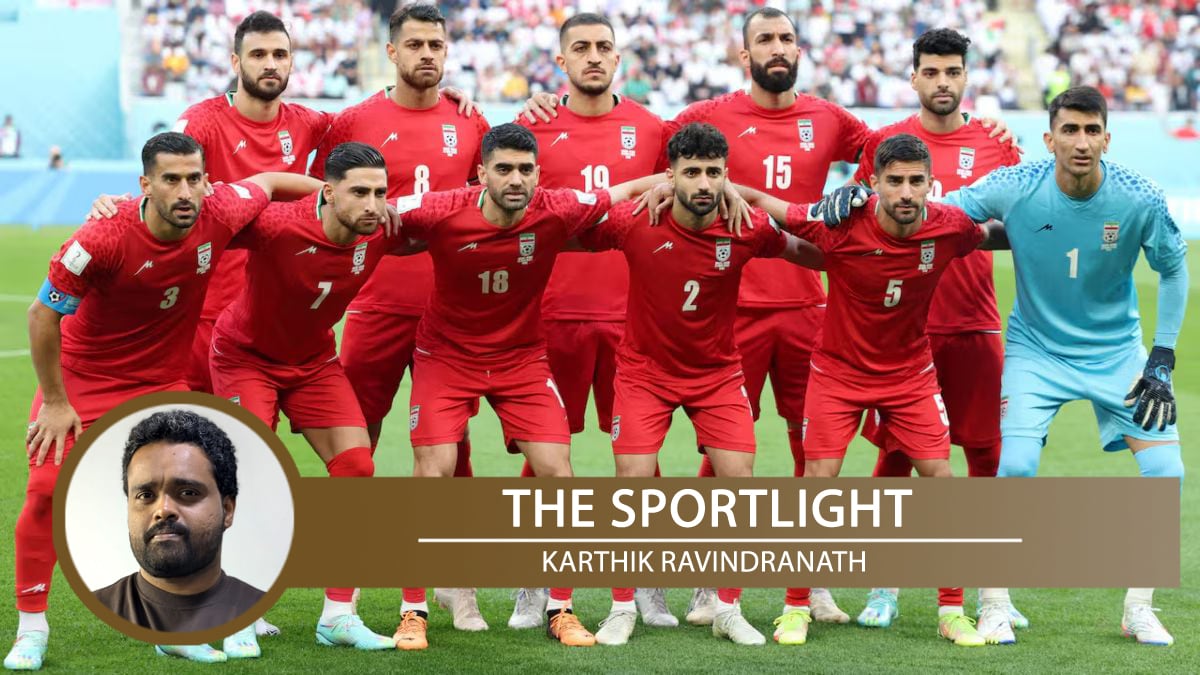
The question of whether Iran would be at this World Cup has consumed more column inches than their actual football. But now, with the matter looking more or less settled, it is time to turn the lens to what they are capable of on the pitch.
Iran arrive at their seventh World Cup ranked 21st in the world, which makes them the highest-ranked of the nine Middle Eastern and North African sides. They have never advanced past the group stage in six previous appearances. They were fancied to go through in 2022, but had their work cut out, following a surprise 6-2 thrashing against England in their opener. After winning the second game against Wales, Iran faced the US in the decisive third game. A draw would have been enough for Team Melli, but they lost 1-0 to the Americans, with Christian Pulisic colliding with the Iranian goalkeeper while scoring the winner.
This time, coach Amir Ghalenoei has named a squad with a strong domestic core: 17 of 26 play in Iran. But, that could turn out to be disadvantage as the league has been suspended owing to war. That is the central uncertainty around Iran's preparation. Their players are match-fit in the technical sense—they have been training in Turkey, where they beat Gambia 3-1 on May 29, and Mali (2-0) on June 4. But, competitive sharpness after months without league football is impossible to guarantee.
The biggest talking point in the squad announcement is an absence. Sardar Azmoun, once touted to be the successor of legendary striker Ali Daei, was dropped following a reported rift with the federation over a social media post. That leaves Mehdi Taremi carrying the attack, which is not an unusual position for him. Taremi, 33, is now at Olympiacos after a season at Inter Milan, and has 105 caps and 60 goals. He scored 29 in 42 games since the start of 2023. Alireza Jahanbakhsh, another player with significant European experience, is expected to be the primary source of creativity.
Group G—Belgium, Egypt, New Zealand—is navigable on paper. Belgium are no longer the force they were, but are still favourites to top the group. Egypt and Iran are evenly matched under current circumstances. But, on a good day, Iran is capable of upsetting Belgium and should definitely aim for a result against Egypt. A win against New Zealand, who are the tournament's weakest side, is almost guaranteed. And, the fact that Iran open against New Zealand is a major advantage. If they secure that victory, they can go into the second match against Belgium, who would have had a tougher opener against Egypt, with the a specific game plan.
This is, on paper, a golden chance to advance to the knockout stages. They are in the best position of all the Middle Eastern sides (Egypt’s opener against Belgium is a disadvantage for The Pharaohs when it comes to group calculus) to advance. Only an unthinkable loss to the Kiwis or a heavy thrashing by Belgium is going make progression tough for Iran. But, the key question is whether a squad that has endured months of war, political upheaval, a dropped star and enforced inactivity can hold it together long enough to make history.
