



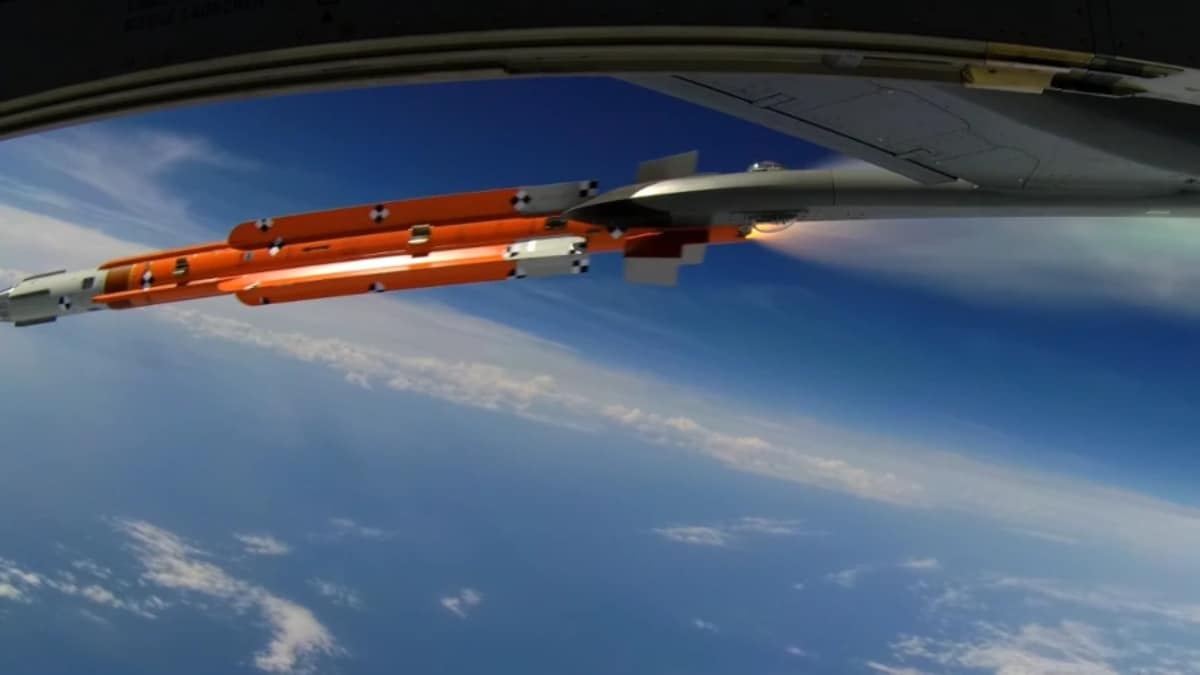
As India moves ahead with plans to significantly expand its Rafale fighter fleet with an additional order of 114 jets from France, missile manufacturer MBDA has successfully completed another key milestone in the development of the Rafale's future air-to-air weapon, the MICA NG (New Generation Interception, Combat and Self-Defence Missile or Missile d’Interception, de Combat et d’Auto-défense de Nouvelle Génération in French).
MBDA, in a press statement, announced that the second development firing of the MICA NG from a Rafale fighter aircraft had been successfully carried out. For the first time, the missile was tested in a supersonic flight configuration, marking another important step towards its qualification and integration with the French fighter jet.
The first development firing of the NG variant from a Rafale jet was carried out in June 2025.
The development assumes significance for India, which recently issued a Letter of Request (LoR) to France for a government-to-government deal worth around ₹3.25 lakh crore to acquire 114 Rafale fighter jets for the Indian Air Force. The deal would substantially expand India's Rafale fleet and deepen its reliance on the aircraft and its associated weapons ecosystem.
The latest test was conducted at the Mediterranean test site of the French Defence Procurement Agency's missile testing centre. It involved teams from MBDA, Dassault Aviation, the French Air and Space Force and the French defence procurement agency DGA or Direction générale de l'armement.
According to MBDA, the test successfully evaluated the performance of the missile's infrared seeker during supersonic flight. “The test successfully evaluated the performance of the missile's infrared seeker during supersonic flight, validating its ability to engage current and future threats,” the statement from MBDA said.
The infrared seeker uses the heat signature emitted by a target to guide the missile. During supersonic flight, the surrounding temperature increases significantly, making it harder for the seeker to distinguish a target from the background. MBDA said the trial successfully validated the seeker's performance in these challenging conditions.
The MICA NG is designed to address emerging aerial threats that are stealthier, faster and more difficult to detect than previous generations of aircraft and missiles.
According to the company, the missile will be capable of engaging conventional aerial targets such as fighter aircraft and helicopters, while also expanding its reach to low-signature threats including drones, stealth aircraft and certain highly manoeuvrable cruise missiles.
According to MBDA, the MICA NG will provide fighter aircraft with capabilities for interception, close-range air combat and self-protection, helping to ensure air superiority. In its VL MICA NG (Vertical Launch) version, the missile will also provide self-defence capabilities for naval vessels and critical land-based assets.
The development is also relevant for India because the IAF already operates MICA missiles on its Rafale fleet.
Only a few weeks ago, MBDA signed an agreement with the IAF to establish an indigenous maintenance, repair and mid-life overhaul (MRO) facility for MICA missiles. Under the arrangement, the MRO facility will be set up, operated and maintained by the IAF, while MBDA will offer equipment, tooling, technical data packages, training and support.
The facility is expected to improve turnaround times for missile maintenance and enhance the long-term operational readiness of the force's MICA inventory.
