



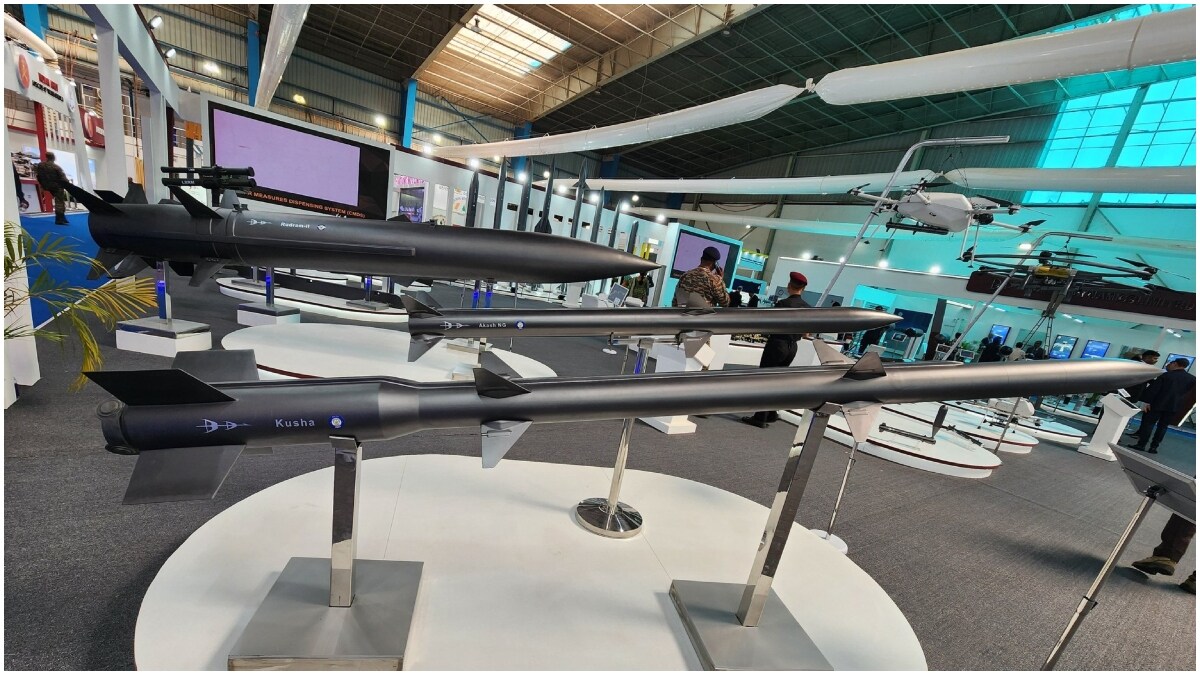
Russian systems like the S-400 remain central to India's “Mission Sudarshan Chakra” (MSC), the project to establish a comprehensive multi-layered air and missile defence shield. However, Project Kusha, an indigenous long-range surface-to-air missile system, is expected to decrease the dependence on foreign systems.
ALSO READ | When will India receive fourth and fifth S-400 missile systems from Russia?
According to available information, it was in September 2023 that the Defence Acquisition Council granted the Acceptance of Necessity (AoN) for procuring five squadrons of the SAM system under Project Kusha for the Indian Air Force (IAF).
Some reports dare to call Project Kusha India's answer to the Russian S-400 Triumf and the American MIM-104 Patriot. Being built at home means the IAF will have more control over its lifecycle and deployment.
In a game-changing move, New Delhi spent around ₹45,000 crore in 2018 for five squadrons of S-400 missile systems, which proved their worth during Operation Sindoor. However, five squadrons under Project Kusha would cost only about ₹21,700 crore, Mathrubhumi claimed in a report. There is also a significant difference in the cost of the missiles fired by both systems. Each S-400 missile costs around ₹100 crore, whereas the indigenously developed missiles under Project Kusha are priced at only ₹40 to ₹50 crore, the report further said.
DRDO and Bharat Electronics Limited (BEL) are reportedly entrusted with the radar system manufacture and overall integration needed for its completion, among other key steps. Project Kusha is expected to plug into the IAF’s Integrated Air Command and Control System (IACCS), enabling real-time data fusion from military and civilian radar networks, the Times of India said in a report. This integration will allow seamless tracking, threat assessment, and coordinated engagements across India's airspace—protecting not just military assets but also civilian infrastructure.
ALSO READ | India's Russia-made S-400 air defence system superior to US Patriot system?
As per available information, Project Kusha will come with at least three interceptor variants and will be capable of taking down targets as far as 400 kilometres away. However, it will be using three different kinds of interceptors with varying engagement ranges. Since they are home-built, the IAF will have complete control over their software and mission algorithms, reports pointed out.
The layered nature of the air defence system means even if an enemy projectile manages to get past the first interceptor, the breach can still be contained—increasing the overall kill probability. "Each interceptor is tailored for different threat envelopes, enabling flexibility in response. Briefings and displays at defence expos have indicated interceptor speeds of around Mach 5.5, alongside the use of advanced seekers and kill-vehicle technologies to improve terminal guidance and accuracy," the TOI report said.
India's ambitious project will be equipped with long-range surveillance radars and fire-control radars so that multiple targets can be tracked simultaneously. They will have the capability to analyse data from radars on the ground, AWACS, and potentially satellites to generate a comprehensive map of the situation.
