



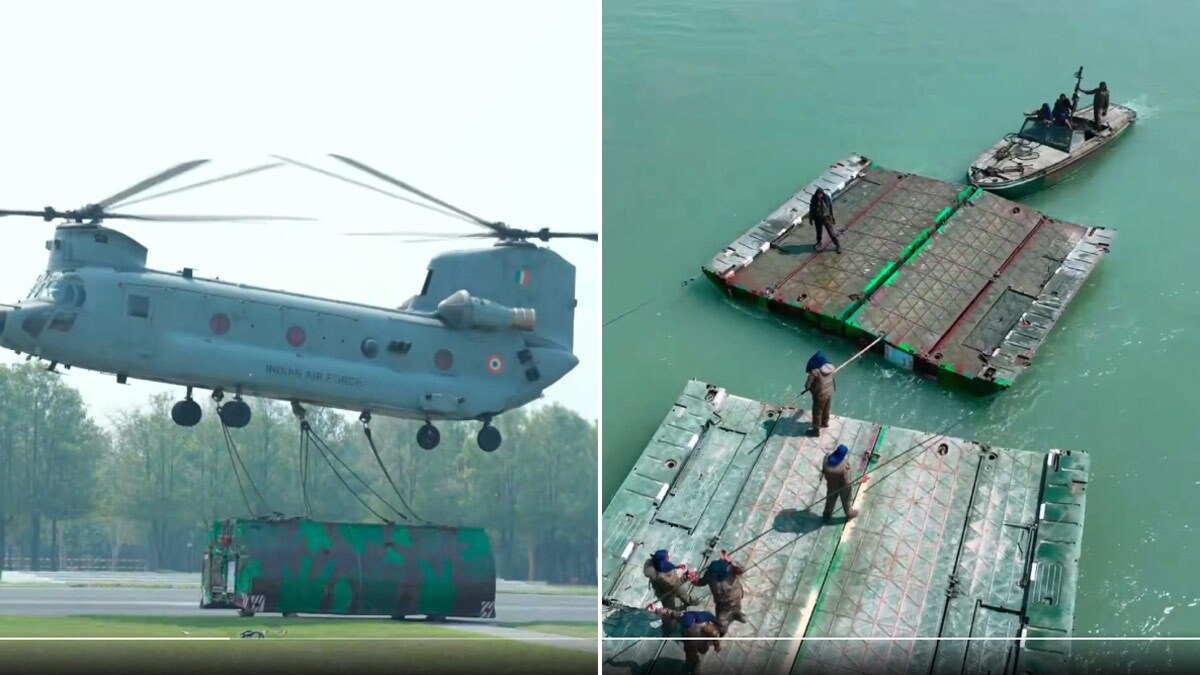
In what comes as a testament to the jointness of the Indian armed forces, the Kharga Sappers, which are a major pillar of the Indian Army’s combat engineering arm, along with the Indian Air Force, for the first time, have deployed a pontoon assault bridge.
A Chinook heavy-lift helicopter of the IAF deployed the assault bridge during a joint exercise.
The Western Command of the Indian Army, in a tweet, said the Kharga Sappers and the Indian Air Force "successfully validated rapid air movement and deployment of an Assault Bridge during a joint exercise, showcasing joint planning, seamless coordination, enhanced battlefield mobility, and operational synergy, reinforcing joint war-fighting capability."
There are several water bodies, including rivers and canals, in the terrain where the Western Command of the Indian Army operates. Assault bridges are an important force multiplier that helps the Army formations keep moving even when there are natural obstacles like water bodies, preserving momentum and sustaining combat power across the battlefield.
ALSO READ: IAF urged to totally spend budgetary allocation for modernisation, upgradation
The assault bridge is assembled from modular segments that are typically transported on heavy-duty Tatra trucks. Once deployed, these segments are connected in the water to form a continuous span of up to 300 metres, a Times of India report said.
India’s strike corps, equipped with the T-90 Bhishma MBT (main battle tank), can use these bridges to cross water obstacles with ease.
A video posted with the Western Command’s tweet shows a Chinook heavy-lift helicopter deploying assault bridge segments into the water, while a Kharga Sappers team assembles them into a fully operational bridge.
The capability to airlift and deploy such bridges using helicopters can significantly enhance the Indian Army’s offensive reach, particularly in river-heavy terrains like Punjab and Jammu.
This ability also comes in handy during natural disasters, enabling the rapid installation of temporary pontoon bridges to improve access for the Army and other relief agencies in affected areas.
