



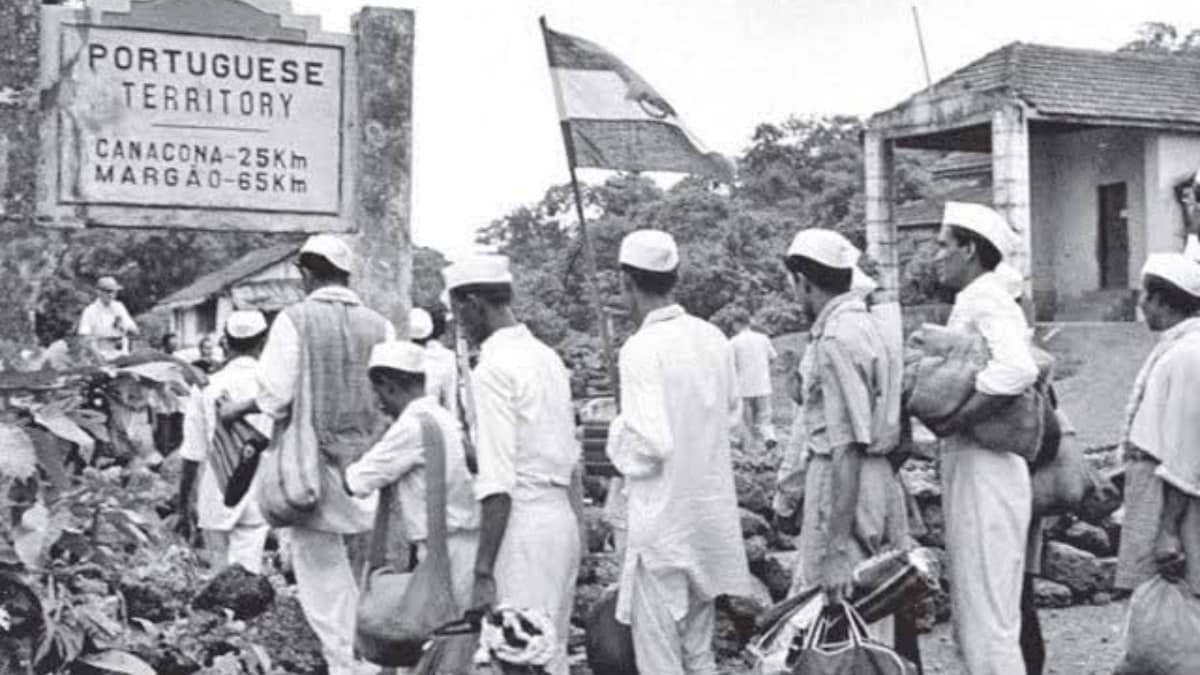
Operation Vijay was planned to annexe the Portuguese State of India, the then territories of Goa, Daman, and Diu. It stemmed from diplomatic talks meant to pressure the Portuguese Goan Administration to give in. However, these did not yield the intended result Nehru had hoped for, which led to Krishna Menon’s suggestion of taking Goa by force.
The operation is often termed the ‘Liberation of Goa’ as well as the ‘Invasion of Goa’. It was an internationally debated and discussed issue with multiple perspectives, which cemented foreign relations for some and eroded them for others. While India saw the action as the liberation of traditionally Indian territory, Portugal viewed it as aggression against its soil and citizens.
Meaning ‘victory’ in Sanskrit, this operation by the Indian Armed Forces involved air, sea, and land strikes for over 36 hours, from which India emerged victorious, ending 451 years of Portuguese rule in the region. In the clash, 22 Indians and 30 Portuguese were killed.
The end of the rule signified a new beginning, wherein Goa was placed under a military administration led by Major General Kunhiraman Palat Candeth. The following year, on 8 June 1962, military rule was replaced by civilian government.
The conflict arose after India gained independence in 1947 and Portugal continued to have control of Goa, Daman, Diu, and Dadra and Nagar Haveli, together known as Portuguese India. The economy in these areas relied on agriculture and iron ore mining, which the Portuguese authoritarian Estado Novo regime considered integral, subsequently rejecting decolonisation.
Events took a turn as local resistance emerged under leaders such as Tristão de Bragança Cunha, founder of the Goa Congress Committee, and Ram Manohar Lohia. Alongside peaceful movements, armed groups such as the Azad Gomantak Dal and the United Front of Goans, supported by India, carried out sabotage and guerrilla attacks. Diplomatic efforts failed as Portugal refused negotiations or a referendum, leading India to impose sanctions and visa restrictions, and to withdraw diplomatic ties.
Hostilities piled up and the operation started on 17 December, with the Indian Army, Navy, and Air Force advancing. While ground forces tackled Panaji and Mormugão, the air force destroyed the Dabolim airstrip and key communication centres, ensuring air superiority. Naval engagements included the disabling of the Portuguese sloop NRP Afonso de Albuquerque at Mormugão and the capture of Anjidiv Island. Continued air, naval, and ground assaults forced a Portuguese surrender by 19 December 1961.
Portugal requested a UN Security Council debate on Goa on the 18th, backed by the US, UK, France, and others. Portugal accused India of aggression, while India argued Goa was an inalienable part of India and that colonialism must end. The US condemned India’s use of force, whereas the Soviet Union defended India, calling the issue domestic and criticising Portuguese colonialism.
An Afro-Asian resolution supporting India failed, whereas a Western-backed ceasefire and troop withdrawal resolution passed with seven votes. The Western resolution was vetoed by the Soviet Union, preventing UN intervention.
Indian forces had recaptured most of Goa from the shackles of colonialism by 18 December 1961. Fearing civilian casualties, Governor-General Vassalo e Silva ordered a ceasefire. Portugal formally surrendered on 19 December, ending 451 years of rule.
Scholars debated the legality of India’s annexation of Goa. As Quincy Wright noted, it revealed an East–West divide in interpreting UN law. India argued colonial acquisition was illegal and that Goa was integral to India, invoking self-determination. While the Indian Supreme Court upheld the annexation and Portugal eventually recognised it in 1974, many international legal scholars maintained that forceful annexation after the UN Charter was illegal, even if later accepted politically.
