



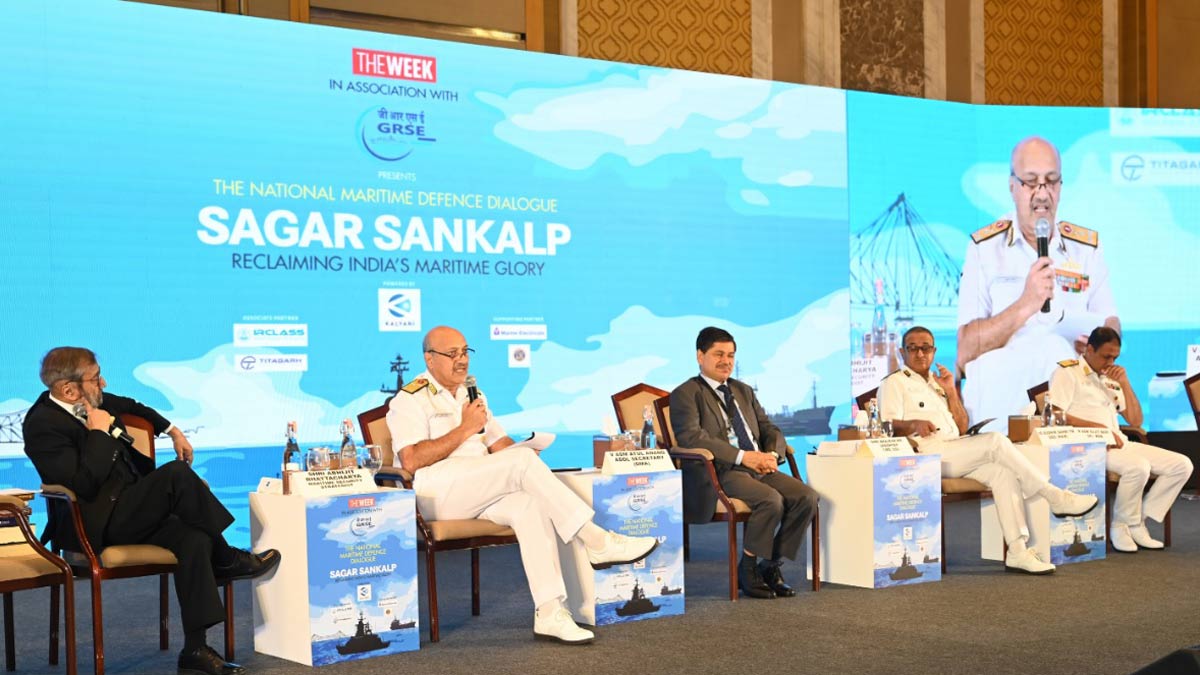
India must align its naval shipbuilding plans with changing geopolitical realities, emerging battlefield technologies and the urgent need for self-reliance if it wants to secure its maritime future, speakers at a panel discussion during the maritime defence conclave organised by THE WEEK in association with Garden Reach Shipbuilders & Engineers (GRSE), observed.
The panel, chaired by maritime security strategist Abhijit Bhattacharyya at the ‘Sagar Sankalp – Reclaiming India’s Maritime Glory’ event, discussed the theme, 'Securing the Seas: Aligning Naval Shipbuilding with Geopolitical Realities'. The panellists, Vice Admiral Atul Anand, additional secretary, Department of Military Affairs; Brajesh Kumar Upadhyay, CMD, Goa Shipyard Ltd; Rear Admiral Sujit Baxi, director general, Warship Design Bureau, Indian Navy; and Sudhir Sahni T.M., deputy director general (Material & Maintenance), Indian Coast Guard, underlined that maritime power is central to national sovereignty and strategic influence.
The speakers stressed that India’s maritime rise would depend not only on building more warships but also on strengthening the institutions and technologies that sustain naval power.
Citing the commissioning of India’s first indigenous aircraft carrier INS Vikrant as a “capability inflexion point” comparable to India’s historic sporting milestones, it was pointed out that this achievement demonstrated that Indian industry can design and build large, complex capital warships, signalling a shift from aspiration to confidence in indigenous shipbuilding.
ALSO READ: From buyer’s navy to builder’s navy: Charting the roadmap for India’s maritime defence dominance
India’s motivation today, the panel said, goes beyond merely expanding the number of warships in the fleet. It is also about “building massive capability, strengthening maritime security and revitalising India’s historical connect with the seas.” With about 58 warships and vessels currently under construction in Indian shipyards, it was observed that the country now has a strong industrial base to build upon.
At the same time, they cautioned that modern naval warfare is evolving rapidly. Recent conflicts show that “missiles are beating metal” and that unmanned systems—surface, subsurface and aerial—are increasingly becoming primary attackers against ships. Shore-based missile systems and asymmetric tactics are also denying access to large naval forces in confined waters, forcing navies to rethink operational doctrines.
These developments, the panel said, require major changes in warship design and strategy. Future vessels must therefore be modular, survivable and capable of rapid force regeneration, allowing them to adapt quickly to different mission requirements. Ships must also be able to operate drones and unmanned systems and function as nodes within a larger networked combat structure rather than as standalone platforms.
A recurring theme was that strategic autonomy depends on ecosystem depth rather than simply producing ships. Speakers noted that strategic autonomy is achieved not when we assemble ships but when we design them indigenously. While India has made progress in design and integration, dependence remains in critical areas such as propulsion systems and large marine engines, highlighting the need for closer collaboration between industry, academia and research institutions.
The panel also stressed the importance of industrial mobilisation and export readiness. Indian shipyards must move beyond domestic demand and aim to export ships, equipment and indigenous designs to friendly countries, turning naval exports into instruments of strategic diplomacy.
The overall message from the discussion was clear: India has made notable progress in indigenous naval construction, but the next phase will require greater coordination, technological innovation and a firm commitment to indigenisation “in letter and spirit.”
