



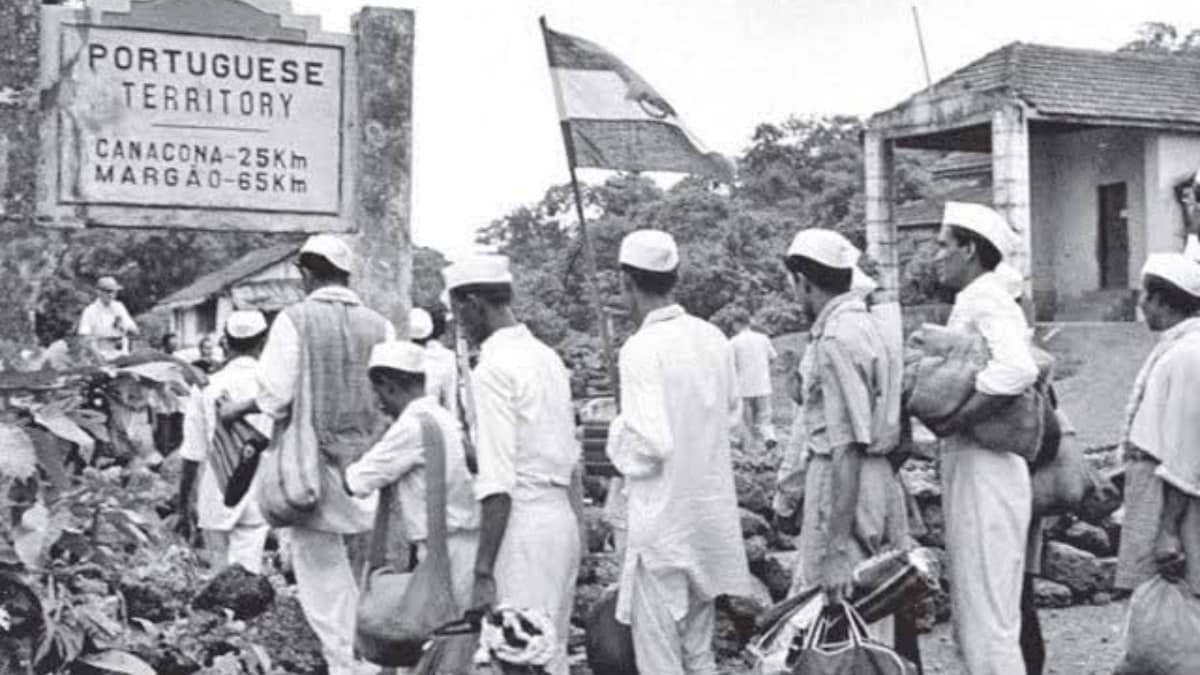
"Goa Liberation Day reminds us of a defining chapter in our national journey. We recall the indomitable spirit of those who refused to accept injustice and fought for freedom with courage and conviction. Their sacrifices continue to inspire us as we work towards the all-round progress of Goa," Prime Minister Narendra Modi said on X on Friday, as the country celebrates an illustrious chapter in its era-defining struggle against European colonialism. Goa Liberation Day is celebrated on 19 December every year to mark the success of 'Operation Vijay', undertaken by the armed forces to liberate the state from the Portuguese in 1961.
The 1961 Goa Liberation War was the shortest major conflict India has fought since independence, lasting just three days, and was the first to feature a major role for the Navy. A total of 4,668 Portuguese-affiliated personnel were captured, as the European nation's order to fight to the last man and destroy Goa was rejected by Governor-General Manuel António Vassalo e Silva, who found it futile to have his soldiers die fighting an unwinnable war. Thirty Portuguese soldiers and 22 Indian bravehearts laid down their lives before Lisbon officially surrendered, making Goa and Daman and Diu part of the Republic of India.
However, Lisbon tried to involve the United Nations, along with fellow European powers, against what it described as India's aggression towards its territories. The United Kingdom, the Netherlands, Brazil, Pakistan, and the United States were among the nations that condemned India's decision to use force to annex Goa. However, full support for the Indian action was expressed by the Soviet Union and all Soviet-bloc countries, Yugoslavia, the Arab States, Ghana, Ceylon, and Indonesia, history documents show.
The United Arab Republic, a sovereign state in the Middle East from 1958 to 1971, expressed its full support for India's “legitimate efforts to regain its occupied territory.” “India has been extraordinarily patient, and a non-violent country has been driven to violence by Portugal,” a representative of the Moroccan Government said. Tunisian Foreign Minister, Dr Sadok Mokaddem, commented that “the liberation of Goa will bring nearer the end of the Portuguese colonial regime in Africa.” Similar expressions of support for India were forthcoming from other Arab countries, as reported by Keesing's Record of World Events (Volume 8, March 1962).
Throwing its weight completely behind New Delhi, Indonesia's Foreign Ministry spokesman said: “We know that India is a peace-loving nation which has been compelled to use force. There can be no compromise with colonialism….”
Sirimavo Bandaranaike, who was the then Prime Minister of Ceylon (Sri Lanka), also openly backed its neighbour. In an order issued on 18 December, Bandaranaike directed that "transport carrying troops and equipment for the Portuguese in Goa shall not be permitted the use of Ceylon's seaports and airports," Keesing's Record of World Events claimed.
"Similar expressions of unreserved support for India were made by governmental leaders in Poland, Czechoslovakia, Hungary, Romania, Bulgaria, and Eastern Germany," the report added.
