



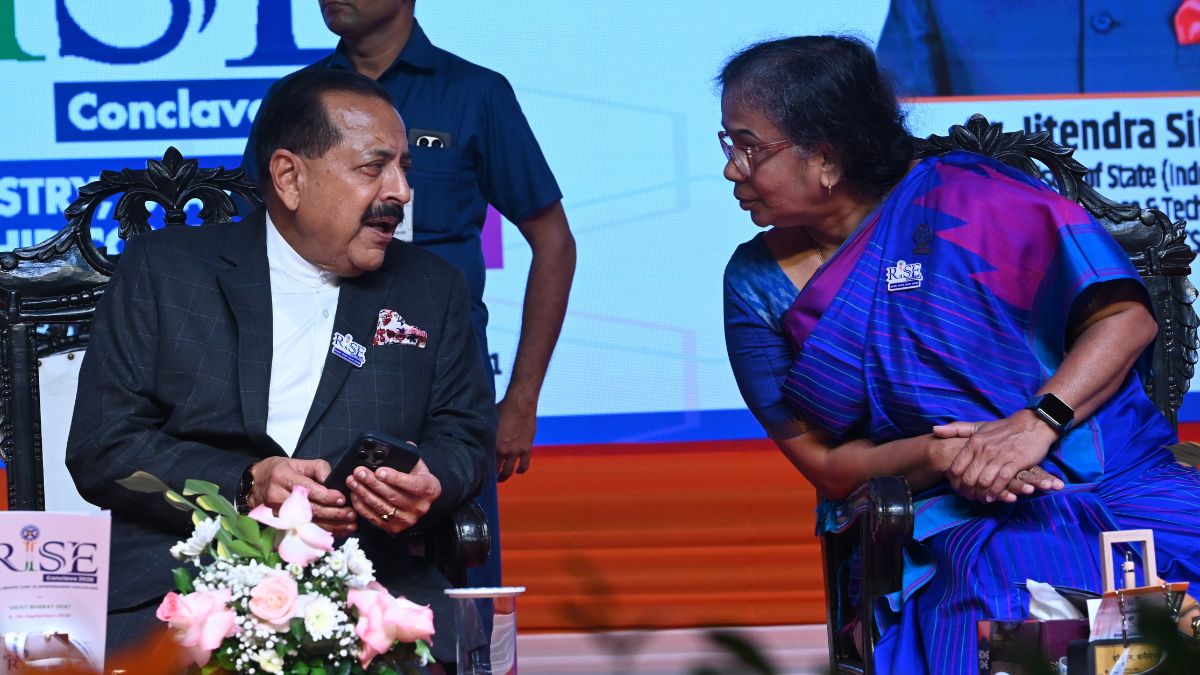
The sixth RISE Conclave 2026 began in Kolkata on Sunday, bringing startups, researchers, industry representatives, investors, incubators, and policymakers together to strengthen the link between scientific research and entrepreneurship.
The conclave being held at the CSIR-Indian Institute of Chemical Biology (CSIR-IICB) in Salt Lake, is being jointly organised by CSIR-CGCRI, CSIR-IICB, CSIR-CMERI, and CSIR-IMMT under the theme, 'Driving Innovation & Entrepreneurship for Viksit Bharat 2047'.
Addressing the inaugural session, Union Minister for Science and Technology, Dr Jitendra Singh, said India’s innovation ecosystem needs to pay greater attention to Tier-2 and Tier-3 cities.
He said more than 50-60 per cent of the country’s startups are from outside metropolitan centres, with young innovators from smaller cities increasingly matching—and in some cases surpassing—their counterparts in major technology hubs.
The minister said the RISE platform is intended to take scientific capabilities closer to innovators across the country, rather than expecting entrepreneurs to move to established technology centres. Bringing startups, industry, mentors, researchers and government representatives together, he said, can help research move beyond laboratories towards technology transfer, commercialisation, and wider societal application.
Kolkata is the sixth city to host the RISE Conclave, following editions in Mumbai, Lucknow, Hyderabad, Chennai, and Bengaluru. Dr Singh said that taking the platform to different parts of the country would expand its outreach and help connect regional scientific strengths with entrepreneurs and innovators.
The Kolkata edition has a distinctive focus through the 4M framework—Minerals, Medicine, Materials and Machines—reflecting the complementary research strengths of the four participating CSIR laboratories.

Dr Singh also highlighted Kolkata’s long-standing contribution to India’s scientific and academic tradition.
Referring to figures including Dr Bidhan Chandra Roy, Prof. U. N. Brahmachari, Sir C.V. Raman, and Dr Syama Prasad Mookerjee, he said the city’s intellectual and institutional legacy provides a strong foundation for linking its scientific heritage with emerging technologies and entrepreneurship.
He also highlighted the government’s decision to establish a ₹1 lakh crore fund for research and development, as well as the role of the Anusandhan National Research Foundation (ANRF), during his inaugural speech.
Dr N. Kalaiselvi, Director General, CSIR and Secretary, Department of Scientific and Industrial Research (DSIR), also addressed the gathering.
Prof. Vibha Tandon, Director, CSIR-IICB; Dr Ramanuj Narayan, Director, CSIR-IMMT; Prof. Bikramjit Basu, Director, CSIR-CGCRI; and Dr Naresh Chandra Murmu, Director, CSIR-CMERI; were among those present, along with senior scientists, researchers, startup founders, industry representatives and other stakeholders.
