



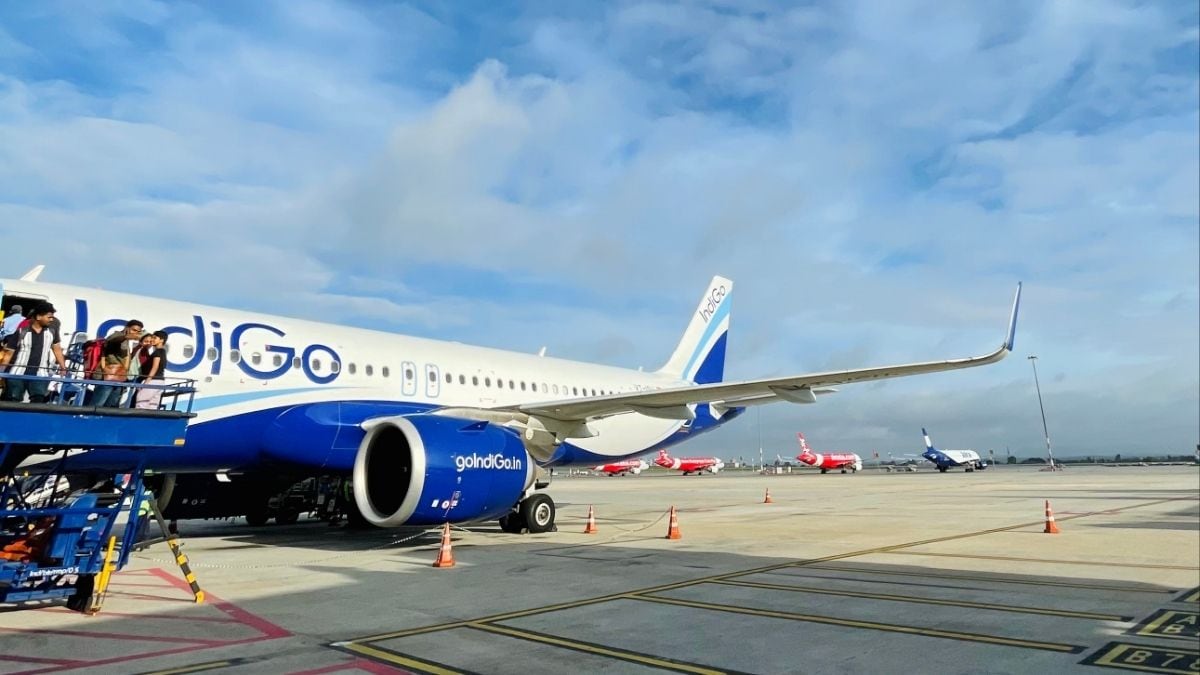
On the face of it, IndiGo airlines couldn’t be any more upbeat. Today marks 20 years of operations, after coming out of nowhere and quickly ascending to be not just India’s largest airline, but one of the world’s fastest-growing airline companies. It operates 220 planes to some 135 destinations in India and abroad, ferrying more than 12 crore passengers annually. And it’s a number that’s rising constantly.
The airline even has a celebratory offer going on, with 20,000 free tickets on offer. But dig deeper, and you see a growing sense of apprehension over the future, with, quite often, the airline’s own stellar successes coming in the way to its detriment.
How the Gurugram-headquartered airline unravelled last December is a ghost that is yet to stop haunting it. When the aviation regulator’s Flight Duty Time Limitation (FDTL) rules kicked in, with fresh limitations on how much time pilots and crew can work and should be given rest, Indigo appeared like a rabbit caught in the headlights. This, despite it having known about the impending rules two years in advance. The result was thousands of flights cancelled, and lakhs of passengers inconvenienced.
The imbroglio left a bitter aftertaste amidst not just India’s burgeoning air commuter demographic, but also with the administration in New Delhi. Fines were imposed, and the airline was told to ship up fast or face the music. It eventually led to the exit of CEO Pieter Elbers, despite his role in steadily expanding the airline’s presence on the international circuit.
That the issue is not yet over was clear from IndiGo co-founder Rahul Bhatia quipping the other day how FDTL made India’s airliners less competitive compared to their global peers and how it needs to be reviewed.
While IndiGo’s overwhelming 66 per cent market share of India’s domestic aviation, its competitors like Air India and SpiceJet are caught up in seemingly directionless ‘Odysseys’ of their own to offer much of a rivalry—ensuring that anything the airline’s bosses say will be taken seriously in the corridors of power.
But what is also inadvertently accomplished, especially since the December meltdown, is the increasing clamour for a third alternative.
Presently, India’s domestic aviation doesn’t have that, with Indigo holding 66.3 per cent of the total 1.34 crore passengers who took to the skies last month; Air India and Air India Express ferried nearly 24 per cent—together making up 90 per cent of the entire market. The other national players have become something of a namesake, with SpiceJet market share falling further to just 1.9 per cent.
The only bright spot is Akasa, which has increased its market share to 6.4 per cent. This is where Adanis’ recent request to tweak rules that forbid airport operators from taking up stakes in airlines becomes significant—Adanis are the biggest private airport operators in the country, and with their deep pockets, it could offer a strong third alternative if rules allowed it (The group has officially denied reports of any such move, though).
However, the reality is this: the more heft IndiGo notches up, the more will be the calls for credible alternatives in the domestic aviation space. After all, the argument is lucid: a market as big, diverse and fast-growing as India’s surely needs more players?
That brings us down to the two crucial internal developments at the airline’s leadership. Willie Walsh took over as new CEO this week, in place of Elbers—Walsh is former chief of the International Air Transport Association (IATA) and having him clearly indicates the global ambitions the airline now has.
The second, even more significant, one is co-founder Rahul Bhatia passing on the baton to his son Madhav. Madhav has been reported to attend internal meetings and is supposedly being groomed for the top role. What vision the two have will determine, for all practical purposes, how high Indigo will fly in its next 20 years.
