



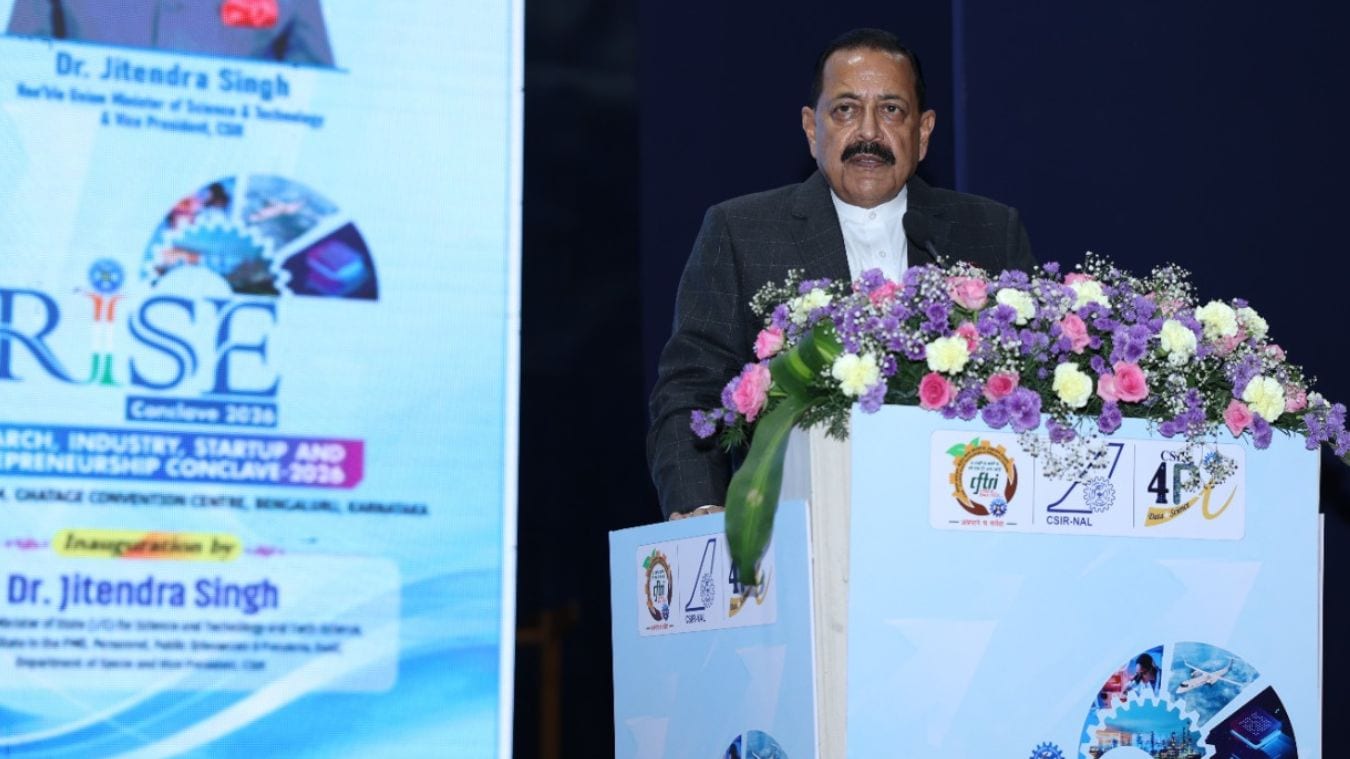
India's startup ecosystem generated nearly 25 lakh jobs over the last decade and their numbers have surged from around 350 to 2.3 lakh, as per Dr Jitendra Singh, the minster for Science and Technolgy, during his address at the RISE Conclave 2026 in Bengaluru on June 13. It was rganised under the theme 'Innovation & Entrepreneurship Driven Growth for Viksit Bharat 2047'.
Dr Singh said that India's startup movement has emerged as a major driver of employment generation, creating nearly 24-25 lakh jobs over the last decade. He noted that the country's startup ecosystem, which comprised only around 350-400 startups about 10 years ago, has today expanded to nearly 2.3 lakh ventures, making India the world's third-largest startup ecosystem and reflecting its transition into a full-fledged innovation economy.
He highlighted the role of visionary leadership in shaping India's innovation landscape. “Many of the transformative changes witnessed in the country's science and technology ecosystem can be traced back to the policy direction provided by Prime Minister Narendra Modi. The PM's call for "Startup India" in 2015 laid the foundation for a vibrant entrepreneurial culture, while subsequent reforms opened new avenues for private participation in strategic sectors and encouraged young Indians to pursue innovation-driven careers. These initiatives have helped build a supportive ecosystem that is enabling the country to harness its demographic dividend and emerge as a global innovation hub,” said Dr Singh.
The minister highlighted that the RISE Conclave was conceived with the objective of bringing together the four pillars of Research, Industry, Startups and Entrepreneurship under one platform. He said the initiative reflects the government's commitment to fostering collaborations among scientists, industries, investors, academia and policymakers to build a self-reliant and innovation-driven India.
Dr Singh also mentioned about the growing momentum in India's aerospace innovation ecosystem, and spoke about the country's first public-private aerospace incubation centre, mach33.aero, established by CSIR-NAL in collaboration with its partners. “The centre has successfully completed five years of operations and has incubated 34 startups. More than 125 startups are participating in the RISE Conclave 2026 and many of them from the aerospace sector, reflecting the growing confidence of young innovators in high-technology domains. Such collaborations between startups and scientific institutions would not only create wealth and employment but could also lead to the emergence of several new unicorns in the years ahead,” said Dr Singh.
He also referred to the changing geography of entrepreneurship in the country. “More than 50 per cent of India's startups are now emerging from Tier-2 and Tier-3 cities, demonstrating that innovation is no longer confined to metropolitan centres. Entrepreneurship today is accessible to individuals with commitment, passion and technological aptitude, regardless of their location or formal educational qualifications,” remarked Dr Singh.
He added that India has consciously ventured into sectors that remained under-explored in the past. Highlighting the opening up of the space sector to private participation, he said that significant progress has been achieved within a short span of time through policy reforms and industry involvement. He added that sectors such as biotechnology, deep ocean exploration and nuclear energy are also witnessing increased collaboration with private stakeholders.
The minister stated that India's global standing in innovation has improved substantially over the last decade. He noted that the country's position in the Global Innovation Index has risen significantly, while patent filings by Indian residents have witnessed steady growth. He further highlighted the increasing quality of Indian scientific output, pointing to the growing presence of Indian research papers among globally cited publications.
Dr Jitendra Singh also mentioned about the progress made under national missions in emerging technologies. He noted that the National Quantum Mission, launched with an eight-year roadmap, has already achieved several milestones ahead of schedule. Similarly, the IndiaAI Mission is creating new opportunities in computing infrastructure, data ecosystems, innovation and future skills.
Referring to the future of the RISE Conclave, the minister said that its success should be measured through concrete outcomes such as technologies licensed from laboratories, startups incubated, investments secured, industry collaborations established, products commercialised and jobs created. He expressed confidence that the Bengaluru edition of RISE would facilitate meaningful partnerships capable of generating long-term economic and societal impact.
Interestingly, the RISE Conclave 2026 featured thematic discussions on Aerospace Technologies for Growth, Artificial Intelligence for societal transformation, and Agri-Food innovation, alongside exhibitions, industry interactions and participation from start-ups, MSMEs, investors, scientists and academic institutions. The programme also included the exchange of technology transfer agreements and interactions between innovators and industry leaders.
