



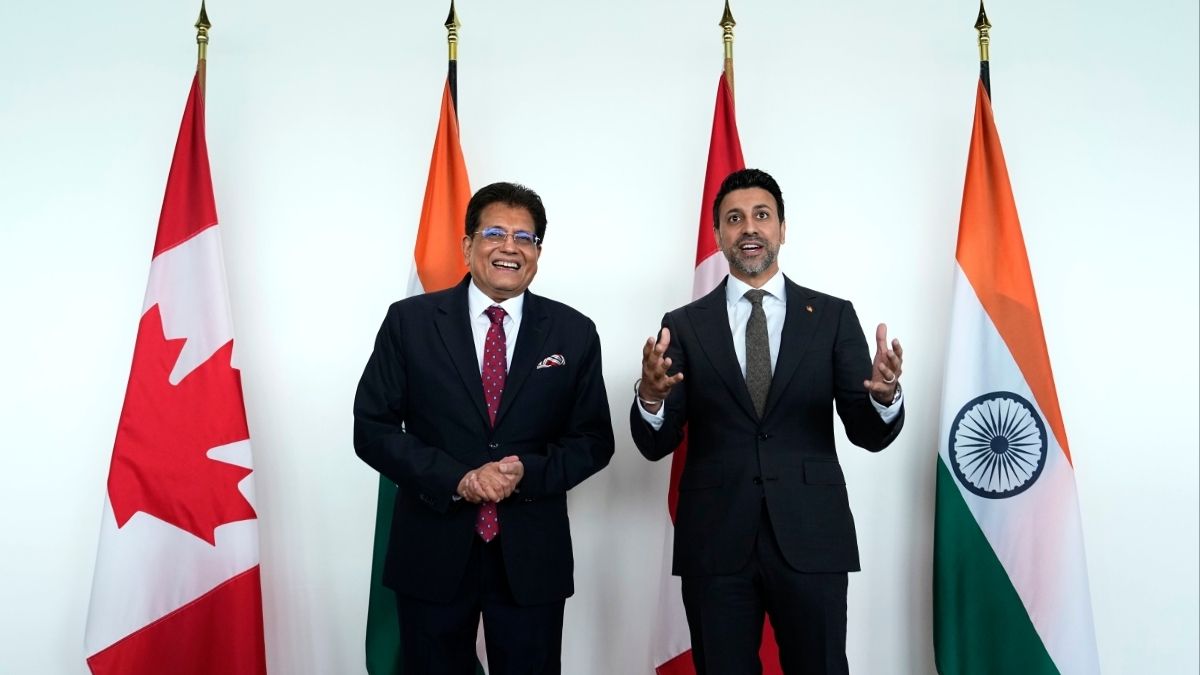
India and Canada are aiming to conclude a landmark free trade agreement before the end of this year, Union Commerce and Industry Minister Piyush Goyal said in Ottawa. Goyal is leading the largest-ever Indian business delegation to Canada, with over 100 senior representatives from mining, energy, automotive, and aerospace sectors.
The minister, who is on a three-day official visit which began on Monday, addressed the media jointly with Canada's Trade Minister Maninder Sidhu, confirming that both prime ministers have tasked their negotiating teams with completing a Comprehensive Economic Partnership Agreement (CEPA) and tripling bilateral trade from the current $17 billion to $50 billion by 2030.
The third round of CEPA negotiations is underway in Ottawa from May 25 to 29, following two completed rounds. Joint Secretary Brij Mohan Mishra leads the Indian team while Bruce Christie represents Canada.
More than the FTA, it is the speed of the turnaround in strained bilateral relations. Canada–India trade talks were first launched in 2010 but collapsed in 2023 after Ottawa accused New Delhi of involvement in the killing of Sikh activist Hardeep Singh Nijjar near Vancouver, a charge India denied. The relationship began to thaw when Prime Minister Mark Carney visited New Delhi in late February 2026, the first such visit by a Canadian prime minister in eight years, where both sides signed Terms of Reference for CEPA and sealed a landmark CAD 2.6 billion ($1.9 billion) uranium supply deal.
The economic stakes are significant. Bilateral merchandise and services trade stood at roughly $8.66 billion in FY2024–25, according to official Indian data, a fraction of its potential. India's key goods exports to Canada include pharmaceuticals, iron and steel, seafood, cotton garments, electronic goods, and chemicals, while imports cover pulses, coal, fertilisers, and petroleum crude.
Canada is also home to over 4,25,000 Indian students, and the Indian diaspora forms a significant bridge between the two economies.
Analysts at the Asia Pacific Foundation of Canada note that both nations are also motivated by a shared interest in diversifying away from dependence on the United States.
India has already concluded trade agreements with the European Union, the United Kingdom, and New Zealand, and is now actively courting Western economies for capital, technology, and innovation partnerships.
