



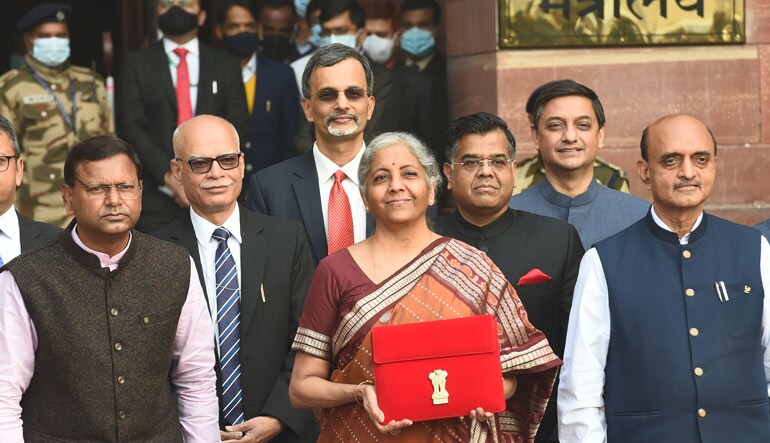
The government has taken various measures to reduce imports and to boost domestic defence manufacturing, in the Union Budget 2022-23.
The Budget, presented in Parliament on Tuesday by Union Finance and Corporate Affairs Minister Nirmala Sitharaman, has earmarked 68 per cent of the capital procurement budget for the domestic industry in the next financial year, up from 58 per cent in the last fiscal year.
The total allocation for defence in the Budget has gone up marginally to Rs. 5.25 lakh crore, up by 4.43 per cent higher than the revised estimates of last year, and 9.8 per cent higher over the budget estimates of last year.
The allocation for the sector is just over 13 per cent of the total Budget, and 2.04 per cent of the country's GDP. India is among the top five biggest spenders on defence, after the UK, Russia, China and the US.
Sitharaman also announced that defence research and development centre will be opened for industry, start-ups and academia with 25 per cent of the R&D budget earmarked for them.
"The private sector will be encouraged to take up design and development of military platforms and equipment in collaboration with DRDO and other organisations under Special Purpose Vehicle (SPV) model,” Sitharaman said in her Budget speech, and announced that an independent nodal umbrella body will be set up for meeting wide-ranging testing and certification requirements.
For the modernisation of armed forces, the Air Force has got the maximum share of Rs. 55,586.65 crore, followed by Navy (Rs. 47,590.99 crore) and Army (Rs. 32,015.26 crore) under capital allocation. In the Revenue Budget, which is for day-to-day expenses, the ministry of defence got Rs. 2.33 lakh crore, and for pensions, it received Rs. 1.19 lakh crore, along with Rs. 20,100 crore for civil work. Overall, the capital allocation saw an increase of 12 per cent compared to Budget estimates of last year, and 9.7 per cent with respect to the revised estimates.
Amidst the backdrop of the military standoff with China, the allocation for modernisation has been increased from Rs 1,13,734 crore to Rs 1,35,061 crore, over 18.50 per cent from the previous budget.
Ironically, the budget data showed that in 2021-22, the Army returned around Rs. 11,100 crore, as it could not spend the amount. Meanwhile, the Navy got an additional allocation of Rs.12,767.99 crore.
To boost the production of locally manufactured military equipment and weapons, last year the government had earmarked Rs 70,000 crore for domestic defence purchases. Emphasis was on promoting the local defence industry, including start-ups. The ministry of defence (MoD), in May, had approved restrictions on the import of an additional 108 military weapons and systems such as next-generation corvettes, airborne early warning systems, tank engines and radars under a staggered timeline of four-and-half years. The first negative list for defence imports, comprising 101 items, that included towed artillery guns, short-range surface-to-air missiles, cruise missiles and offshore patrol vessels was issued last August 2020.
Reacting to budgetary allocation, Defence Minister Rajnath Singh said, "It is in line with the ‘Vocal for Local’ push and it will certainly boost the domestic defence industries."
Welcoming the announcements, the industry body, Society of Indian Defence Manufacturers (SIDM), said setting aside 68 per cent of capital outlay for the domestic industry will sustain investments and attract fresh capacity creation. “Creation of a nodal body for setting up testing and certification requirements of defence systems and platforms will help the domestic industry through faster processes and cost-efficiency,” S.P. Shukla, president of SIDM said.
“Allocation of 25 per cent of Defence R&D budget for start-ups, academia and private industry is a much-needed reform,” he observed.
