



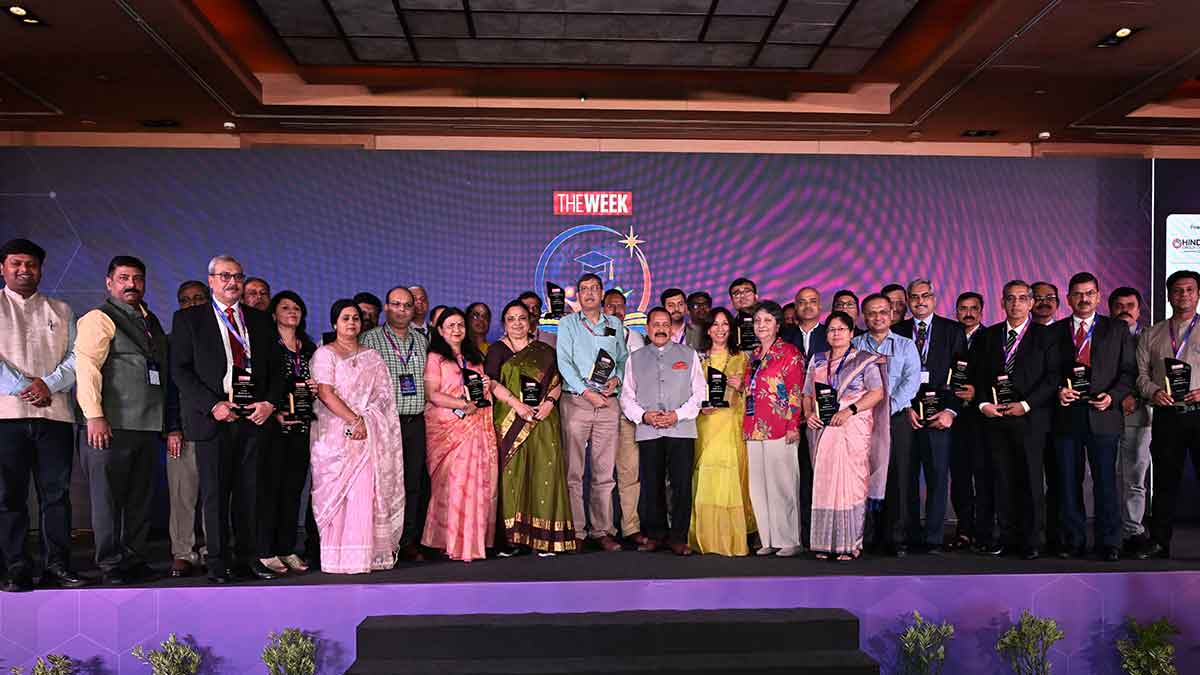
In an era defined by artificial intelligence and technological disruption, education is increasingly being tested on a fundamental question: how to prepare young people not only for the workplace of the future but for life itself. As leading educators, policymakers and experts gathered in New Delhi for THE WEEK Education Conclave 2026 on June 10, this concern formed the backdrop to the wide-ranging discussions.

Across the day’s deliberations, one idea recurred with clarity. Education cannot be measured only in terms of skills and employability; it must also be judged by its ability to nurture empathy, resilience, curiosity and independent thought. As machines become more capable, these distinctly human qualities are increasingly seen as the real differentiators.
Setting the tone for the day was Dr Jitendra Singh, minister of state (independent charge), science and technology; earth sciences; minister of state in the prime minister’s office; personnel, public grievances and pensions; atomic energy; space, who described the present moment as one of the most transformative periods in India’s educational history. “The National Education Policy was the game changer,” he said, describing it as a framework that has reshaped the way learning is conceived and delivered.
For Singh, the most significant shift has been the democratisation of education through technology. Digital tools and online platforms, he argued, have weakened traditional barriers that once separated students in metropolitan centres from those in smaller towns and rural regions. “In order to make education accessible, there has been a democratisation of society, and this happens because of the optimum use of technology.” The minister pointed to examples that would have been difficult to imagine a generation ago: students preparing for competitive examinations without expensive coaching, accessing high-quality resources online and competing on an equal footing with urban peers.
Yet, even as speakers celebrated technological advancement, several cautioned against allowing innovation to eclipse the values that sustain democratic societies and meaningful human relationships.
Former chief justice of India Justice D.Y. Chandrachud offered perhaps the most profound reflection on this balance. Speaking about democracy, citizenship and the role of young people in shaping India’s future, he argued that dissent remains one of the most important pillars of a healthy society. “Dissent is crucial in a democracy. It allows for reasonable dialogue. It is the absence of dialogue that often leads to violence,” Chandrachud said. At a time when public discourse across the world is becoming increasingly polarised, he suggested that the ability to disagree respectfully may be among the most important skills young people can cultivate.
If Chandrachud spoke about the importance of democratic engagement, artist, educator and social change-maker Rouble Nagi focused on a challenge emerging from the digital age itself: the risk of losing touch with basic human empathy. “Empathy, compassion, kindness is not what AI would teach you,” she said.
For Nagi, the rapid integration of artificial intelligence into everyday life raises questions not merely about jobs or productivity but about human behaviour and relationships. She expressed concern that excessive dependence on technology may be diminishing people’s ability to think independently and engage deeply with the world around them. Her advice to students was refreshingly uncomplicated and deeply human. “Don’t put pressure on yourself. It is okay to make mistakes.”
That emphasis on learning through setbacks found a powerful echo in the experiences shared by Dr K. Rajalakshmi Menon, director general of aeronautical systems at DRDO. “Resilience is needed from the start of life,” she said. Menon’s own career illustrates that principle. Trained initially in physics before pursuing a master’s degree in computer science, she eventually rose to become one of India’s leading defence scientists. Looking back, she recalled that her path was far from straightforward. Her message to students was that success rarely follows a predetermined script. Instead of obsessing over perfect plans, young people should focus on recognising and making the most of opportunities as they arise.
The theme of preparing students not merely for examinations but for life also featured prominently in discussions on educational reform. Dr Narayana Bharath Gupta, commissioner of higher education, Government of Andhra Pradesh, outlined a vision that places outcomes rather than inputs at the centre of educational policy. “We measure what walks out of the institution,” Gupta said. For him, the true test of an educational institution lies not in admission figures or infrastructure but in the quality of graduates it produces. The Andhra Pradesh government is increasingly focusing on outcome-based learning, industry partnerships, technology-enabled education and international collaborations designed to expose students to global opportunities.
The broader vision was explored further during a panel discussion on the ‘Andhra Pradesh Model’, where policymakers, administrators and academic leaders described efforts to integrate foundational literacy, AI-enabled personalised learning, industry-linked skilling, global partnerships and emotional resilience into a comprehensive educational framework.
If educational institutions are being forced to reinvent themselves, so too are students navigating increasingly uncertain career choices. Few stories illustrated this better than that of IAS officer Athar Aamir Khan. Widely admired by civil services aspirants, Khan, who now serves as deputy commissioner of Budgam in Jammu and Kashmir, revealed that his own journey was shaped by doubt and difficult decisions. “I enrolled myself in Jammu Medical College, but after six months I realised this is not what I wanted,” he recalled. Leaving medicine to prepare for the Civil Services Examination (CSE) meant abandoning a secure path and embracing uncertainty. “CSE is stressful, but uncertainty is always there,” he said. Success, he added, depends less on extraordinary talent than on discipline and consistency.
The discussion became particularly engaging as students took centre stage. Questions ranged from subject selection and preparation strategies to the ideal age for beginning CSE preparation. Khan avoided offering formulaic answers. Aspirants, he suggested, should choose subjects based on genuine interest rather than perceived scoring trends and cultivate the habit of reading widely.
Another highlight of the conclave was an Art of Living session on intuition, where blindfolded children astonished the audience by performing tasks, including playing a video game without relying on sight. Whether viewed as a demonstration of concentration, awareness or untapped cognitive potential, the session served as a reminder that human capabilities continue to surprise us, even in an age increasingly shaped by machines.
